
Last Updated on July 23, 2026 by Jeremy
AI Agents Tutorial for Beginners
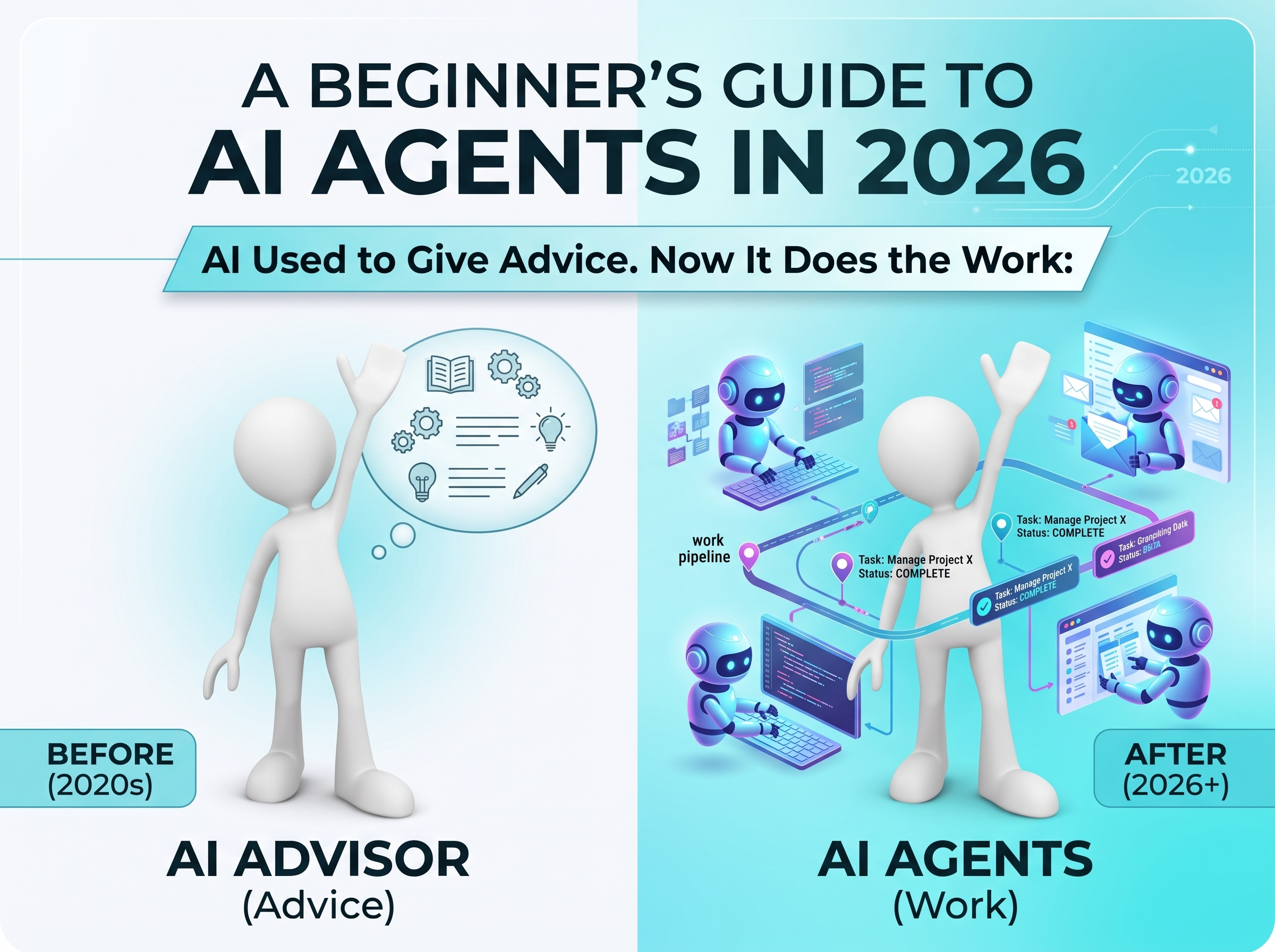
For the last few years, artificial intelligence has helped us think, research, outline and create. In 2026, it is beginning to do something far more important: carry out connected pieces of work.
The biggest change in AI is not simply that chatbots are becoming better at answering questions. The bigger shift is that AI systems can increasingly use approved tools, move between steps, retrieve information, complete actions and return with a finished result.
That distinction matters for anyone building an online business alone.
I manage multiple websites, affiliate programs, social pages, content plans, client projects and local work. The problem is rarely a shortage of ideas. The problem is the hundreds of small steps required to turn an idea into something published, promoted, measured and improved.
That is where AI agents may become one of the biggest changes small business owners have seen since the rise of the internet itself.

TL;DR: What You’ll Learn
- What AI agents are and how they differ from chatbots and assistants.
- How AI agents can complete multi-step business workflows.
- Which tasks content creators and small businesses could delegate first.
- How to integrate an agent without handing over uncontrolled access.
- Where human judgment, approvals and accountability still matter.
- Why AI may not have plateaued at all—it may simply have changed direction.
What Are AI Agents and How Do They Work?
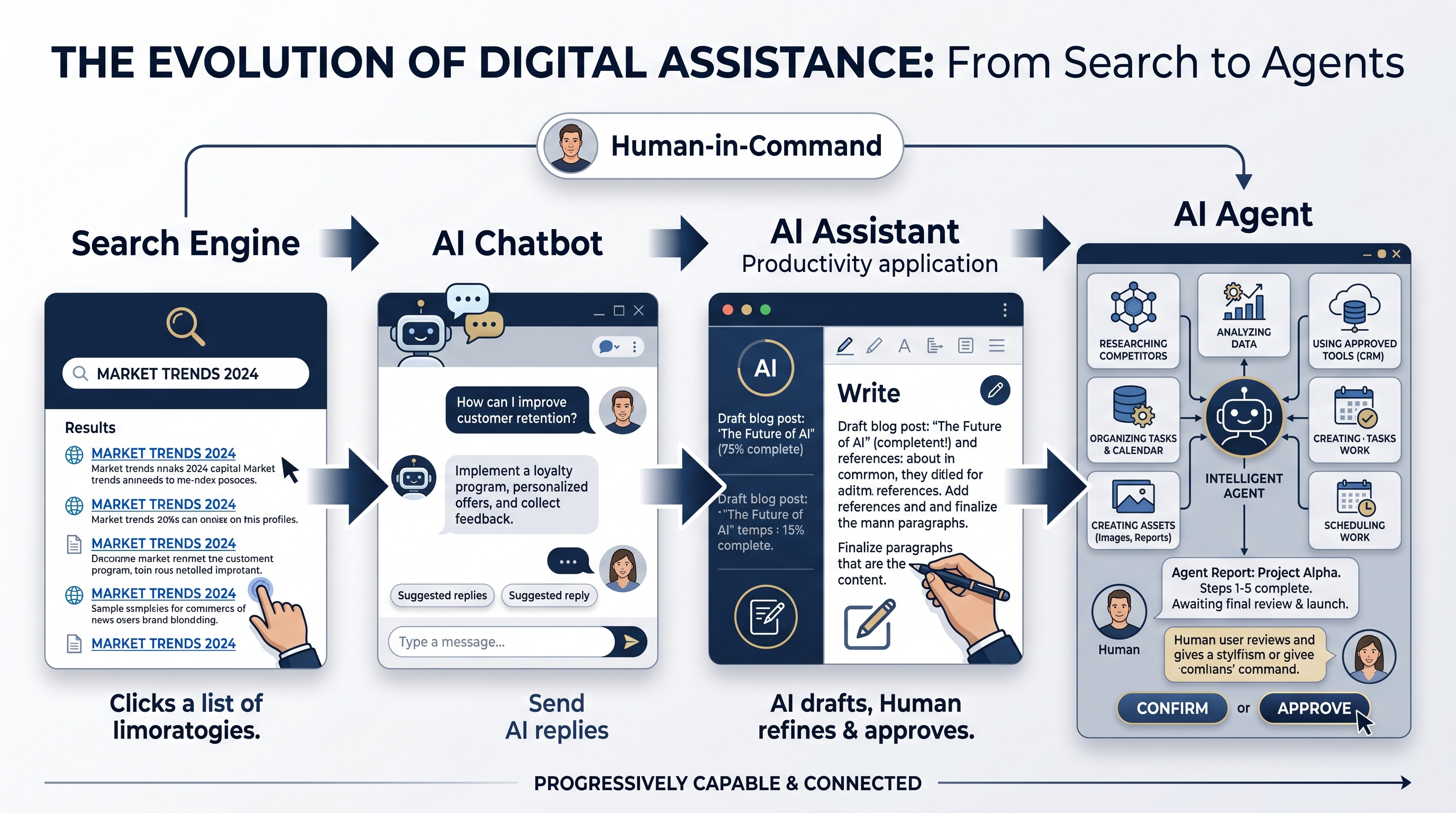
An AI agent is a software system that receives a goal, evaluates what needs to happen, uses the tools available to it and works through a sequence of steps to reach an outcome.
IBM describes an AI agent as a system that can autonomously perform tasks by designing workflows with the tools available to it. Those tools might include databases, browsers, calendars, company knowledge bases, email platforms, customer records or publishing systems.
The easiest way to understand an AI agent is to compare it with the technology most of us already use.
| Technology | What You Give It | What It Returns | Typical Limitation |
|---|---|---|---|
| Search engine | A query | Links and information | You still evaluate and assemble everything. |
| AI chatbot | A question or prompt | An answer, idea or draft | You usually move the work into other tools. |
| AI assistant | A specific task | Help completing part of that task | It often waits for instructions at each stage. |
| AI agent | A goal, permissions and boundaries | A completed or partially completed workflow | It still requires monitoring, evaluation and guardrails. |
A chatbot might suggest five article ideas.
An AI assistant might help you outline one of them.
An AI agent could potentially research the topic, compare it against your existing content, recommend internal links, prepare a draft, create a social-media package, place the project on your calendar and pause for your approval before anything is published.
AI Used to Help With the Work—Now It Can Connect the Work
In my earlier guide, AI Isn’t the Enemy—It’s the Partner Most Marketers Are Still Misusing, I shared the five-stage workflow I use to move from an idea to a finished article:
- Validate the idea.
- Build the outline.
- Draft in sections.
- Create the visuals.
- Optimize and publish.
That workflow is still useful. It gives AI context, keeps my voice in the final product and prevents the lazy “write me an article” approach that creates generic content.
But there is an important limitation: I still have to move the work from one stage to the next.
I perform the keyword research, transfer the outline, check the claims, add personal experience, prepare image prompts, upload the images, insert links, format the HTML, publish the article and create the promotional posts.
Agentic AI is attempting to connect those steps.
That is the shift Kyle explained in his recent Wealthy Affiliate article, AI Just Went From Giving Advice to Doing the Work.
His point was not simply that AI can create another blog post. It was that an agent can begin handling the chain: research, decisions, tools, images, scheduling and connected workflows. He also explained that Wealthy Affiliate is moving in a more agentic direction, where members may eventually delegate meaningful pieces of business work rather than receive isolated suggestions.
Build the Foundation Before Automating It
AI agents become more useful when your website, audience, niche and publishing process already have a clear direction. Wealthy Affiliate is the platform where I learned to build that foundation and where I continue documenting this journey.
What AI Agents Can Do for Content Creators and Small Businesses
Large enterprises are already building agents for customer service, internal knowledge, sales and operational workflows. OpenAI’s Presence platform, announced in July 2026, is designed to help eligible enterprise customers deploy voice and chat agents that can answer questions, access approved company systems, follow policies, complete approved actions and escalate situations that require people.
Most solo creators do not need enterprise infrastructure. But the underlying idea applies to businesses of every size:
Give the system a defined job, limited access, measurable expectations and a clear point where a human takes over.
Content Research
An agent could gather current sources, compare search intent, identify content gaps and organize findings before you begin writing.
Content Repurposing
One finished article could become social posts, Pinterest descriptions, email copy, video talking points and short-form captions.
Website Monitoring
An agent could flag broken affiliate links, outdated claims, missing internal links, slow pages and content that needs updating.
Inbox Organization
Routine messages could be categorized, summarized or drafted while sensitive conversations remain queued for personal review.
Customer Support
An approved agent could answer common questions, retrieve information and escalate unusual, financial or emotionally sensitive issues.
Performance Reporting
Instead of dumping numbers into a dashboard, an agent could summarize what changed, why it may matter and which pages deserve attention.

The First Tasks I Would Hand to an AI Agent
Kyle ended his article by asking members which recurring task they would delegate first.
My answer came quickly because I already know where my time disappears.
1. Social Posting Across My Different Brands
I operate several websites and Facebook pages. Every article can create multiple useful social posts, but turning those ideas into a consistent schedule requires hours of repeated work.
I would want an agent to:
- Read each new article.
- Identify the strongest lessons and hooks.
- Draft platform-specific posts.
- Match each post with the correct article and image.
- Place everything into a reviewable calendar.
- Publish only after the rules I set are satisfied.
2. Filtering Scammers, Bots and Low-Value Comments
Website moderation is not as simple as approving anything that sounds positive. Some comments are generic, AI-generated, link-driven or written only to gain a backlink.
An agent could compare new comments against a moderation policy, identify suspicious patterns and separate genuine questions from obvious noise. I would still make the final call on uncertain cases, but I would not need to examine every meaningless submission from scratch.
3. Turning Analytics Into Useful Decisions
Most dashboards provide more numbers than direction.
I do not need another report telling me that a page received 47 visits. I need to know:
- Which pages gained or lost visibility?
- What search questions are appearing?
- Which affiliate links receive attention?
- Which articles deserve an update?
- What should I realistically work on next?
An agent that connects analytics, search data and my content inventory could turn scattered statistics into a weekly decision report.
4. Finding Opportunities Across Multiple Websites
When you manage several brands, ideas are everywhere. The harder job is deciding which idea belongs on which site and which one matters today.
An agent could compare keyword opportunities, seasonal timing, existing authority, affiliate options and current publishing gaps. It would not choose my entire strategy, but it could reduce the time required to see the most promising options.
How AI Agents Improve Efficiency Without Replacing You
Efficiency does not mean removing every person from the process.
It means reserving human attention for the work that benefits from experience, creativity, judgment, relationships and accountability.
| Traditional Creator Workflow | Agent-Assisted Workflow |
|---|---|
| Manually research every idea. | Agent prepares a research brief with sources for review. |
| Move information between several apps. | Agent uses approved connections to move the project forward. |
| Rewrite the same message for each platform. | Agent prepares variations based on predefined brand rules. |
| Check every page and link manually. | Agent monitors and reports exceptions that need attention. |
| Review raw analytics dashboards. | Agent summarizes changes and recommends pages to inspect. |
| Make every routine decision repeatedly. | Agent follows documented rules and pauses when judgment is needed. |
The goal is not to remove Jeremy from From 0 → 100K.
The goal is to remove the hours spent transferring the same article title, URL, summary, image and CTA between different systems.
My stories, opinions, mistakes, recommendations and final decisions still need to come from me. The machine can help assemble the work, but the trust belongs to the person whose name is on the page.
How to Integrate AI Agents Into Existing Workflows
The biggest mistake would be connecting an agent to everything before deciding exactly what it should do.
OpenAI and Anthropic’s guidance both point toward a more disciplined approach: start with clear tools and instructions, keep the design as simple as possible, test the workflow and add complexity only when it produces a measurable benefit.
Step 1: Choose One Repeated Job
Do not begin with “manage my online business.” That is not a task. It is a collection of hundreds of tasks with different risks and expectations.
Begin with something narrower:
- Prepare a weekly social-media draft calendar.
- Summarize new analytics changes every Monday.
- Identify broken affiliate links.
- Categorize incoming customer questions.
- Build a research packet for each approved article idea.
Step 2: Document How You Currently Do It
An agent cannot reliably follow a process you have never defined.
Write down the inputs, decisions, tools, exceptions and final output. The exercise often reveals that the process itself needs improvement before it should be automated.
Step 3: Decide What Requires Human Approval
Create a clear approval boundary.
Research and classification may be allowed to proceed automatically. Publishing, deleting, sending money, changing account settings, making legal claims or handling serious customer disputes may require a person.
Step 4: Limit Permissions
An agent should receive the minimum access required to perform its job.
A social-drafting agent does not need access to financial accounts. An analytics agent does not need permission to delete website content. A customer-support agent should not issue unusual refunds unless your policy explicitly allows it.
Step 5: Test With Low-Risk Work
Start where errors are easy to find and reverse.
Drafting, summarizing, researching, categorizing and preparing reports are generally more sensible starting points than unsupervised publishing, purchases or account changes.
Step 6: Evaluate the Output
Measure:
- Time saved.
- Error rate.
- How often human intervention is required.
- Whether the output actually improves the business.
- Whether the workflow is cheaper and easier than doing it manually.
A complicated automation that constantly needs correction is not efficient. It is another job.
When Should You Deploy an AI Agent in Your Business?
An AI agent is most useful when a task has a clear objective but requires several connected steps.
Strong Use Case
- The task happens repeatedly.
- The outcome is measurable.
- The rules can be documented.
- The work spans several tools.
- The result is easy to review.
- Mistakes can be corrected safely.
Weak or High-Risk Use Case
- The goal changes constantly.
- The task depends heavily on empathy.
- The decision creates legal obligations.
- The agent would control sensitive money or data.
- An error would be difficult to reverse.
- No one is responsible for reviewing results.
The question is not merely, “Can an agent do this?”
The better question is, “Can an agent perform this inside a clear boundary—and can I verify the result?”
AI Agents vs Human Agents: Which Is Better?
This comparison is often framed as a competition, but that misses the practical opportunity.
| AI Agents Are Stronger At | Humans Are Stronger At |
|---|---|
| Repetitive processes | Unusual and ambiguous situations |
| Rapid information retrieval | Understanding personal context |
| Working across large datasets | Building genuine relationships |
| Following documented procedures | Ethical and accountable judgment |
| Operating at any hour | Empathy and emotional sensitivity |
| Scaling routine tasks | Original lived experience and perspective |
The strongest model is not necessarily AI instead of humans.
It is humans deciding the goal, defining the boundaries and taking responsibility while AI handles repeatable parts of the process.
OpenAI’s Presence announcement follows that model. Its enterprise agents are designed to complete approved actions and hand complex, sensitive or exceptional situations to human employees.
Automate the Task, but Keep the Control
Agentic systems can be powerful because they are not limited to generating text. That same ability creates risk.
An agent might misunderstand a request, use an incorrect source, choose the wrong tool, expose information, repeat a flawed process or confidently complete an action that should have been reviewed.

The Main Risks to Watch
- Incorrect information: An agent can still misunderstand context or rely on weak sources.
- Excessive permissions: Access to more systems creates more opportunities for damage.
- Private-data exposure: Customer, employee or business information must be handled carefully.
- Automation at scale: A bad decision repeated 1,000 times is worse than one manual mistake.
- Loss of brand voice: Automatically generated content can become generic or disconnected from the person behind it.
- Weak accountability: Someone still needs to own the outcome.
Practical Guardrails for Beginners
- Start with read-only access whenever possible.
- Require approval before publishing or sending.
- Keep financial and administrative permissions separate.
- Log what the agent did and which tools it used.
- Test against examples you already understand.
- Create escalation rules for uncertain situations.
- Review performance regularly rather than “setting and forgetting.”
Has AI Plateaued—or Are We Measuring the Wrong Thing?
There is a growing debate over whether AI has plateaued.
Some users compare each new chatbot release with the last and conclude that the improvements no longer feel as dramatic. The answers may be cleaner, the reasoning may be stronger and the output may be faster, but the experience can still look like the same box waiting for another prompt.
That may be the wrong measurement.
The next major leap may not be a chatbot that produces a noticeably better paragraph. It may be a system that remains with a project, gathers information, uses tools, requests approval and completes connected work over a longer period.
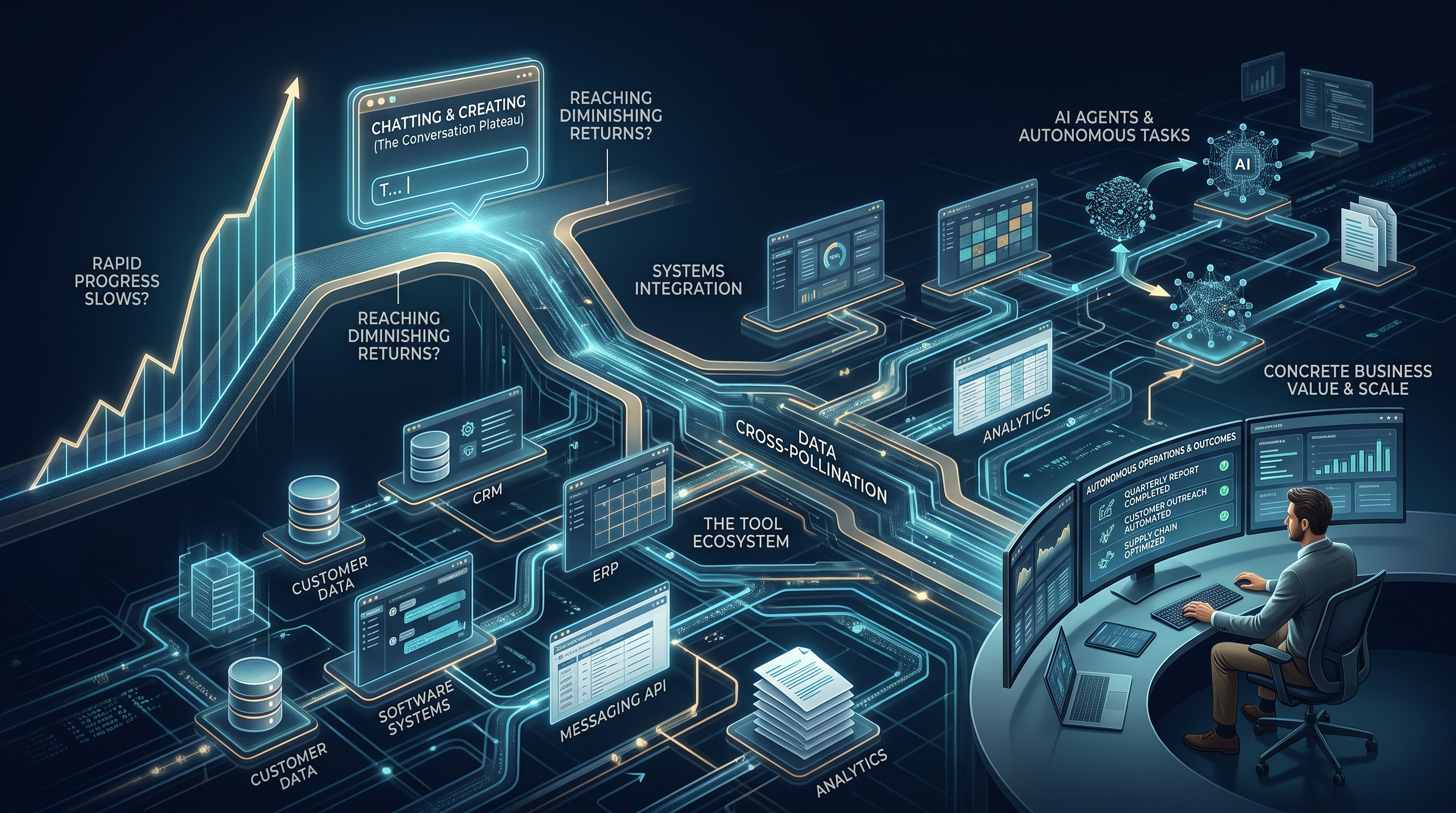
OpenAI’s agent tools now include concepts such as tool use, handoffs between agents, guardrails, tracing and pauses for human approval. Anthropic similarly recommends starting with simple, composable workflows and adding agentic complexity only where it demonstrably improves results.
In other words:
The technology is moving away from being only a destination where you ask questions. It is becoming a layer that can operate across other systems.
What This Means for Online Business Beginners
AI agents do not eliminate the need to learn how an online business works.
They make that understanding more important.
You cannot properly supervise keyword research if you do not understand search intent. You cannot approve an article if you cannot recognize weak information. You cannot automate affiliate promotion if you have not defined your audience, offers and disclosure rules.
Someone who understands the fundamentals can direct an agent.
Someone who does not understand the fundamentals may simply automate mistakes faster.
That is why I continue building From 0 → 100K around skills, systems and real examples rather than promises of instant passive income.
You can explore the larger journey through:
- Start Here: Your Path From 0 to 100K
- Free Second-Income Blueprints by Profession
- The Economy Changed. Most Career Advice Did Not.
- What Proof Is There That Making Money Online Actually Works?
- My Tested Tools and Platform Reviews
- The Tools I Use
Learn the Business Before You Delegate the Business
Wealthy Affiliate combines website building, keyword research, training, community support and AI-assisted publishing tools. It is where I built my foundation and where I continue documenting what works, what changes and what beginners should understand next.
A Beginner’s Six-Step AI Agent Action Plan
Do not begin by trying to build an army of digital employees.
Begin by finding one recurring task that steals two hours every week and asking whether an agent can safely reduce it to twenty minutes of review.
That is a real business improvement.
Frequently Asked Questions About AI Agents
What is an AI agent in simple terms?
An AI agent is a software system that works toward a goal by evaluating information, selecting steps and using approved tools. Unlike a basic chatbot, it may continue through multiple stages without waiting for a separate prompt at every step.
How is an AI agent different from ChatGPT?
A standard chatbot conversation primarily returns answers or generated content. An agentic system can combine a model with tools, instructions, memory, approvals and external systems so it can perform a connected workflow. Some ChatGPT features are themselves agentic, so the distinction is increasingly about capability rather than a single product name.
Can AI agents run a small business?
AI agents can assist with many recurring business tasks, but allowing one system to control an entire business would create major reliability, security and accountability risks. A better approach is assigning narrow jobs with limited permissions and human review.
What is the best first task to give an AI agent?
Start with a repetitive, low-risk and measurable task such as research preparation, content repurposing, analytics summaries, inbox categorization or broken-link monitoring. Avoid beginning with payments, sensitive account changes or irreversible publishing.
Will AI agents replace employees?
Some routine tasks and roles will change, but AI agents remain weaker at empathy, unusual circumstances, trust, accountability and nuanced judgment. Many practical deployments combine automated work with human approvals and escalation.
Do AI agents make mistakes?
Yes. Agents can misunderstand goals, use incorrect information, select the wrong tool or complete an action that should have been reviewed. Testing, limited permissions, logs, evaluation and human approval remain important.
Has AI plateaued in 2026?
Chatbot improvements may feel less dramatic to some users, but AI development is increasingly focused on connected tools, longer-running tasks, workflow orchestration and agents that act under defined permissions. The direction is changing from answers alone toward completed work.
Final Takeaway: The People Who Learn to Direct AI Will Have the Advantage
Twenty years ago, the internet rewarded people who learned how to build websites.
Ten years ago, it rewarded people who learned social media, video and online audiences.
More recently, it rewarded people who learned content, search intent and digital products.
Now we are entering a stage where people must learn how to direct intelligent systems.
That does not mean blindly trusting AI or removing yourself from your business.
It means learning how to turn a vague idea into a clear objective, a clear objective into a documented process and a documented process into a supervised workflow.
AI used to give advice.
Now it is beginning to do the work.
The opportunity belongs to the people who know which work to delegate—and which decisions must remain human.
Ready to Build Something Real?
Start with the skills, website and system first. Then let AI help you remove the friction.
Sources and Further Reading
- OpenAI: Introducing OpenAI Presence
- OpenAI Developers: Agents SDK Guide
- OpenAI: A Practical Guide to Building AI Agents
- OpenAI: New Tools for Building Agents
- Anthropic: Building Effective Agents
- IBM: What Are AI Agents?
- AWS: What Are AI Agents?
- Wealthy Affiliate: AI Just Went From Giving Advice to Doing the Work


Leave a Reply