
Last Updated on October 8, 2026 by Jeremy
Most affiliate-marketing advice is written for one of two people: the complete beginner who has not built anything yet, or the successful creator preparing to leave a job behind.
There is far less guidance for the person moving in the opposite direction—the creator who already built websites, learned the systems, developed the skills and now needs to return to full-time employment without abandoning everything.
That is the transition I am making now.
I am grateful that I had the opportunity to spend a concentrated period building my affiliate-marketing business across multiple websites. That time gave me experience with content, SEO, affiliate programs, email systems, website design, social media and the less glamorous maintenance behind all of it.
Now the challenge is different. I am not starting from zero. I am shifting from building to maintaining—and that distinction changes the strategy.

Image disclosure: The supporting images in this article were created with AI-assisted image tools to illustrate the situations being discussed.
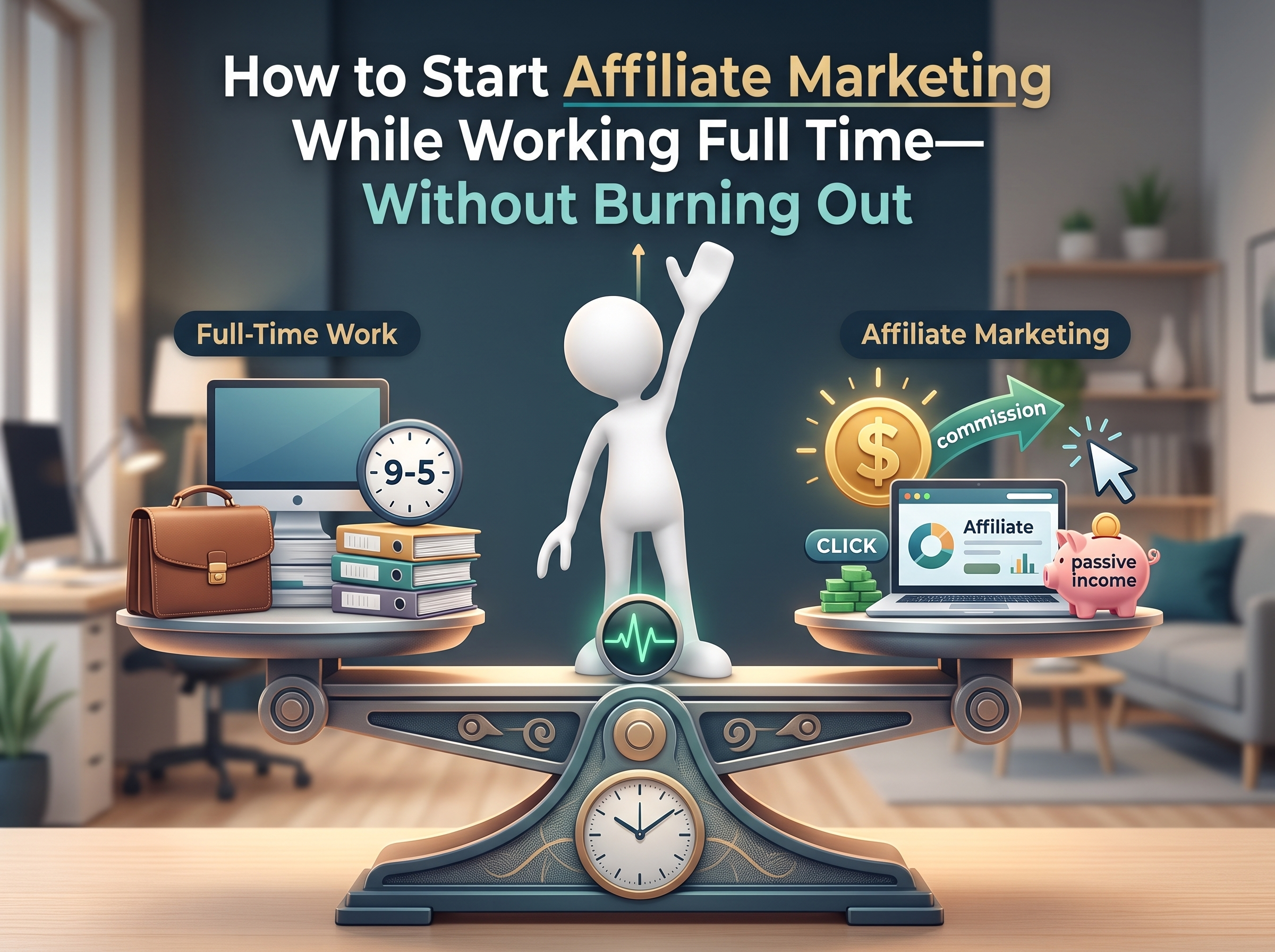
You can start affiliate marketing while working full time, but you should not copy the schedule of a full-time creator. Choose one audience, one useful content system and one primary monetization path. Protect a few repeatable work periods each week, measure progress by completed priorities rather than hours, and design the business so it can survive busy weeks.
Why This Transition Deserves Its Own Conversation
Search for advice about balancing a job and an online business and you will repeatedly encounter familiar recommendations:
- Wake up earlier.
- Work during lunch.
- Use every evening productively.
- Publish more often.
- Automate everything possible.
- Sacrifice now so you can leave your job later.
Some of that advice is useful. Consistency matters. Focus matters. Trust matters. A business will not grow if nothing is completed.
But the usual conversation often skips three realities.
Your Job Uses Real Energy
A free hour after work is not automatically a productive hour. Commutes, physical work, decisions, family responsibilities and mental fatigue all affect what you can realistically complete.
Not Every Task Is Equal
Writing another article may feel productive, but repairing a broken affiliate path, updating a converting page or answering a reader’s real question could be more valuable.
Maintenance Is Still Work
Updating links, checking disclosures, replying to comments, protecting security and improving existing content do not look exciting. They still preserve the asset you built.
There is also a major difference between starting an affiliate business beside a job and returning to employment after a period of full-time business building.
The beginner must create foundations. The established creator must decide which foundations deserve continued attention.

The goal is not to fill every empty square. It is to protect enough focused time to keep the business useful.
What the Gurus Usually Get Right—and What Is Often Missing
I do not believe established affiliate-marketing teachers are automatically wrong. Many emphasize ideas that remain important: earn trust, publish useful material, understand the audience, improve existing content and remain consistent.
The problem is often one of context.
Advice created by somebody whose full-time occupation is running an online business may be difficult to apply directly when your best daytime hours belong to an employer. The strategy may be sound while the expected pace is unrealistic.
| Common Advice | Why It Helps | What a Full-Time Employee Must Add |
|---|---|---|
| Be consistent. | Repeated effort produces more opportunities to learn, reach people and improve. | Consistency does not have to mean daily production. A sustainable weekly or biweekly rhythm is better than an exhausting sprint followed by silence. |
| Publish more content. | Useful content can expand topical coverage and answer more reader questions. | Existing pages may need updates, clearer intent, better internal links and stronger conversion paths before the site needs another article. |
| Build an audience. | Trust makes recommendations more useful and creates repeat visitors. | Choose one or two communication channels you can maintain. Being weakly present everywhere is not the same as building a relationship. |
| Automate your business. | Templates, scheduling and workflows can reduce repetitive effort. | Automation only helps after the process works manually. Automating a confusing funnel distributes the confusion faster. |
| Outsource lower-value work. | Delegation can protect the owner’s time. | A side business may not have enough revenue to support contractors. Simplification should usually come before new expenses. |
| Treat it like a business. | Goals, tracking, compliance and deliberate decisions matter. | A real business must fit its owner’s current capacity. Pretending you have forty extra hours does not make the plan more professional. |
The Missing Question
What stage is your business actually in?
A beginner needs to build. A growing publisher needs to test. An established but time-limited creator may need to protect, consolidate and improve.
Those stages require different schedules—even when the long-term goal remains the same.
Building Full Time Is Not the Same as Earning a Full-Time Income
This distinction matters for honesty and planning.
When I say I spent time building my affiliate business full time, I am describing how I used my working hours. I am not claiming that every website had already replaced a full-time wage or that the business had reached a finished, passive stage.
I used that time to create and rebuild websites, publish content, test affiliate programs, improve internal linking, develop tools, design customer journeys, correct mistakes and learn how the moving parts fit together.
That work created something valuable: infrastructure.
Infrastructure does not eliminate future work, but it changes the type of work required. I no longer need to learn every basic WordPress function from the beginning. I do not need to discover what an affiliate disclosure is for the first time. I do not need to create every navigation structure, brand direction or content category from nothing.
Instead, the questions become:
- Which websites deserve priority?
- Which existing pages are closest to producing a return?
- Which systems are functional enough to maintain?
- Which unfinished ideas should be paused?
- What can be improved without creating another major project?
- How do I continue without sacrificing my job, health or family?
That is not quitting. It is moving from expansion into stewardship.
The Three Affiliate-Marketing Stages
Foundation
You are choosing an audience, learning the tools, creating the website, understanding search intent, joining relevant programs and publishing the first useful resources.
This stage requires more learning because almost every task is new.
Construction
You have foundations, but the business needs depth. You are building content clusters, reviewing products, testing calls to action, improving design, developing an email path and finding where readers respond.
This is where I had the benefit of concentrating much of my time.
Maintenance and Selective Growth
You cannot—or should not—continue expanding everything at the same speed. The priority becomes preserving working assets, repairing weak links, refreshing valuable content and adding something new only when it serves a clear purpose.
This is the stage I am entering as I return to full-time work.
Many affiliate-marketing programs focus heavily on Stages 1 and 2 because they are easier to turn into sequential lessons. Stage 3 is messier. It depends on what you built, what receives traffic, what earns revenue, what remains incomplete and how much energy your employment leaves behind.
That may be why fewer people talk about it.

A functioning system should reduce repeated decisions—not create more dashboards to maintain.
How to Start Affiliate Marketing While Working Full Time
If you truly are starting from the beginning, your greatest advantage will not be an aggressive schedule. It will be narrowing the project enough that you can repeat it.
1. Choose One Audience Before Choosing Products
Do not begin by collecting affiliate links.
Begin with a group of people whose questions, frustrations or buying decisions you understand. A focused audience makes it easier to decide what to research, what to publish and which products are genuinely relevant.
Your first site does not need to cover every interest you have. A smaller, useful direction is easier to maintain around employment than a broad online magazine.
2. Pick One Primary Content Format
You can eventually combine articles, videos, email and social media. You do not need to master all four during your first month.
- Written guides if you explain things clearly through text.
- Video demonstrations if the product or process must be seen.
- Short social content if you understand a specific community.
- Email if you already have a relevant audience or customer list.
The other channels can support the primary one later.
3. Choose One Monetization Path
A new affiliate does not need twenty networks and a spreadsheet filled with offers.
Choose one relevant product category or training path. Learn its terms, disclosures, tracking method and actual customer fit. Then create useful content around the decision the reader is already trying to make.
The content should remain useful even when the reader does not purchase.
4. Build a Minimum Viable Publishing Rhythm
Your minimum rhythm should be the amount you can maintain during a difficult month—not what you can produce during an unusually quiet weekend.
For one person, that may be one strong article every week. For another, it may be two meaningful updates and one new article per month.
Neither schedule guarantees traffic or income. A realistic schedule simply gives you enough time to learn from completed work.
5. Separate Creation From Administration
Do not spend your best writing period checking email, changing colours, browsing affiliate dashboards or installing another plugin.
- Creation: research, writing, filming, editing and publishing.
- Administration: updates, links, reports, comments, compliance and maintenance.
When the lists are mixed together, an evening can disappear without producing—or protecting—anything important.
My Maintenance-First System for Returning to Full-Time Work
I am not entering this transition with a perfect formula. This is the system I intend to test and refine as my available time changes.
Weekly Priority Order
- Protect website security, uptime and essential technical functions.
- Fix broken affiliate links or conversion paths.
- Respond to genuine reader, customer or client activity.
- Improve pages already receiving impressions, clicks or engagement.
- Complete the most strategically useful new article.
- Repurpose that completed work for one relevant social channel.
- Record what changed so the next work session starts faster.
This order may not look exciting. It is designed to prevent valuable assets from being neglected while I chase the feeling of constant production.
Maintain Before You Multiply
If I cannot maintain the pages, systems and promises that already exist, creating more of them is not meaningful growth.
A Realistic Weekly Schedule
I do not want to prescribe a rigid timetable before I have lived through this transition. Work hours, commutes, family needs and energy will determine what is sustainable.
| Work Period | Primary Purpose | Example Tasks |
|---|---|---|
| Short weekday session | Remove friction | Check important messages, record ideas, fix one broken link or prepare the next assignment. |
| Focused weekday session | Build one section | Research one question, draft one article section or update one existing page. |
| Primary weekend block | Finish meaningful work | Complete, edit and publish the week’s highest-priority asset. |
| Monthly review | Choose direction | Review traffic, affiliate clicks, costs, unfinished tasks and what no longer deserves attention. |
The schedule should support the work. It should not become another system that requires constant maintenance.
What I Am No Longer Willing to Measure
When time becomes limited, the wrong measurements can create unnecessary guilt.
I do not want to judge the business solely by:
- How many hours I spent at the computer.
- How many unfinished drafts I opened.
- How many social platforms I touched.
- How early I woke up.
- How my publishing frequency compares with a full-time creator.
- How many new tools I tested.
More useful measurements include:
- Did I finish the most important task?
- Did I protect something already working?
- Did I make one reader’s decision easier?
- Did I strengthen a relevant monetization path?
- Did I learn something that changes the next decision?
- Can I repeat this pace next week?
What Should Be Automated?
Automation can help a time-limited affiliate marketer, but it should remove repetition without removing judgment.
Good Candidates for Automation
- Backups and security checks.
- Routine publishing reminders.
- Email delivery for requested resources.
- Basic analytics reports.
- Reusable article and disclosure templates.
- Scheduling approved social posts.
- Standard publishing and update checklists.
Tasks That Still Need Human Judgment
- Deciding whether a product genuinely fits the reader.
- Adding first-hand experience.
- Checking whether information remains accurate.
- Evaluating comments and reader questions.
- Choosing which page deserves attention.
- Making claims about products, income or results.
- Deciding what should not be published.
AI and automation can accelerate parts of the process. They cannot take responsibility for the recommendation carrying your name.

A sustainable transition connects both parts of your life without pretending either one requires no effort.
How Do You Know What to Maintain?
When you already have a website, begin with evidence instead of another brainstorming session.
- Check traffic and impressions. Find pages search engines are already testing with users.
- Check affiliate clicks. Identify pages where visitors show buying or comparison intent.
- Check accuracy. Update prices, program details, broken products and outdated recommendations.
- Check the next step. Ensure the reader can move naturally from education to comparison or action.
- Check effort against value. Do not spend five hours polishing a page nobody needs while ignoring one already receiving relevant visitors.
This does not mean every low-traffic page is worthless. Some pages support topical depth, internal navigation or a specific customer journey. It means every task should have a reason beyond keeping you busy.
When Should You Add New Content?
Maintenance-first does not mean never publishing again. New content still matters when it fills a real gap.
I would prioritize a new article when:
- Readers repeatedly ask a question the site does not answer.
- Keyword research reveals relevant intent existing content does not serve.
- A new article completes a useful topic cluster.
- A genuine experience creates information competitors cannot copy honestly.
- A relevant product solves a problem already discussed on the site.
- The article creates a logical bridge between education and monetization.
I would delay it when the idea merely repeats something already published, exists only to hold an affiliate link or requires an entirely new system I cannot maintain.
Protect Your Employment Too
An affiliate business built beside a full-time job needs boundaries.
- Do not use employer time or equipment without explicit permission.
- Review employment agreements for outside-work, confidentiality or conflict provisions.
- Keep employer information and business content separate.
- Do not publish confidential workplace details.
- Track business expenses and income properly.
- Use clear disclosures wherever commercial recommendations appear.
The side business should create options—not unnecessary conflict with the income currently supporting your household.
What If You Have Not Built the Foundation Yet?
If you are reading my transition and thinking, “That is helpful, but I still need to build the website,” then your starting point will be different.
You need a structured learning path, a manageable project and enough hands-on practice to understand how content, traffic, trust and monetization connect.
- Start Here: Your Path From 0 to 100K
- Explore the Second-Income Blueprints
- Follow the Actual Progress and Updates
- See the Original Learning Roadmap
Wealthy Affiliate is one platform I have used to learn and build, but it is not a guaranteed-income system and it is not the only possible route. Read the evidence, understand the ongoing costs and decide whether its environment fits how you learn.
My Honest Position During This Transition
The Real Goal Is Continuity
The goal of affiliate marketing while working full time should not be to prove how little sleep you need.
It should be to build a useful asset that survives real life.
Some weeks will allow meaningful expansion. Other weeks may consist of protecting the website, answering an important message and leaving a clear note for the next session.
If the system only works when you have unlimited time, it is not yet a sustainable system.
If it can slow down without disappearing, preserve trust without constant promotion and continue teaching you where value exists, then it has a chance to grow alongside your life.
For me, returning to full-time work is not the end of the From 0 to 100K project.
It may be the most honest test of it yet.
Further Reading and Research Context
- Smart Passive Income: Affiliate Marketing Strategies — trust, audience service and responsible recommendations.
- Smart Passive Income: The Work Behind Blogging — acknowledges that maintaining content is not completely passive.
- Neil Patel: Publishing Frequency and Organic Growth — consistency and compounding search visibility.
- Neil Patel: Advanced Affiliate Strategies — includes improving existing content as an affiliate strategy.
These resources provide industry perspectives. Their examples and outcomes are not guarantees that another person will achieve the same traffic, timeline or income.
Need the Foundation Before You Can Maintain It?
Wealthy Affiliate is where I learned much of the website, content, research and affiliate-marketing process I now use. The platform can provide training, hosting, research tools and a community—but the work, judgment and results still belong to the person building the business.
Start free, explore the environment and decide whether it fits your available time before making a larger commitment.
Explore Wealthy Affiliate Starter Read My Full Review FirstAffiliate disclosure: The Wealthy Affiliate button is an affiliate link. If you later purchase or upgrade, I may earn a commission at no additional cost to you. Joining a platform does not guarantee traffic, sales or income.

Leave a Reply