
Last Updated on July 17, 2026 by Jeremy
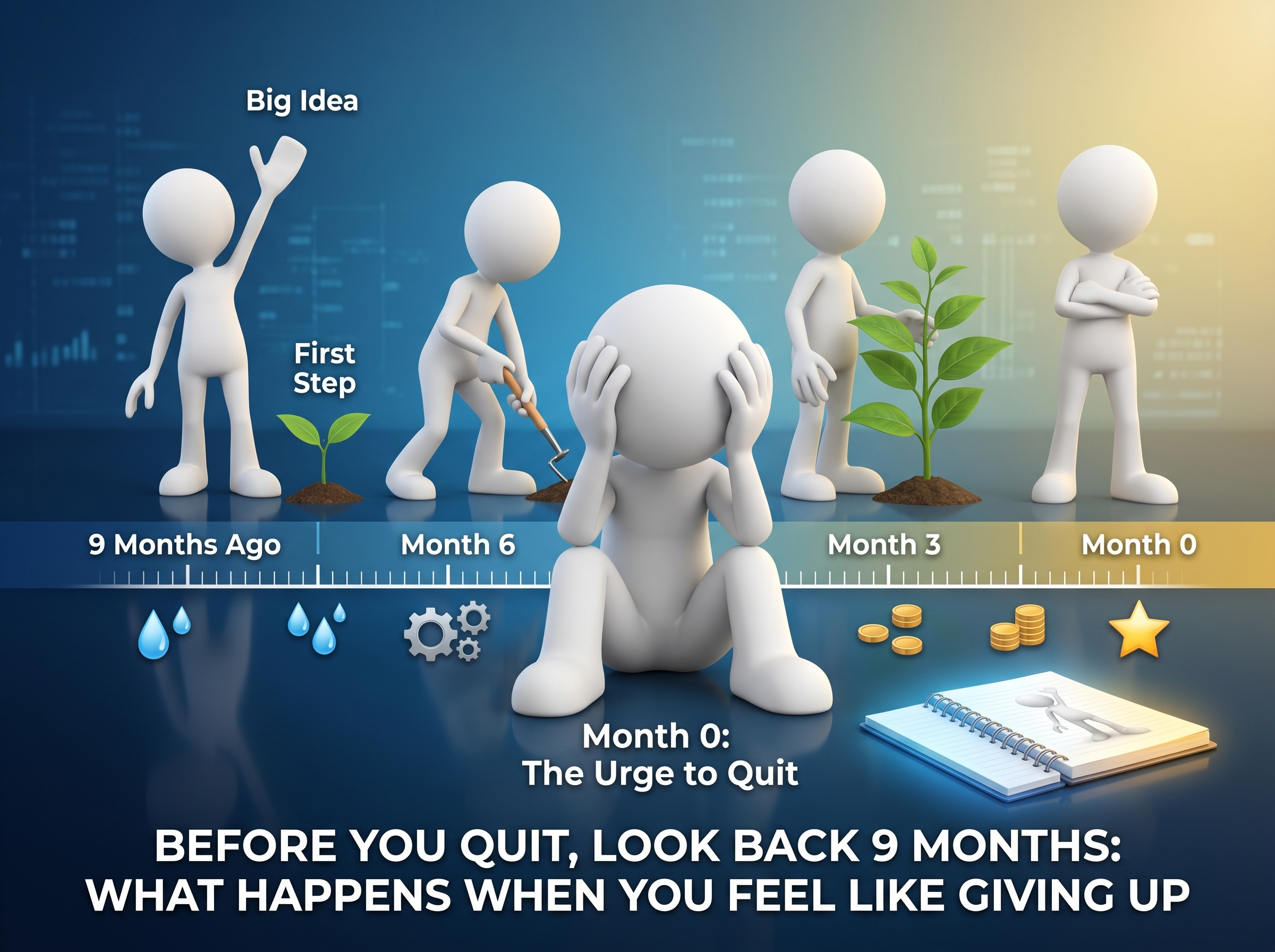
A lot can change in nine months.
On September 22, 2025, I started From 0 to 100K as a public experiment. The goal was not to pretend I already had everything figured out. It was to document what actually happens when someone tries to build a real online business from the ground up.
Now it is July 17, 2026. My location has changed. My priorities have changed. The website has changed. I have changed.
The income, however, remains inconsistent.
That is the part of the journey people often skip over. They show you the finished website, the big traffic chart, the affiliate payment, or the social media post that finally took off. They rarely show you the days when another bill arrives, the motivation disappears, and you seriously wonder whether one more article will make any difference.
So, what happens when you feel like giving up?

Keep going.
That was my wife’s first suggestion for this article. The title would be “What Happens When You Feel Like Giving Up?” and the entire article would consist of two words:
Keep going.
Honestly, she was not wrong.
But “keep going” is easy advice to give when you are not the one questioning the bills, watching uneven traffic, waiting for commissions, or wondering whether your time would be better spent somewhere else.
The better question is not whether you should keep going.
The better question is:
How do you keep going when the results have not caught up with the effort yet?
TL;DR
Before quitting, compare where you are today with where you started—not where someone else is after ten years. In nine months, From 0 to 100K grew into 65 posts, 54 pages, dozens of Blueprint resources, hundreds of comments, videos, tools, and an expanding body of work. The income remains inconsistent, but the assets, experience, audience, and opportunities are real. When money is tight, use free tools, eliminate unnecessary expenses, keep creating, and measure progress over longer periods.
What Can Change in Nine Months?
My broader online journey began in October 2022, but From 0 to 100K is a separate chapter. It began on September 22, 2025, with a specific purpose: document the road from an idea to a functioning online business.
Nine months later, the site now contains:
Most of those pages are not filler. Many are the individual career and income Blueprints I have been creating for people who want a practical starting point based on their existing experience.
The website now has articles, videos, Blueprints, reviews, resource pages, social content, internal systems, and a growing collection of ideas that did not exist nine months ago.

Would I like the traffic and earnings to be further ahead? Of course.
But that is different from saying nothing has happened.
What I saw day to day
Another article. Another page. Another video. Another comment. Another task that seemed small by itself.
What exists after nine months
A legitimate content library, a recognizable brand, a clearer strategy, growing skills, and assets that can continue working long after the day they were created.
The Feelings Nobody Puts in the Success Story
There are days when building online feels exciting. Ideas come easily. An article starts ranking. Someone leaves a thoughtful comment. A video turns out better than expected.
Then there are the other days.
- You question whether the subscription you are paying for is still worth it.
- You wonder whether another article will bring any traffic.
- You see someone else’s results and feel like you are falling behind.
- You spend hours creating something that receives almost no immediate reaction.
- You begin confusing slow progress with failure.
That last one is dangerous.
Slow progress is not the same thing as no progress.
When income remains inconsistent, every expense feels louder. Every low-traffic day feels more personal. Every decision starts carrying extra weight.
Even a small purchase can force a choice between something you want and something needed to produce income elsewhere. That is real life. Building an online business does not happen in a protected bubble where bills, family responsibilities, vehicles, jobs, and unexpected expenses politely wait their turn.
The honest middle
I am not writing this from the finish line. I am writing it from the middle—where the work is real, the potential is visible, but the financial results are not yet consistent enough to relax.
That may make this story less glamorous, but it also makes it more useful.
Income Is Not the Only Evidence That You Are Building Something
Money matters. I am not going to pretend that pageviews, comments, or encouraging messages can pay the internet bill.
But income is often a lagging result. The work and infrastructure usually arrive first.
Before a website consistently earns, it needs assets:
- Useful articles people can discover through search or social media.
- Pages that answer specific questions and guide readers toward a next step.
- Videos that introduce your voice and strengthen trust.
- Internal links that help readers explore more than one page.
- Affiliate relationships and offers that genuinely match the audience.
- Social posts that keep the brand visible and bring people back.
- Comments, conversations, and feedback that reveal what people care about.
Those assets can sit quietly for months before they begin working together.

One of the biggest changes in my own thinking is that an article is no longer just an article.
One strong topic can become:
- A long-form website article.
- A YouTube video or Blueprint explanation.
- A Facebook post and follow-up discussion.
- A Pinterest pin.
- A short-form video.
- An internal link from older content.
- An affiliate opportunity.
- A future update based on reader questions.
That is where compounding begins. Not necessarily in one viral moment, but in multiple pieces supporting one another.
What Do You Do When the Money Is Not Coming In Yet?
“Keep going” does not mean ignoring reality.
It does not mean putting every expense on a credit card, buying every new tool, or refusing to take local work because you believe the internet owes you an income.
Sometimes the most responsible way to keep an online business alive is to earn money offline while continuing to build online.
I have taken local service work, completed yard jobs, installed items, cut grass, and done whatever practical work was available. That money can cover immediate needs while the digital assets continue developing.
You do not fail at online business because you temporarily earn money somewhere else.
You may be funding the very business you are trying to build.
When finances tighten, I believe in asking three questions:
1. Does this expense directly help me create or earn?
A tool may be useful, but useful is not always essential. If it does not improve production, save meaningful time, attract traffic, or help generate revenue, it may need to wait.
2. Is there a free version that keeps the momentum alive?
You do not need the premium version of everything. Free tools can carry a surprising amount of the workload while you build.
3. Am I protecting momentum—or protecting my ego?
There is no shame in scaling back. Cancel unnecessary subscriptions. Use simpler software. Take temporary work. Adjust the plan.
The goal is not to look successful.
The goal is to stay in the game long enough to become successful.
Free Tools and Platforms Can Keep You Building
One reason people stop is because they believe an online business requires an expensive stack of software from day one.
It does not.

Many of the essential jobs in a content business can be handled with free plans, starter accounts, open-source software, or platforms that cost nothing to publish on.
WordPress
An open-source publishing platform that gives creators ownership and room to grow.
Wealthy Affiliate Starter
A way to begin exploring affiliate marketing, training, community support, and website-building tools without committing to the full paid platform immediately.
Canva Free
Useful for graphics, thumbnails, social posts, simple branding, and basic visual content.
CapCut or VLLO
Video-editing options that can help produce YouTube videos, Reels, Shorts, and social clips.
Google Search Console
Free insight into indexing, search impressions, queries, and how Google is discovering your content.
Google Analytics
Free traffic, engagement, and audience information for understanding what visitors do on your site.
Google Docs and Sheets
Writing, planning, tracking, content calendars, and basic business organization without another subscription.
Meta Business Suite
Free scheduling, messages, insights, and basic management for Facebook and Instagram.
YouTube and Pinterest
Free publishing platforms that can introduce your content to audiences outside traditional Google search.
I have put together a dedicated page showing the tools I personally use, have tested, or consider worth exploring. It includes both free and paid options so you can build a stack based on your actual needs rather than collecting subscriptions.
Build With the Tools You Actually Need
See the website, writing, SEO, design, video, analytics, social media, affiliate, and business tools behind From 0 to 100K.
Shawn’s Facebook Results Show What Quiet Compounding Looks Like
A recent Wealthy Affiliate post from Shawn, known inside the community as shawn8183, captured this lesson perfectly.
Shawn creates Facebook content while working as a truck driver. His workspace changes constantly. Sometimes he creates from the cab of his truck, a hotel room, a bunkhouse, or wherever the day leaves him.
He built a routine around consistent posting, conversations, analytics, and learning what his audience responded to.
What made his story especially valuable was not simply the number of views he received. It was the way he measured progress.
Instead of comparing this week’s numbers with last week’s numbers, he compared the same period across an entire year.
What Shawn discovered
Day to day, his routine felt repetitive: create, post, reply, study, and repeat.
Over a longer period, however, those ordinary days compounded into millions of views, a growing audience, organic reach, product opportunities, and Facebook earnings.
He also noticed something important in his analytics: negative-looking indicators did not necessarily mean the strategy was failing. Some reflected his decision to stop relying on paid promotion and focus on organic growth instead.
Context mattered more than the colour of an arrow on a report.
His posts built trust. His Stories kept the audience engaged. His Reels introduced his content to new people. Each format played a different role, and together they created something stronger than any individual post.
You can read Shawn’s full breakdown here:
Is All This Time on Facebook Actually Worth It? Here’s What One Year Taught Me
His story does not guarantee that everyone will achieve the same numbers. That is not the lesson.
The lesson is that consistent work can be difficult to measure while you are standing inside it.
Most People Are Using the Wrong Comparison Window
When people feel discouraged, they usually compare themselves in one of two ways:
- They compare today with yesterday and conclude that nothing changed.
- They compare their beginning with someone else’s mature business and conclude that they are behind.
Both comparisons can distort reality.
A website may receive only a handful of search visitors in one reporting period. That can feel disappointing. But what existed nine months earlier?
In the case of From 0 to 100K, the answer is simple:
None of this existed.
No 65-post library.
No 54 pages.
No career Blueprint collection.
No growing archive of comments.
No established design system.
No YouTube Blueprint series.
No documented nine-month case study.
A recent 28-day snapshot showed 161 visitors, 136 search impressions, six unique visitors from search, and nine tracked key events. Those numbers are not a victory lap.
They are a baseline.
They tell me the site is being seen, people are interacting with it, and there is still considerable work ahead.
Both things can be true:
I am not where I want to be.
The traffic and income still need to grow. More content needs to rank, stronger distribution is required, and monetization must improve.
I am no longer where I started.
The foundation is much larger, the systems are better, the skills are stronger, and the website contains real assets that can continue compounding.

What “Keep Going” Actually Means
Keeping going does not always mean doing more.
Sometimes it means doing less, but doing it consistently.
It can mean:
- Publishing one useful article instead of chasing five unfinished ideas.
- Recording one video even though you do not feel energetic or polished.
- Updating an older article rather than starting from zero.
- Using a free tool instead of paying for another premium subscription.
- Taking a temporary local job to cover expenses without abandoning the long-term plan.
- Replying to one meaningful comment and learning what your audience needs.
- Resting before exhaustion turns into resentment.
- Saving your reports so future-you can see what present-you cannot.
There is an important difference between quitting and adjusting.
Quitting says the work was pointless.
Adjusting says the destination still matters, but the route needs to change.
You are allowed to change the schedule, simplify the strategy, reduce the expenses, or earn money another way.
You do not have to abandon the goal simply because the original plan became difficult.
From 0 to 100K has already changed considerably since September 2025. That is not evidence that the original plan failed.
It is evidence that the project is alive.
Start Free, Learn the Process, and Build at Your Own Pace
Wealthy Affiliate has been the central platform behind this particular From 0 to 100K experiment. It is where much of the training, keyword research, website management, community discussion, and Blueprint development has taken place.
It is not magic, and joining does not guarantee income. You still have to choose a direction, create useful content, learn how traffic works, and continue through the slow periods.
But when money is tight, being able to begin with a free option gives you a chance to explore the process before deciding how deeply you want to commit.
Start Building Without Pretending You Have It All Figured Out
Explore the platform behind From 0 to 100K, begin with the free option, and learn how websites, content, keywords, affiliate marketing, and online business fit together.
Before You Quit, Look Back
Nine months ago, From 0 to 100K was an idea.
Today, it has 65 posts, 54 pages, hundreds of comments, a growing Blueprint library, videos, reviews, resources, analytics, and an increasingly clear purpose.
The income remains inconsistent.
The journey is not finished.
Some days are still exhausting.
But unfinished is not the same as unsuccessful.
I could look at today’s traffic and decide it is not enough.
Or I can look back to September 22, 2025, and recognize that every piece now sitting on this website had to be created one decision at a time.
That is the silver lining.
Progress was happening even when it did not feel dramatic.
So, what happens when you feel like giving up?
Keep going—but keep going intelligently.
Use the free tools. Cut what you do not need. Take practical work when necessary. Adjust the strategy. Save your reports. Measure in months and years instead of hours and days.
Most importantly, do not judge your entire journey by the chapter that exhausted you.
You may not be where you want to be yet.
But look back.
You are probably much further from where you started than you realize.
Frequently Asked Questions
Is nine months long enough for a website to make money?
There is no guaranteed timeline. Some websites earn within months, while others take much longer. Results depend on the niche, content quality, traffic sources, competition, monetization, publishing consistency, and whether the content matches what people are actively looking for.
Should I quit if my website has very little traffic?
Low traffic does not automatically mean you should quit. First review your keyword choices, content quality, indexing, internal links, promotion, user experience, and whether you have published enough useful content. You may need to adjust the strategy rather than abandon the website.
Can I build an online business without paying for expensive tools?
Yes. Free versions of WordPress-related tools, Canva, Google Analytics, Google Search Console, Google Docs, Meta Business Suite, YouTube, Pinterest, video editors, and starter training platforms can cover many early-stage needs. Paid tools should be added when they solve a real problem or save enough time to justify the expense.
What should a website have after nine months?
There is no universal number of articles or visitors. A healthy nine-month website should show evidence of consistent publishing, clear categories, improving content quality, indexing, internal links, analytics data, and a growing understanding of its audience. Progress matters more than matching someone else’s exact numbers.
Does taking an offline job mean my online business failed?
No. Local or traditional work can provide cash flow while digital assets develop. Many successful creators funded their businesses through other work. The important thing is deciding whether you still want the long-term goal and maintaining a realistic level of progress.


Leave a Reply