
Last Updated on October 2, 2026 by Jeremy
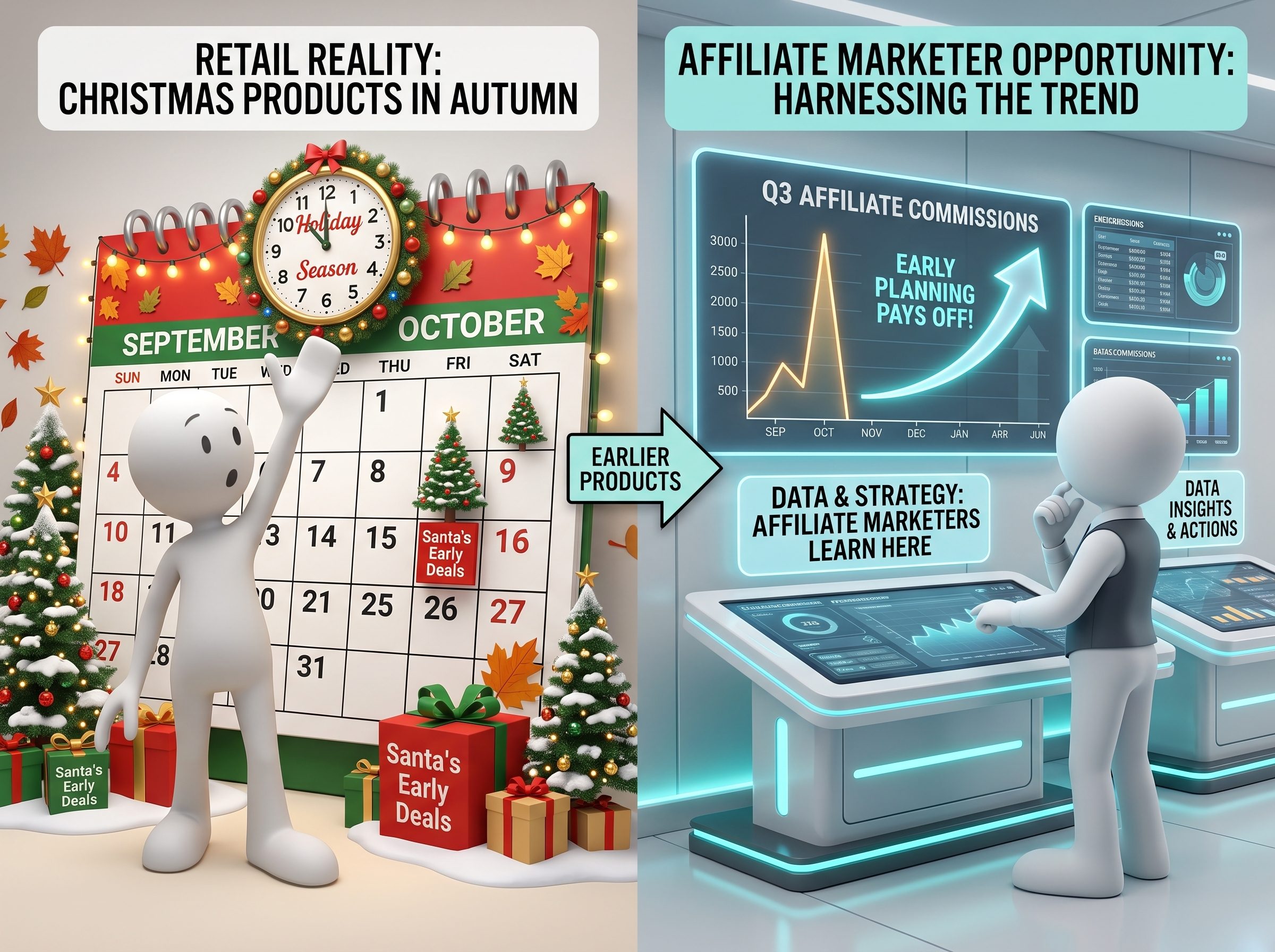
Have you noticed Christmas products appearing in stores before Halloween is even over—or sometimes while back-to-school stock is still being cleared?
I have been watching that timeline move for years. It started when I worked at a Home Hardware in a small Saskatchewan town. I do not remember my exact starting date anymore, but I remember when I began paying attention.
At first, Christmas merchandise arrived around inventory time, when fall was setting in and the first frost was usually close. By my third, fourth and fifth years, it seemed to arrive one or two weeks earlier—not merely a day or two. By years six and seven, I was tired of Christmas before December even began.

Image disclosure: Illustrative images in this article were created with AI to help visualize the retail and marketing concepts discussed.
The Quick Answer
Christmas products appear earlier because major retailers are competing for a limited seasonal budget, spreading sales across a longer period, reacting to early-shopping behaviour and trying to secure purchases before customers spend elsewhere. Affiliate marketers face the same pressure—but copying the loudest retailer is not necessarily the best way for a smaller business to compete.
Affiliate disclosure: This article includes links to Wealthy Affiliate. I have been a paying member since October 2022 and may earn a commission if an eligible referral later upgrades, at no additional cost to that person. Training and tools can support a business, but they cannot guarantee traffic, sales or income.
When I First Noticed Christmas Moving Earlier
During my first couple of years working at Home Hardware, the timing did not seem unusual. Christmas stock arrived around inventory, fall temperatures and the first frost. That sequence felt natural.
Then the display schedule started creeping forward.
By years three through five, Christmas merchandise was arriving one or two weeks earlier than I remembered. By years six and seven, it was not only happening inside our store. Christmas was showing up earlier almost everywhere I looked.

I have now been away from that store for roughly six years, but the pattern has become harder to ignore. In Canada, I have seen Christmas merchandise displayed in Costco and Walmart during the middle of September—alongside back-to-school clearance and Halloween stock.
That does not mean every store follows the same schedule, and my observations are not a national retail audit. They are simply what I have watched happen from the perspective of someone who spent seven years inside a store and continued noticing the pattern after leaving.
Costa Rica Showed Me It Is Not the Same Everywhere
During our time in Costa Rica, the difference stood out.
In larger centres, Christmas products and decorations were appearing, but we did not notice the same September and October retail takeover we had become accustomed to in Canada. Some stores appeared to begin showcasing Christmas merchandise closer to the beginning of December.
Life in the jungle also creates an entirely different seasonal atmosphere. There is no first frost telling you winter is close. Christmas does not arrive against the same background of cold weather, snow tires, furnaces and early darkness.
That experience reminded me that the holiday retail calendar is not some unavoidable law of nature. It is shaped by culture, climate, commercial competition, supply chains and what local customers have been trained to expect.
Why I Have Always Thought Christmas Should Wait
Personally, I have always felt that Christmas displays in Canada should wait until after November 11.
Remembrance Day deserves its own space. It should not have to compete with artificial snow, sale signs, inflatable decorations and an escalating holiday-sales campaign.
That is a personal position, not a rule I can impose on retailers or other families. People are free to decorate and shop whenever they choose. But the timing has always felt important to me.
When Christmas products began arriving earlier, my first reaction was to blame corporate greed. There is certainly a commercial motive—stores want their share of the seasonal budget—but the complete explanation is more complicated.
Why Retailers Start the Holiday Season So Early
They Want the First Purchase
A customer has a limited holiday budget. If one retailer captures that budget in September or October, a competitor may never get the chance.
People Really Do Shop Early
Some households spread purchases across several pay periods, avoid last-minute stress or wait for particular sale events.
Inventory Needs Selling Time
Seasonal merchandise occupies warehouse, truck and shelf space. Retailers want enough time to sell through it before markdowns become necessary.
Online Shopping Changed the Calendar
Black Friday, Cyber Monday, October sales and marketplace promotions blurred the boundary between early shopping and the traditional holiday season.
National Retail Federation survey data supports the fact that early shopping is not imaginary. In its 2025 survey, 42% of U.S. shoppers planned to begin browsing or buying before November. The leading reasons were spreading out the budget and avoiding last-minute stress.
Retailers did not invent every early shopper—but they have become very good at encouraging more of them.
The Holiday Numbers Explain the Competition
The pressure makes more sense when you see how much money moves during a short period.
Important distinction: Amazon does not publish a simple figure labelled “Christmas sales.” Its $213.4 billion fourth-quarter total demonstrates the scale of the company during the holiday quarter, but it should not be presented as money spent only on Amazon Christmas purchases.
Adobe also found that affiliates and partners—including social influencers—contributed 20.4% of measured online retail revenue during the 2025 holiday season. That does not mean an individual affiliate receives 20.4% of sales. It shows that partner-driven discovery occupies a meaningful place in the online buying journey.
Small publishers, creators and online businesses are participating in an enormous market. The mistake is assuming we must behave exactly like the largest participants to earn any part of it.
What Affiliate Marketers Usually Learn From This
Most seasonal-marketing advice follows a predictable formula:
- Publish gift guides earlier.
- Add countdown timers.
- Promote Black Friday links everywhere.
- Create urgency before competitors do.
- Send more emails as the deadline approaches.
- Turn every product into a holiday purchase.
Some of that advice works. Timing matters. Search engines need time to discover content, audiences need time to make decisions and offers can expire.
But if every affiliate publishes the same gift guide, uses the same countdown, repeats the same sale language and sends people toward the same Amazon listing, starting earlier does not make the content more useful.
It only makes the noise begin sooner.
We Do Not Need to Copy the Big-Box Playbook
A small business cannot out-stock Walmart, out-deliver Amazon or outspend Costco. Trying to imitate them on their strongest advantages is a losing strategy.
What a smaller publisher can do is something those companies often struggle to scale: answer one person’s real question with context, judgment and experience.
This is where authenticity becomes more than a fashionable marketing word.
If you have used a product, explain what surprised you. If you have not used it, say so and research it properly. If a cheaper option solves the same problem, include it. If the sale is not actually a good deal, do not pretend it is.
A forced sale may produce one transaction. An honest answer can create a returning reader.
Think Outside the Proverbial Holiday Box
Seasonal content does not have to be another list of “25 perfect gifts.”
Try approaching the customer’s actual situation:
- Budget problem: What useful gift can someone buy without financing Christmas?
- Timing problem: Which gifts genuinely require early ordering?
- Fit problem: What should you buy for someone whose hobby you do not understand?
- Space problem: What gifts work for RVers, travellers or people living in small homes?
- Waste problem: Which purchases will still be useful after December?
- Trust problem: Is the Black Friday price genuinely lower than the normal price?
- Local problem: Can a small or local business solve the need better than a marketplace?
These questions are not as flashy as a red countdown timer. They are far more likely to produce content worth finding.

Prepare Early Without Selling Christmas in September
There is an important difference between preparing early and promoting aggressively early.
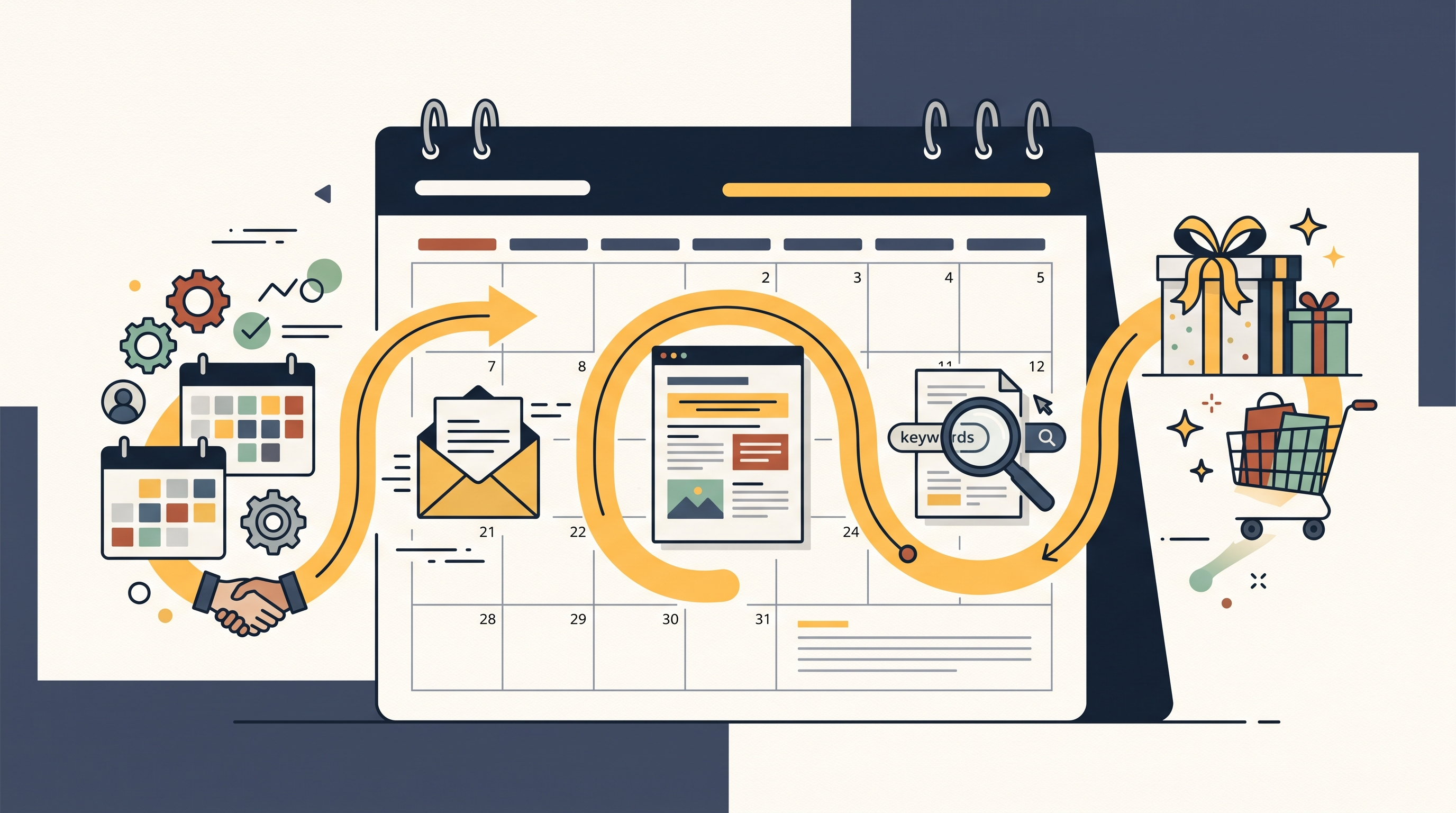
An affiliate marketer may need to begin seasonal research months in advance. Useful preparation can include:
- Reviewing last season’s results: Which pages received traffic, and which offers actually helped?
- Updating older content: Remove discontinued products, broken links and expired prices.
- Researching customer problems: Look beyond generic gift keywords.
- Testing links and disclosures: A seasonal traffic spike is wasted if the page does not work.
- Publishing educational content: Give the page time to be discovered before the busiest period.
- Creating social assets: Build several useful angles instead of repeating one sale graphic.
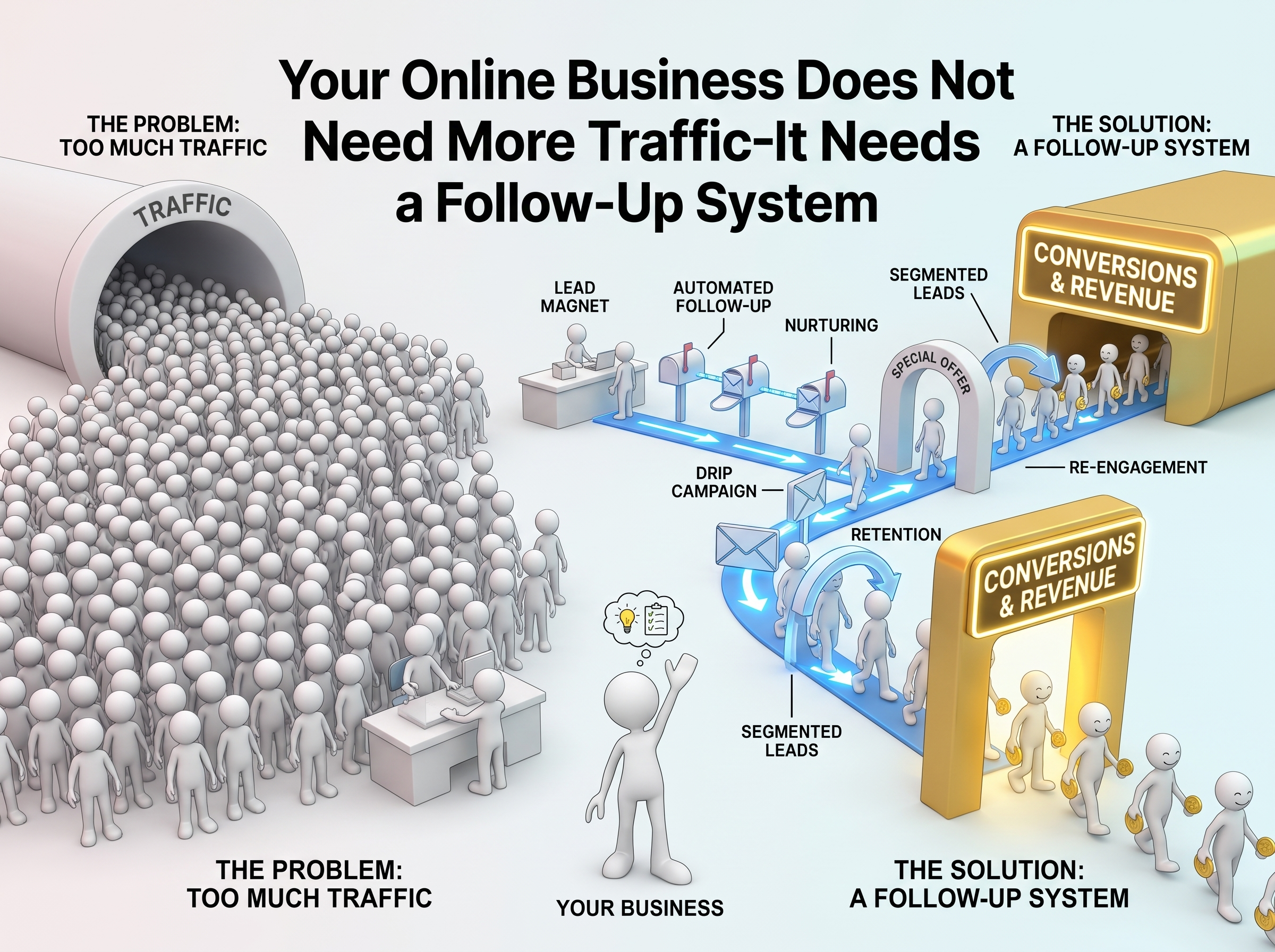
- Planning follow-up: Decide what readers need after the first click.
The Better Seasonal Timeline
Research early. Build early. Update early. Earn trust early. Then introduce the offer when it becomes relevant—not simply because another retailer put a plastic snowman beside the school supplies.
Black Friday Is a Moment, Not a Business Model
Black Friday can be valuable. People are actively searching, comparing and waiting for deals. Some businesses produce a significant portion of their yearly sales during this period.
But a website that becomes useful only when a promotion appears does not have much of a relationship with its audience.
Your Black Friday article should connect to a broader system:
- Evergreen reviews explaining the product outside the sale period
- Tutorials showing how the product solves a problem
- Alternatives for people who are not a good fit
- Price context explaining whether the promotion is meaningful
- Post-purchase help for readers who decide to buy
Black Friday should amplify trust you already built. It should not replace it.
You can also follow the real experiments, creative work and lessons behind my campaigns through the From 0 to 100K progress updates.
The Lesson I Took From Seven Years in Retail
Watching Christmas arrive earlier every year taught me more than I realized at the time.
Retailers understand that timing, visibility and repetition influence buying decisions. Affiliate marketers should understand those things too. But understanding them does not mean we must use them without judgment.
Small businesses will not beat Amazon by becoming a noisier, less convenient version of Amazon.
We can compete by noticing what the large campaign misses: the individual person trying to make a sensible decision.
If our content is authentic, our recommendation fits and we genuinely solve the customer’s problem, the sale feels more natural because it is the next logical step—not the result of pushing someone through an artificial holiday deadline.
Build Your Online Business Before the Holiday Rush!
Do not wait. Do not miss out. Start now while everyone else is still thinking about it.
START FREE TODAYThere is nothing technically wrong with this CTA—but it asks for the click before proving it understands the person.
Start With the Problem You Are Trying to Solve
If you want to build useful websites, research what people need and learn how ethical affiliate promotion actually works, Wealthy Affiliate is one training option I have personally used.
It will not build the business for you or guarantee income. My full review explains what the platform includes, what I have paid, where it helped and who should probably avoid it.
Read My Honest Review First Explore the Free Starter AccountNo guaranteed-income claim. Inspect the free option and decide whether you will realistically use the training.
Frequently Asked Questions
Why do Christmas products appear earlier every year?
Retailers want more time to sell seasonal inventory, capture customers before competitors do and serve shoppers who spread purchases across several months. Earlier online promotions have also expanded the traditional holiday-shopping calendar.
What is Christmas creep?
Christmas creep is an informal term describing Christmas merchandise, decorations and promotions appearing progressively earlier in the year.
Do customers actually begin holiday shopping before November?
Yes. National Retail Federation survey data found that 42% of surveyed U.S. shoppers planned to begin browsing or buying before November in 2025.
How much was spent online during the 2025 holiday season?
Adobe Analytics measured $257.8 billion in U.S. online spending from November 1 through December 31, 2025. That figure covers U.S. e-commerce measured by Adobe, not worldwide retail spending.
How much did Amazon make during the holiday quarter?
Amazon reported $213.4 billion in total net sales for the fourth quarter of 2025. This includes its retail, cloud, advertising and other business operations and should not be labelled as Christmas retail sales.
How early should affiliate marketers prepare holiday content?
Research and updates can begin months before the holiday season. The goal should be giving useful content time to be discovered—not pressuring customers to purchase Christmas products months early.
Do affiliate marketers need Black Friday promotions?
No. Black Friday can create a valuable promotional opportunity, but an affiliate business should still provide useful evergreen reviews, tutorials and comparisons outside the sale period.
Why Trust This From 0 to 100K Article?
The retail observations in this article come from seven years working at a Home Hardware in small-town Saskatchewan, followed by continued observation of seasonal merchandising in Canada, the United States and Costa Rica.
Personal observations are identified as personal experience. Industry spending figures are drawn from Adobe Analytics, the National Retail Federation and Amazon’s investor reporting.
From 0 to 100K documents an unfinished online-business journey. It does not present marketing tools, affiliate links or holiday promotions as guaranteed paths to income.


Leave a Reply