
Last Updated on August 28, 2026 by Jeremy
This is not an income report. This is not a fake guru story. This is a brutally honest look at what online income has and has not done for me after years of building websites, writing content, testing affiliate programs, winning a content contest, and learning digital skills the hard way.
Most people who ask whether making money online actually works are not really asking about the internet.
They are asking something much more honest.
They are asking, “Is this real, or is it all just another polished-up online fantasy?”
I get it.
The online business world has done a terrible job of earning people’s trust. For every real story, there are a hundred fake screenshots. For every honest beginner trying to build something, there is some self-declared guru standing beside a rented sports car telling people they can quit their job in 30 days.
That is not what this article is.
This is not an income report. This is not a “look how much money I made” post. This is not me pretending I cracked some secret code.
This is simply my attempt to answer one question as honestly as I can:
What proof is there that making money online actually works?
My answer is probably not the answer most people expect.
Because after years of building websites, writing articles, testing affiliate programs, creating content, publishing a book, winning a content contest, earning small commissions, getting clicks that did not convert, and learning skills I never would have learned otherwise, I came to a conclusion that surprised me.
The proof was never the money.
The money matters, of course. I am not going to sit here and pretend it does not. A commission is real. A contest payout is real. An affiliate balance is real. A booking through a travel link is real.
But the money is only one kind of evidence.
The real proof is bigger than that.
The Proof Was Never The Money
When people look for proof that making money online works, they usually look for the wrong thing first.
They look for the big income screenshot, the giant PayPal balance, the Stripe dashboard, or the headline that says someone made $10,000 this month.
And yes, those things can be real.
But they can also be faked, rented, exaggerated, cropped, or taken wildly out of context.
That is why I stopped looking at money as the only proof.
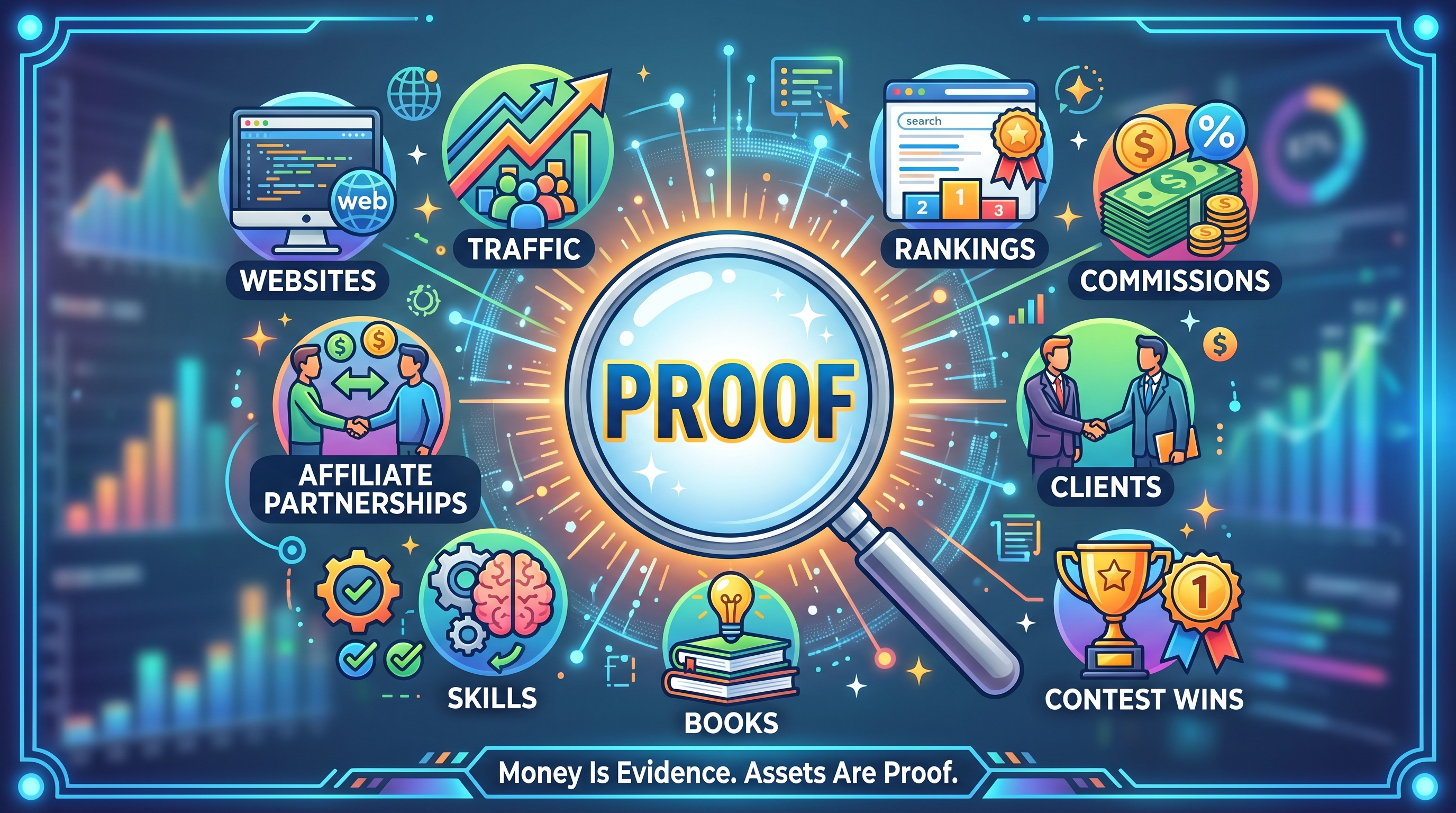
- Money is evidence.
- Assets are proof.
- Skills are proof.
- Traffic is proof.
- Content is proof.
- Opportunities are proof.
A website that did not exist before is proof.
A blog post that gets found by a stranger is proof.
A reader clicking an affiliate link is proof.
A company accepting you into an affiliate program is proof.
A contest judge choosing your article over other entries is proof.
A small commission is proof.
A failed campaign is proof too, because at least you now have real data instead of theory.
That shift changed how I looked at the whole journey.
Instead of asking, “Why am I not rich yet?” I started asking better questions.
What did I learn? What did I build? What traffic did I earn? What did people click? What offers converted? What offers failed? What skills can I now use somewhere else?
That is where the real story starts.
Building Online Taught Me What Traditional Education Never Did
At one point, I had a choice.
I could chase the traditional route again, or I could keep building online.
I chose to build.
That decision eventually led me to create From0to100K.com, EverythingRVsandMore.com, EarthboundTours.com, FlyFishCR.com, Nomad-Ninja.com, VirtualFitnessQuest.com, and EverythingRVsandMore.store.
I already wrote about that journey in my article, I Built 7 Websites Instead Of Going Back To University. Here Is What It Actually Taught Me.
But this article is not really about the number of websites.
The websites are just the visible part.
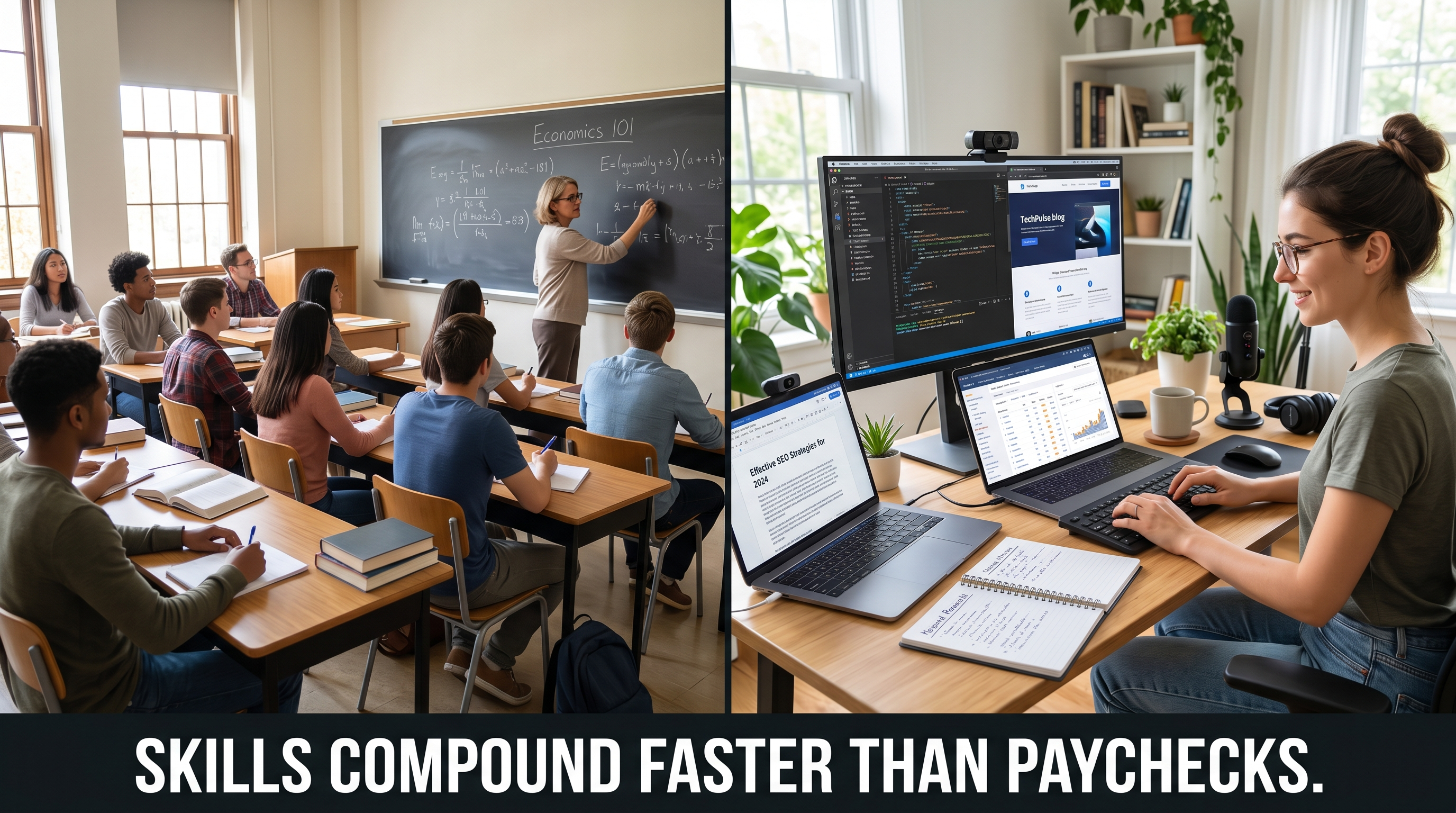
The real value was what building them forced me to learn.
I had to learn WordPress, writing, SEO, affiliate marketing, analytics, internal linking, calls to action, content structure, keyword intent, page design, publishing discipline, and how to keep going when a page did not immediately do anything.
No course could have taught me all of that in the same way.
Because this was not theory.
This was real work on real websites with real consequences.
If an article was bad, nobody read it. If a headline was weak, nobody clicked. If a page was confusing, people left. If an affiliate offer did not match the reader, nothing happened.
That is not failure in the traditional sense.
That is feedback.
And feedback is one of the most valuable parts of building online.
Small Commissions Matter More Than People Think
One of the biggest mistakes beginners make is dismissing small commissions.
I understand why.
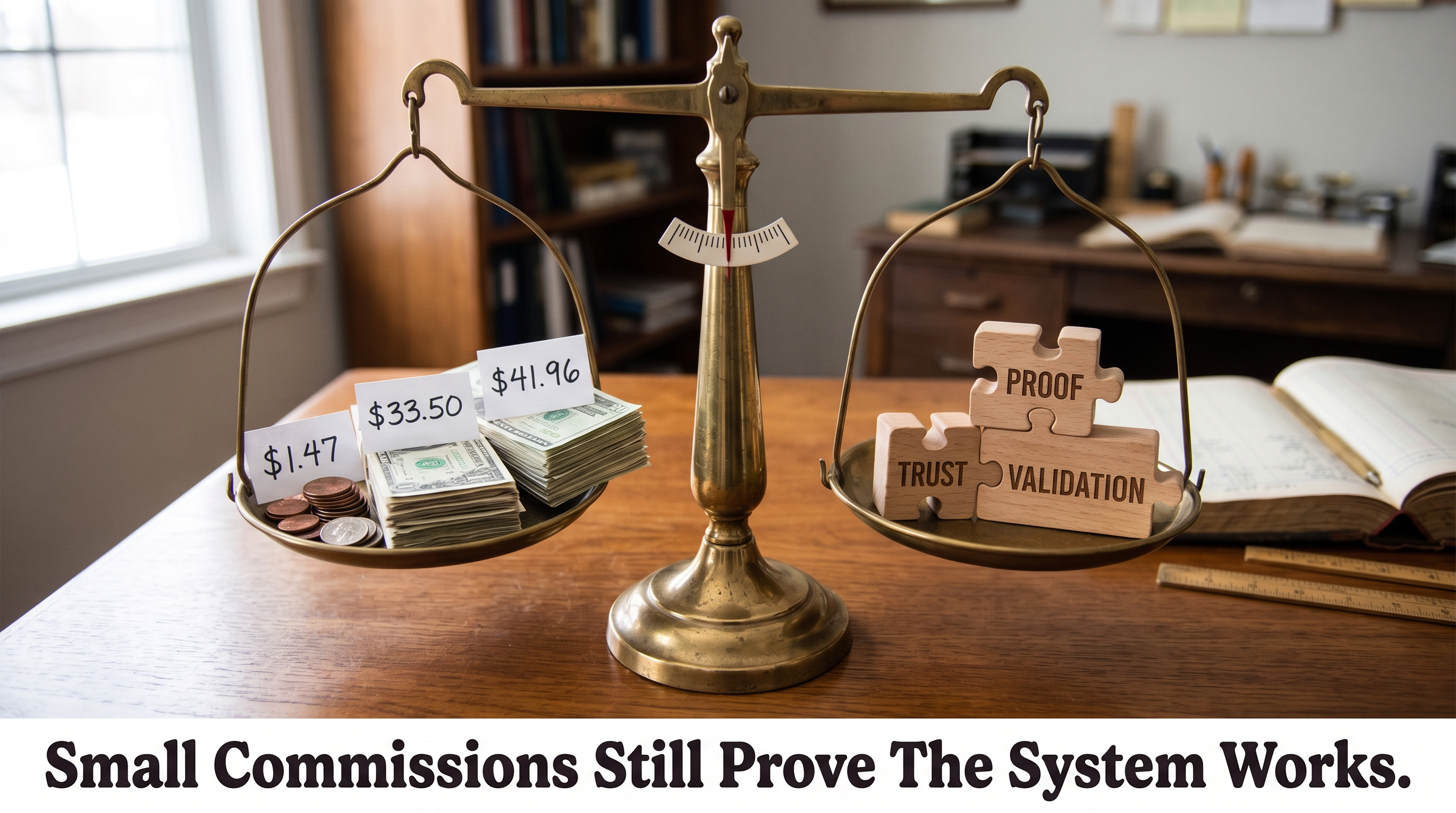
If someone earns $1.47, nobody is quitting their job. If someone earns $33.50, that does not pay the rent. If someone earns $41.96, that is not a financial freedom story.
But that is exactly why those numbers matter.
They are not impressive enough to fake. They are not flashy enough to brag about. They are not the kind of numbers that make people jealous.
They are just real.
My AllStays affiliate earnings showed a total of $41.96.
That number is not life-changing.
But it proves something happened.
Someone found my content. Someone clicked. Someone trusted the recommendation enough to take action. The system worked.
Same thing with Impact.
At one point, my current balance showed $33.50.
Again, not huge.
But real.
AWIN showed a payable balance of $1.47.
Some people would laugh at that.
I do not.
Because $1.47 proves the same basic mechanism as $147.
The amount is different. The principle is the same.
A person found content, clicked a link, and a commission was tracked.
That matters.
CJ also showed a small balance. Rakuten has produced little to no results for me so far.
And I think that belongs in this article just as much as the wins.
Because the honest version of online income includes dashboards that barely move.
The Dashboard Nobody Wants To Talk About
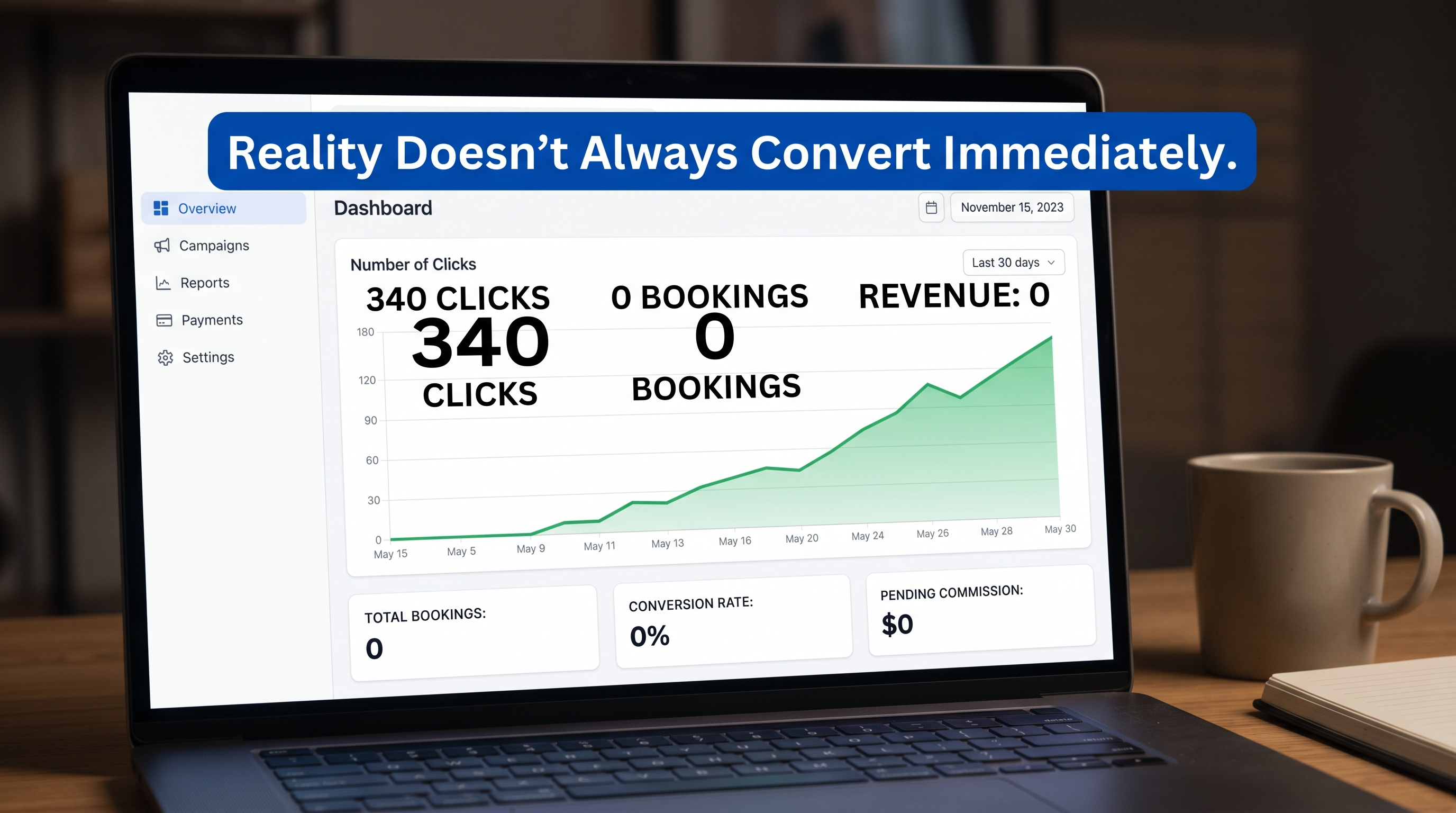
Here is one of the most honest pieces of proof I can give you.
TravelPayouts showed 340 clicks for the current month.
And 0 bookings.
That is not the kind of thing most people would put in a “make money online” article.
But I think it is one of the most important parts.
Because 340 clicks means something is working.
People are seeing the content. People are engaging. People are interested enough to click.
But 0 bookings means something else is not working yet.
Maybe the offer is not right. Maybe the timing is wrong. Maybe the reader is still researching. Maybe the travel season has not lined up with the content yet. Maybe the article attracts dreamers more than buyers.
This is the part of online business that rarely gets talked about honestly.
Clicks are not cash. Traffic is not income. Attention is not conversion. But attention is still valuable because it tells you where the work needs to happen next.
This is why I do not trust people who only show the winning dashboards.
The dashboards that do not convert are where you learn the most.
The $600 Contest Win That Changed How I Looked At Content

One of the clearest examples I have that online income can come from unexpected places was my LegalShield contest win.
LegalShield held an affiliate content contest.
The prizes were simple:
I entered with an article called Legal Protection For RVers.
That topic made sense for me.
I had experience in the RV space. I understood the lifestyle. I knew RVers deal with more than campgrounds and scenic views.
There are real-world issues that can come up when you live on the road, travel across provinces or states, buy and sell vehicles, deal with service problems, or try to understand legal documents.
So I wrote the article from that angle.
Not as some dry legal pitch.
Not as a generic affiliate article.
I wrote it for a real audience with a real use case.
The result?
I won 2nd place, and the prize was $600 paid through Impact.
That was a big moment for me.
Not because $600 made me rich.
It did not.
But because the money did not come from a direct affiliate sale.
It came from quality content.
That matters.
Most people think online income only happens when someone clicks your link and buys something.
That is one path.
But it is not the only path.
Good content can create opportunities you did not expect. It can get noticed by affiliate managers. It can win contests. It can open conversations. It can build credibility.
That contest win taught me something important:
Sometimes the article is the asset before it ever earns a commission.
The $34 Viator Commission That Took Months To Arrive
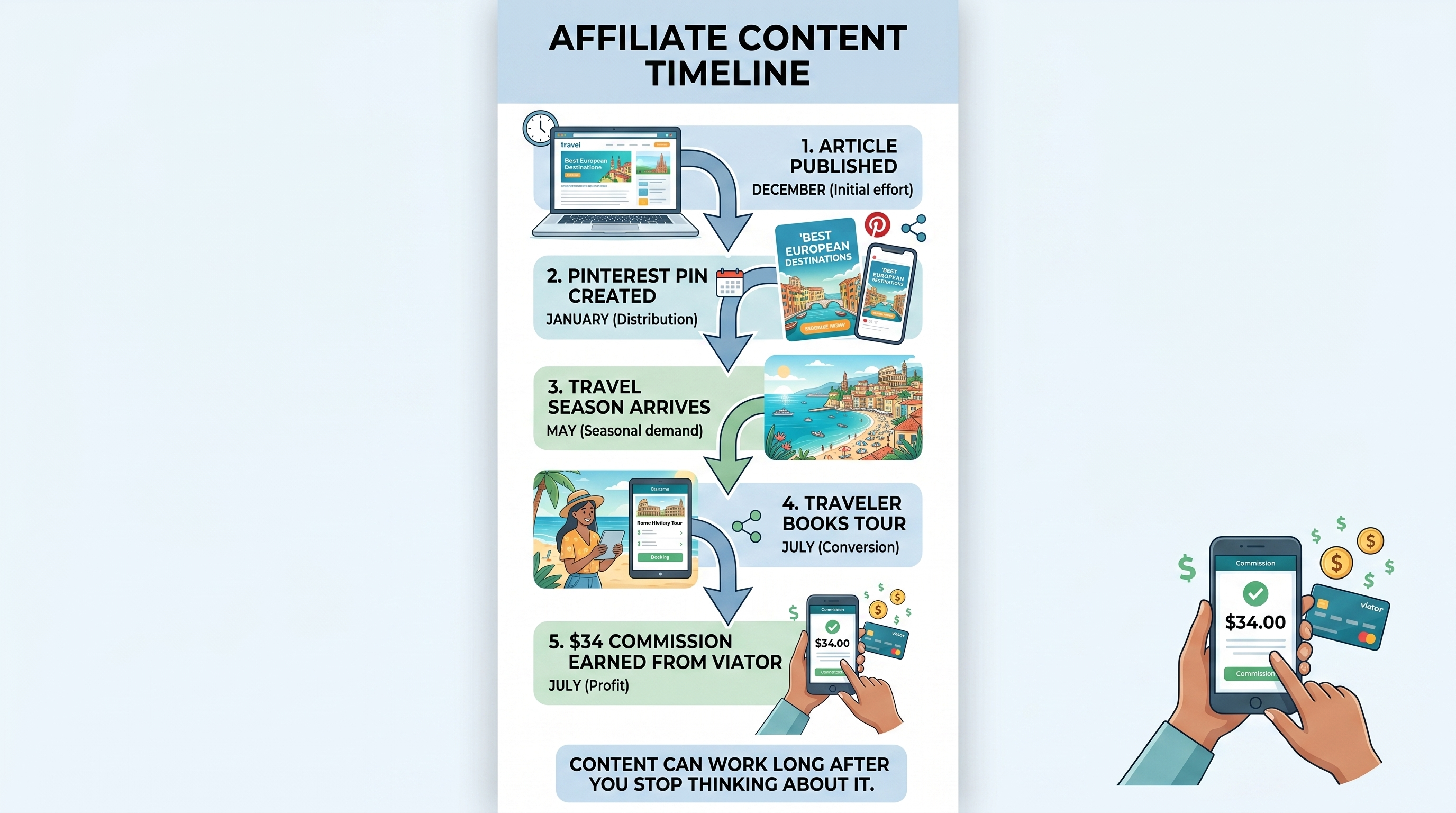
Another example came from Viator.
I wrote about this in a Wealthy Affiliate post called What Happened In December.
The short version is this:
I wrote a travel-related article in December. At the time, it did not feel like anything dramatic happened.
Later, a Pinterest pin was created.
Then travel season came around.
Eventually, one traveler booked through my link.
The sale value was approximately $420.
The commission was approximately $34.
Again, not retirement money.
But that commission told a much bigger story.
The article kept working after I had moved on.
The pin kept circulating after it was created.
The link stayed in place.
The content waited for the right person at the right time.
That is one of the most powerful things about digital assets.
You can write something once, improve it over time, share it in multiple places, and it can still create value months later.
That does not mean every article will do that.
Most will not.
Some articles sit there and do almost nothing. Some get traffic but no clicks. Some get clicks but no commissions.
Some surprise you months later.
That is why consistency matters.
You are not just writing one article.
You are building a library of chances.
Digital Assets Compound Slowly
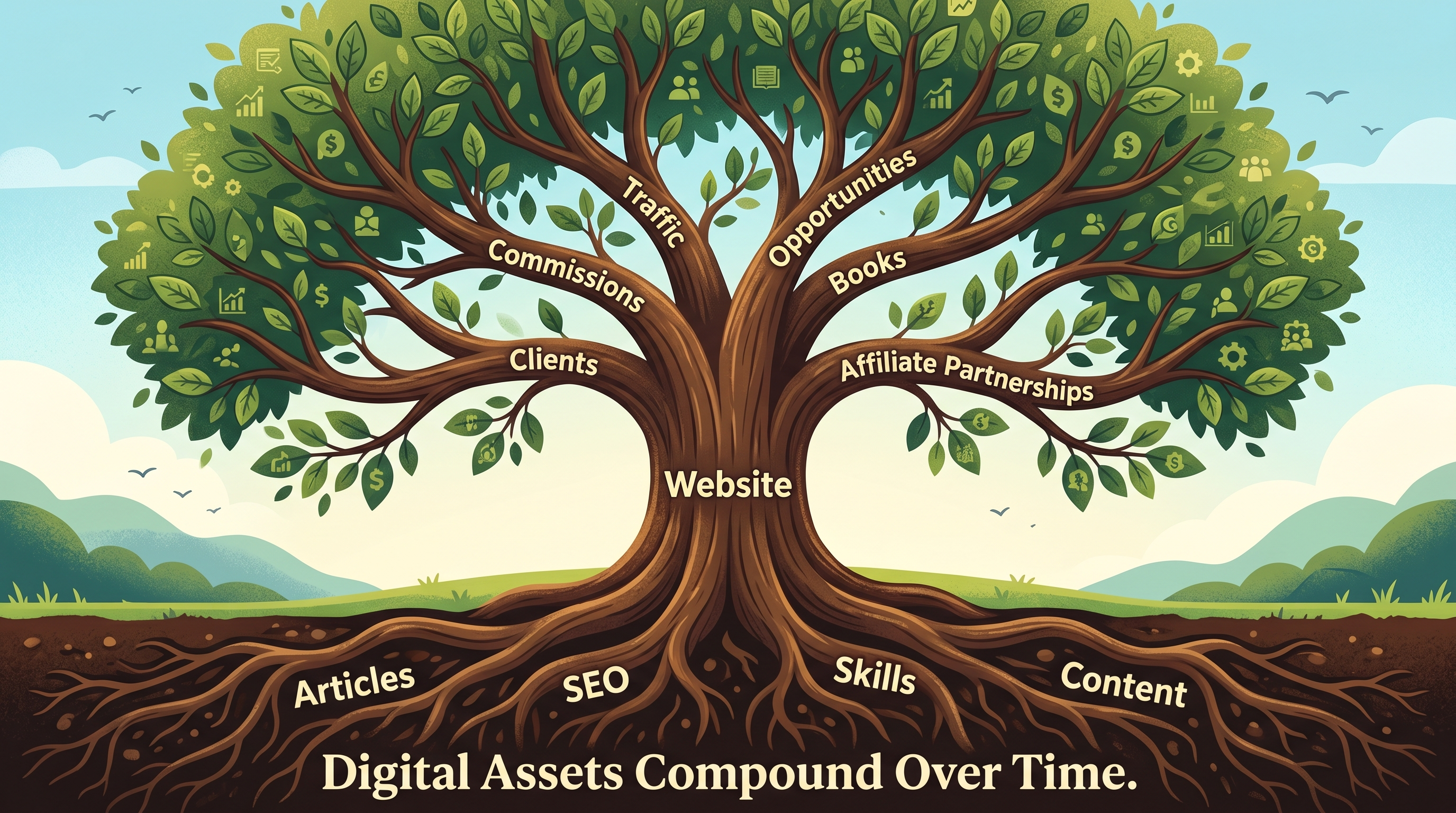
The hardest thing about building online is that the results are rarely instant.
You can spend hours writing an article and get nothing. You can publish a page and hear silence. You can join an affiliate program and see no sales.
But over time, assets start to stack.
One article becomes ten. Ten becomes fifty. Fifty becomes a site with topical authority.
A site becomes a portfolio.
A portfolio becomes proof that you know how to build.
That proof can lead to affiliate commissions, but it can also lead to other things.
It can lead to business conversations, client opportunities, partnerships, confidence, and new assets.
Affiliate disclosure: As an Amazon Associate I earn from qualifying purchases.
During this journey, I also published Freedom Is The New Rich.
I am not mentioning that as a sales pitch.
I am mentioning it because digital publishing became another asset I created along the way.
Before building websites, writing articles, learning affiliate marketing, and documenting this journey, that book likely never happens.
The book is not separate from the journey.
It is part of the proof.
Writing becomes content. Content becomes a website. A website becomes authority. Authority becomes opportunity. Opportunity becomes another asset.
That is how this compounds.
Slowly. Messily. Often without applause.
But it does compound.
I Am Not The Only One Seeing This
One reason I still believe in this path is because I have seen other people experience the same pattern.
Not always in huge numbers. Not always quickly. But consistently enough that the pattern becomes hard to ignore.
Inside Wealthy Affiliate, I have seen stories that line up with my own experience.
ScottyOG wrote about making his first $8 sale thirteen years ago.
Eight dollars.
That is the kind of number most people would ignore.
But to someone building from zero, that first sale is not about the amount.
It is about proof.
Again, not fake guru money.
Real beginner proof.
MagiStudios shared how online skills and vibe coding created a $500 opportunity.
That matters because it shows something beyond affiliate commissions.
Skills can create income in different ways.
John Maluth wrote about how a single blog post generated his first $100 affiliate commission.
That is the same principle again.
One useful article can become an income-producing asset.
BoomerGP08 has written about making close to $4,000 a month in a niche.
That is what long-term consistency can look like after the foundation is built.
And MagiStudios also shared a bigger breakdown about earning $536,306.06 by following three strategies, with the key idea being simple but powerful:
Brand + Problem + Solution.
That is really what this whole thing comes down to.
You build a brand. You help solve problems. You connect people with solutions.
Sometimes that earns money. Sometimes it earns trust first. Sometimes trust becomes money later.
What The Failures Proved
I do not want this article to sound cleaner than the journey actually was.
There have been plenty of failures.
Articles that did not rank. Affiliate programs that went nowhere. Links that received no clicks. Clicks that created no sales. Products I tested and later ignored. Ideas that felt exciting for a week and then fizzled out.
This is normal.
It is also valuable.
Every failed article teaches something. Every dead affiliate link teaches something. Every low-converting page teaches something. Every empty dashboard teaches something.
Beginners often think failure means the whole thing does not work.
But online business is more like testing than guessing.
You publish. You measure. You adjust. You improve. You try again.
That process is where the skill is built.
And once you have the skill, you are not starting from zero anymore.
So What Counts As Proof?
1. A Website That Exists Because You Built It
That matters.
Most people never build anything. They think about it, talk about it, watch videos about it, and then never publish.
A live website is proof that you moved from idea to asset.
If you are still at that stage, my guide on how to start an affiliate website with no experience is a good place to begin.
2. A Skill You Did Not Have Before
Learning to write a useful article is proof. Learning SEO is proof. Learning how to structure a page is proof. Learning how to create content that solves a problem is proof.
Those skills can move with you.
They are not trapped inside one website.
3. Traffic From Real People
Traffic is not income.
But traffic proves attention.
If people are finding your content, something is happening.
From there, you can improve the offer, the call to action, the page layout, and the content itself.
If traffic is the current problem, I wrote a separate guide on how to build traffic to a new affiliate website without paying for ads.
4. A Click
A click is small, but it matters.
A click means someone trusted you enough to leave your page and check out the thing you recommended.
That is not nothing.
5. A Commission
Whether it is $1.47, $8, $34, $41.96, $209, or $600, a commission proves the mechanism can work.
The next challenge is improving consistency.
6. An Opportunity
The LegalShield contest win proved this for me.
Good content can create opportunities beyond standard affiliate sales.
That is why I care so much about writing quality.
If you want to see how I approach content, I broke down my process here: How I Write Blog Posts That Actually Rank.
7. A Digital Asset You Own
A website is an asset. A ranking article is an asset. An email list is an asset. A book is an asset. A collection of helpful content is an asset.
Even if it is not producing massive income today, it can still have future value.
Does Making Money Online Actually Work?
Yes.
But not in the way most people are sold.
It does not work like a magic button. It does not work just because you bought a domain. It does not work just because you joined an affiliate program. It does not work just because you published one article and waited.
It works when skills, content, traffic, trust, timing, offers, and persistence start lining up.
Sometimes that produces small commissions.
Sometimes it produces bigger commissions.
Sometimes it produces contest wins.
Sometimes it produces opportunities.
Sometimes it produces nothing for a while, but still teaches you what to fix.
That is the honest answer.
Making money online works.
But it usually works slower, messier, and less dramatically than people want it to.
And honestly, that might be a good thing.
Because if it were as easy as the gurus claim, everyone would do it.
The barrier is not technology.
The barrier is patience, consistency, and being willing to build before the results show up.
What I Would Tell A Beginner Today
If someone asked me whether they should try making money online, I would not tell them to quit their job.
I would not tell them to bet everything on a blog.
I would not tell them they will be rich in six months.
I would tell them this:
Start because you want to learn skills that can pay you for years. Start because you want to understand how websites, content, SEO, affiliate marketing, and digital publishing work. Start because building an online asset is better than only consuming online content.
Start because even a small win can prove that you are capable of more.
Start because the internet rewards useful content, even if it does not reward it immediately.
And start with the right expectations.
You are not building a lottery ticket.
You are building a skill stack, a content library, a digital asset, and proof.
That is also why I continue to recommend learning inside a platform like Wealthy Affiliate, not because it magically makes money for you, but because it gives beginners structure, training, tools, hosting, community, and a place to start building real skills.
You can read my full honest breakdown here: Wealthy Affiliate Review: The Real Story For Beginners Who Want Digital Skills That Pay.
I also keep a running list of tools and resources I use here: Tools And Resources.
The Final Answer
The proof that making money online works is not one screenshot.
It is not one commission.
It is not one viral post.
It is not one lucky article.
It is the pattern.
For me, the pattern looks like this:
I built websites. I learned skills. I wrote content. I earned small commissions. I had dashboards that did nothing. I had clicks that did not convert. I won a $600 content contest. I earned a Viator commission months after publishing. I created a book. I built relationships. I created digital assets that did not exist before.
That is the proof.
Not that I became rich overnight.
Not that every article worked.
Not that every affiliate program paid.
But that the process is real.
The skills are real. The opportunities are real. The commissions are real. The failures are real too.
And strangely enough, that makes me trust the whole thing more.
Because real business has both.
Wins and misses. Clicks and dead ends. Small commissions and empty dashboards. Unexpected payouts and long quiet stretches.
The biggest thing online business gave me was not a commission.
It was ownership.
Ownership of skills. Ownership of content. Ownership of websites. Ownership of digital assets. Ownership of future opportunities.
So if you are looking for proof that making money online works, do not start by looking for someone else’s luxury lifestyle.
Look for the assets.
Look for the skills.
Look for the boring little wins.
Look for the honest failures.
Look for the person still building after the hype wears off.
That is where the real proof usually is.
FAQ: Making Money Online Proof
Does making money online actually work?
Yes, making money online can work, but usually not in the fast or easy way many people advertise. In my experience, it works when useful content, digital skills, traffic, trust, and the right offers come together over time.
What is the first real proof that affiliate marketing works?
The first real proof is often not a large commission. It may be a click, a small sale, a first affiliate approval, a ranking article, or a reader taking action because of something you created.
Do small affiliate commissions matter?
Yes. Small commissions matter because they prove the mechanism works. A small commission is not life-changing, but it shows that tracking, trust, content, and affiliate links can connect.
Why do some affiliate dashboards get clicks but no sales?
Clicks without sales can happen for many reasons. The offer may not match the audience, the timing may be wrong, the reader may still be researching, or the page may need a stronger call to action.
Is affiliate marketing still worth learning?
Yes, if you treat it as a long-term skill and asset-building process. The biggest value is not only commissions. It is learning writing, SEO, content creation, analytics, digital marketing, and online business strategy.
What should beginners focus on first?
Beginners should focus on building one useful website around a specific audience and problem. Learn how to publish helpful content, attract traffic, and connect readers with relevant solutions.


Leave a Reply