
Last Updated on June 25, 2026 by Jeremy
Affiliate disclosure: This article includes affiliate and referral links. If you click through and make a purchase, sign up, or take a qualifying action, I may earn a commission or referral reward at no extra cost to you.
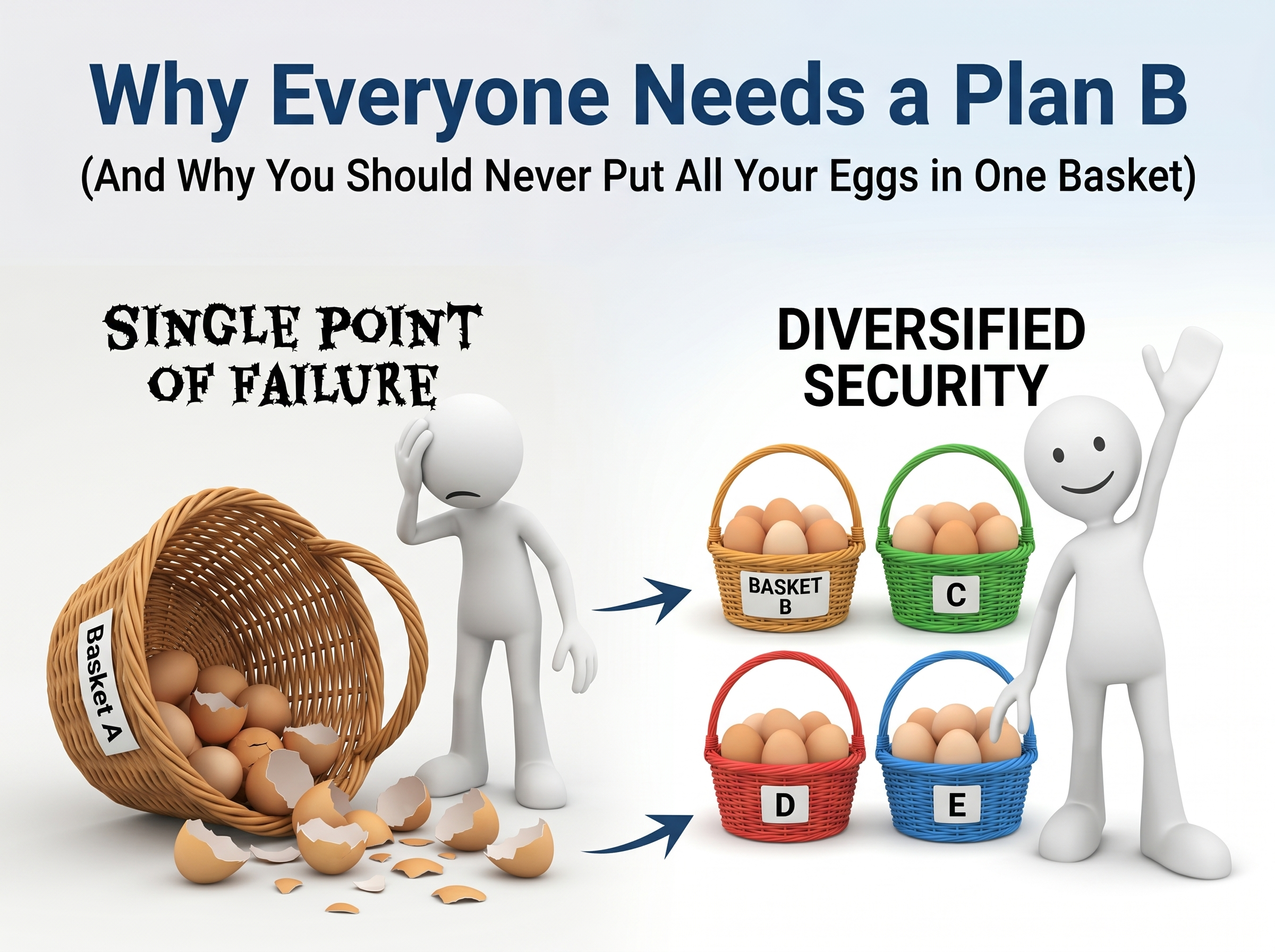
There is a saying most of us have heard our entire lives: do not put all your eggs in one basket. It sounds simple enough. Do not rely on one thing. Do not risk everything on one opportunity. Do not assume that one job, one business, one platform, one income stream, or one plan will always be there.
I understood that saying on the surface for years, but I do not think I fully understood it until recently. Four years ago, I thought I was building my Plan B. I thought affiliate marketing was the backup plan. I thought building websites was the escape route. I thought if I kept writing, publishing, learning, testing, and improving, eventually the compounding would catch up.
And to be clear, I still believe that. In fact, I believe it more now than I did when I started. But what I did not fully understand at the beginning was that a Plan B is not only about building a dream. Sometimes a Plan B is what buys you enough time to keep the dream alive.
This is not one of those articles where I pretend everything worked perfectly. It did not. This is the real version. The version where I started with network marketing, moved into affiliate marketing, built several websites, hit one of the hardest financial stretches we have faced four years later, started delivering groceries, launched a local service business, and somehow became even more convinced that building online still matters.

I did not build websites because I thought life would be easy. I built websites because I knew one day life probably would not be.
Quick Answer: Why Does Everyone Need a Plan B?
Everyone needs a Plan B because life can change faster than your income, job, business, or original plan can adjust. A good Plan B is not about expecting failure. It is about building skills, assets, and backup income options before you desperately need them.
- Plan A: the path you are currently relying on.
- Plan B: the backup option that gives you flexibility if life changes.
- Big mistake: putting all your eggs in one basket and hoping nothing shakes it.
- My approach: build skills, build assets, and build options while continuing the journey.
What Does “Don’t Put All Your Eggs in One Basket” Really Mean?
The phrase “do not put all your eggs in one basket” means you should not rely on one single option so heavily that if it breaks, falls apart, disappears, or stops working, everything else collapses with it. Most people think of this phrase in terms of investing, but I think it applies to much more than money in the stock market.
It applies to careers, income, business, family decisions, online platforms, and your future. If your entire financial life depends on one job, one employer, one customer, one platform, one algorithm, one business model, or one opportunity, then whether you realize it or not, you have a basket problem.
That does not mean the basket is bad. A job can be a good basket. A business can be a good basket. Affiliate marketing can be a good basket. Self-employment can be a good basket. The problem starts when it is the only basket.

Looking back, I can see that I have spent the last several years trying to build more baskets. Some worked. Some did not. Some were slow. Some taught me lessons I needed before the next one made sense. That is where this story really begins.
My First Basket
Before affiliate marketing, I started with LegalShield around 2020 and 2021. At the time, I believed network marketing could become my path forward. I liked the idea of helping people, building relationships, and creating something that could grow beyond a regular paycheck.
I do not look back at that chapter as a waste. It taught me how to talk to people. It taught me how uncomfortable selling can feel when you are still finding your voice. It taught me that belief matters, but belief by itself is not enough. It also taught me that I did not want my entire future tied to recruiting, meetings, follow-ups, and trying to convince people to join something they may not fully understand yet.
That experience eventually helped me understand the difference between MLM and affiliate marketing, which I later wrote about here: Understanding the Differences Between MLM and Affiliate Marketing.
The biggest lesson from that first basket was simple: I wanted leverage, but I wanted it in a way that fit my personality and lifestyle. I did not want to constantly chase people. I wanted to build something people could find.
Building a Better Basket
In October of 2022, I started building websites. Not one website. Several. Looking back, some people might say I went too wide too fast, and maybe they are right. But I was learning. I was testing. I was trying to figure out what I was capable of building.
I started writing blog posts, learning SEO, testing affiliate programs, building pages, fixing designs, breaking things, rebuilding things, and slowly understanding how content could become an asset. That word matters: asset.
That is what attracted me to affiliate marketing in the first place. With MLM, I felt like I always had to keep moving people through conversations. With affiliate marketing, I could write something once and potentially have it help people over and over again. A blog post could rank. A review could bring in traffic. A helpful guide could earn trust. An affiliate link could produce a commission long after the original work was done.

I have written before about the proof that making money online can work, and I still stand by it. You can read that article here: What Proof Is There That Making Money Online Actually Works?.
But proof does not mean fast. Proof does not mean smooth. Proof does not mean easy. Proof does not mean you will never need another income stream while the online business grows. That is the part I had to learn the hard way.
I Thought Success Would Be Linear
When I first started building online, part of me imagined the path would be fairly straightforward. Not instant. Not overnight. But at least somewhat predictable. Write articles, get traffic, earn commissions, scale up, repeat.
That is the clean version. The real version had more bends in the road. In 2022, there was excitement, new websites, big ideas, and a steep learning curve. In 2023, there was more content, more experiments, more mistakes, and more lessons. In 2024, Costa Rica opened new doors and new ideas, but the building continued. In 2025, I was still publishing and still waiting for compounding to become big enough to matter. Then 2026 arrived with financial pressure, Instacart, local service work, affiliate marketing still growing, and the dream still alive.
Most online business stories are packaged after the success has already happened. They start with struggle, skip the long middle, and jump straight to the result. I am still in the middle. That is what makes From 0 to 100K different. I am not writing this from the finish line. I am writing it from the road.
Then Life Tested My Plan
Four years after starting this affiliate marketing journey, we hit one of the most difficult financial stretches we have experienced. That is not easy to admit, especially when you run a site called From 0 to 100K. But if I am going to document the real journey, then I cannot only write about the clean parts.
The truth is, our websites were not dead. They were not useless. They were not failures. They were still growing, still had value, and still had potential. But they were not producing enough income yet to carry everything.
That distinction matters. There is a big difference between something failing and something not being mature enough yet. Our income simply had not caught up to our dreams, and life does not pause while you wait for Google rankings, affiliate commissions, email lists, YouTube channels, or content libraries to compound.

That is when “do not put all your eggs in one basket” stopped being a cute saying. It became real life. I realized I needed more baskets, not because I was giving up on affiliate marketing, but because I needed to protect the future I had already spent years trying to create.
Why I Did Not Want Another Job
When financial pressure hits, the obvious answer is usually to go get a job. I understand why people say that. A job can create stability, predictable income, and breathing room. I am not anti-job.
But for me personally, I knew going back into a traditional job would come with tradeoffs I did not want to make again. We had already spent years trying to build a life with more flexibility. We had lived in an RV, operated parks, traveled through Canada and Costa Rica, and started building websites, brands, and income streams that could eventually support a different kind of life.
So my first instinct was not to find another employer. My first instinct was to find flexible income that would help us survive without completely surrendering the freedom we were trying to build. I have written more about those tradeoffs here: Affiliate Marketing vs 9–5 Jobs: The Real Tradeoffs Nobody Talks About.
That article matters because this is not about pretending jobs are bad. It is about understanding what you are trading: time, flexibility, control, location freedom, energy, and creative ownership.
So We Adapted
This is the part where ego has to get out of the way. It is easy to talk about building websites, online income, freedom, and long-term vision when everything is moving smoothly. It is harder when you are doing grocery deliveries, mowing lawns, trimming yards, answering messages, and then coming home to write another article.
But that is real life, and honestly, I am not embarrassed by it. Some people might look at grocery delivery or lawn work and think I took a step backwards. I do not. I see it as protecting the future I had already spent four years building.

Instacart Became Immediate Cash Flow
One of the first things I started doing was Instacart deliveries. It was not glamorous, passive, or the online business dream people like to talk about. But it solved a real problem. It created income now, gave me flexibility, and allowed me to work around family, writing, websites, and everything else we were trying to manage.
Get It Done Services Became Another Basket
We also started a local service business called Get It Done Services. Mowing lawns, trimming, yard work, small jobs, and the kind of work where you show up, solve the problem, and get paid. There is something grounding about that.
Online business can feel invisible sometimes. With a local service business, the value exchange is immediate. A customer needs a lawn cut, you cut it, and they pay you.
The Websites Never Stopped Working
This is the part I do not want people to miss. While I was delivering groceries, the websites still existed. While I was mowing lawns, the articles were still indexed. While I was trimming yards, older content could still bring in visitors. While I was dealing with real-life pressure, the digital assets I had built did not disappear.
That is why I still believe in affiliate marketing. Because even when it is not enough yet, it can still be working slowly and quietly in the background. That is compounding. It does not always feel exciting while it is happening, but it matters.
The Internet Lied To Me… Sort Of
I do not think affiliate marketing is a scam. I do not think making money online is fake. I do not think building websites is a waste of time. But I do think the internet has made the process look cleaner than it really is.
People love showing the result: the screenshot, the commission, the lifestyle, the polished story. What they do not always show is the middle. The waiting, confusion, bad articles, website rebuilds, failed ideas, months where traffic barely moves, products that do not convert, and personal life pressure that hits while you are still trying to build.
That is the part beginners need to see more often. When people do not expect the middle to be hard, they assume hardship means failure. It does not always mean that. Sometimes hardship just means you need a better structure around the dream: more baskets, more skills, more flexibility, more patience, and more honesty.
I Did Not Build Websites Because Life Was Easy
There is one sentence that sums up this whole article for me:
I did not start affiliate marketing because everything was perfect. I started because I wanted options. I wanted skills that could travel with me. I wanted something that did not depend entirely on one boss, one location, one season, one company, or one paycheck.
When pressure hit, I was not starting from zero. I had websites, skills, content, experience, and a better understanding of SEO, affiliate marketing, writing, branding, and online business than I had four years earlier. Was it enough yet? No. Was it useless? Absolutely not.
That is the nuance most people miss. A Plan B does not have to fully replace your income on day one to be valuable. Sometimes its first job is simply to give you more options than you had before.
My Dream Never Changed
Through all of this, the dream never really changed. The route changed, the timeline changed, the pressure changed, and the income streams changed. But the dream itself stayed alive.
One of the visions my wife and I have talked about is eventually being part of something bigger than websites, side hustles, or surviving month to month. We have looked at the idea of a retreat-style property in Panama: a place connected to nature, purpose, freedom, and a life that actually feels aligned with who we are.

You can see the kind of vision that inspires us here: Tierra Viva Panama.
That dream is not some overnight fantasy. It is a long-term vision, and long-term visions require short-term survival. That is another reason Plan B matters. Dreams are fragile when they only depend on one basket. If one income stream breaks, the dream should not automatically die with it.
My Plan C
At first, I thought the story was simple. Plan A was the traditional path. Plan B was affiliate marketing. But now I see it differently. My Plan C is helping other people build their own Plan B before they desperately need one.
I know what it feels like to be in the middle. I know what it feels like to believe in something that has not fully paid off yet. I know what it feels like to need money now while still trying to protect a bigger vision. I know what it feels like to wonder if you are behind, and I know what it feels like to question whether you should keep going.
Most people do not need more hype. They need a realistic starting point. They need a simple path. They need something that meets them where they are. That is why I started building free Blueprints.
Find Your Own Plan B
Maybe you are reading this as a truck driver. Maybe you are a nurse, teacher, fitness trainer, store manager, salesperson, tradesperson, or someone who is already self-employed but knows your current income still depends too much on your time.
That is exactly why the Blueprint Hub exists. Not to tell everyone to quit their job. Not to pretend online income is instant. Not to sell a fantasy where everything magically works after 30 days. The goal is much simpler than that: help ordinary people start building a second income path before life forces them to.

You do not have to have everything figured out. You do not have to quit your job, risk your savings, or build seven websites like I did. You just need a place to start.
Final Thoughts
I used to think having a Plan B meant admitting Plan A might fail. I do not see it that way anymore. Now I think having a Plan B is one of the most responsible things a person can do.
It is not about fear. It is about options. It is about protecting your family, creating breathing room, building skills that can move with you, and not putting all your eggs in one basket while acting surprised when life shakes the basket.
For me, affiliate marketing is still part of the plan. So is content. So are websites. So is Instacart. So is Get It Done Services. So is the long-term Panama vision. So are the Blueprints. None of those things contradict each other. They are all part of the same mission: build skills, build assets, build options.
The best time to build your Plan B is before you need it. The second-best time is today.
FAQ: Building a Plan B and Creating More Income Options
What does “do not put all your eggs in one basket” mean?
It means you should not rely on one single option so heavily that everything falls apart if that option fails. In life and business, this can apply to relying on one job, one client, one income stream, one platform, one business model, or one investment.
Why is having a Plan B important?
Having a Plan B is important because life is unpredictable. Jobs change, industries shift, expenses rise, businesses slow down, and personal situations can change quickly. A Plan B gives you more options before you are forced into desperate decisions.
Should everyone have multiple income streams?
Most people should at least consider building more than one income stream. That does not mean doing everything at once. It means slowly building skills, assets, or flexible income options so your entire financial life does not depend on one basket.
Is affiliate marketing a good Plan B?
Affiliate marketing can be a good Plan B because it allows you to build content, websites, and digital assets around products or services you recommend. However, it is not instant. It takes time, consistency, traffic, trust, and patience.
How do I start building a backup income while working full-time?
Start small. Pick one skill or business model you can build around your current schedule. That might be affiliate marketing, local services, freelance work, content creation, delivery work, or something else. The key is to start before you urgently need the money.
What if I do not know what business to start?
That is exactly why I created the Blueprint Hub. Instead of giving everyone the same generic advice, the goal is to create career-specific starting points for different people in different situations. Visit the Blueprint Hub and find the path that fits you best.


Leave a Reply