
Last Updated on August 1, 2026 by Jeremy
I am not a software developer. I did not go back to university for computer science, enrol in a coding bootcamp, or spend years pretending I understood every error message that appeared on my screen.
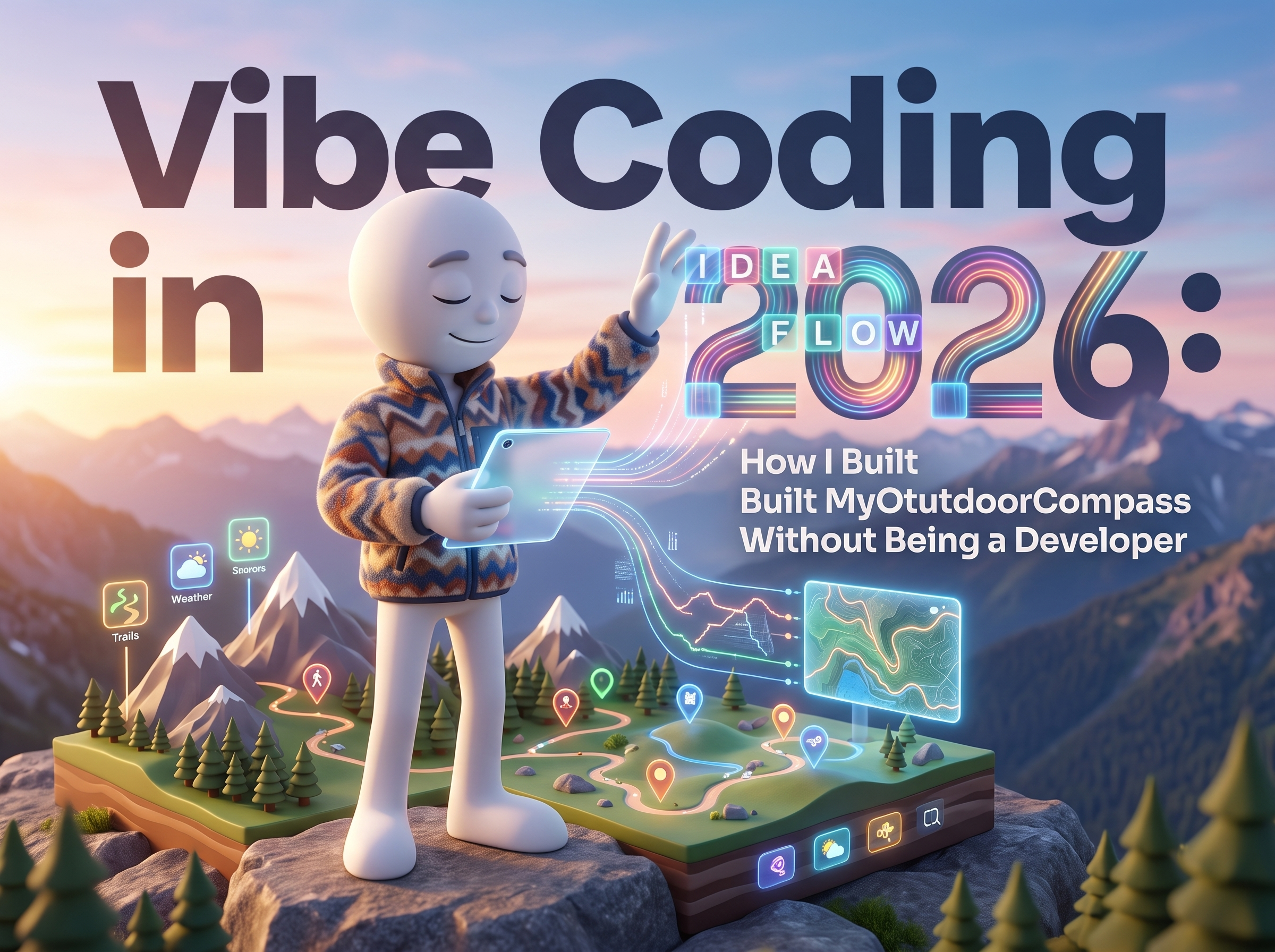
Yet in 2026, I have a working beta of MyOutdoorCompass.com: an AI-powered outdoor decision tool being built to combine questions, personal context and changing travel information in one place.
That does not mean AI built a perfect product while I drank coffee and offered encouragement. It means the barrier between an idea and a working prototype has changed—and so has the definition of who is allowed to build.

Quick Answer: What Vibe Coding Actually Let Me Do
- I turned a problem I understood into a working AI-tool beta without becoming a traditional developer first.
- AI accelerated code generation, but I still had to define the product, test behaviour, connect services, find failures and make judgment calls.
- My Wealthy Affiliate payments from October 2022 through August 2026 total $1,988 USD—roughly $2,800 CAD using a late-July 2026 exchange rate.
- That is dramatically below four years of average Canadian university tuition, but the paths deliver different things and should not be treated as interchangeable credentials.
What Is Vibe Coding?
Vibe coding is the informal name for building software by describing what you want in natural language and letting an AI system generate or change much of the code. Instead of manually writing every function, the builder explains the goal, tests the result and keeps refining it.
That sounds simple because the first ten minutes often are. The deeper work appears after the prototype starts doing real things.
A button can look perfect and connect to nothing. A map can load but misunderstand the user’s route. An AI answer can sound confident while missing the campground restriction that actually matters. Authentication, privacy, database rules, API costs, error handling and live-data freshness do not disappear because the code arrived through a prompt.

University and applied online learning solve different problems. The useful comparison includes cost, time, structure, credentials and actual output.
The Problem Came Before the Code
MyOutdoorCompass did not begin with “I want to make an app.” It came from years of RV travel, four seasons operating parks in British Columbia, winters in Costa Rica and watching how outdoor decisions are scattered across too many places.
A camper may need weather, wildfire status, road conditions, campground fit, vehicle length, park rules, family needs and a backup plan. A search engine can provide links. A normal chatbot can provide a general answer. I wanted something that would ask the missing questions and reason around the person’s actual situation.
That domain knowledge matters. AI knew more programming syntax than I did. It did not automatically know which campground questions frightened a new RVer, why a 32-foot trailer changes route planning, or why “quiet time starts at 10 p.m.” may matter to someone arriving late.
What I Had to Learn to Build MyOutdoorCompass

The Dollar Comparison: University, College or Wealthy Affiliate
Here is the comparison I wanted to see for myself. These are planning estimates, not promises about the cost of any individual school. Tuition varies by province, institution and program, and none of the university figures below includes housing, food, transportation, books, student fees or interest.
Statistics Canada’s 2025/26 averages put Canadian undergraduate tuition at $7,734 per year across all fields, $7,878 for mathematics, computer and information sciences, and $8,618 for business, management and public administration.
| Learning route | Illustrative tuition or platform cost | Typical time | What it is designed to provide |
|---|---|---|---|
| Computer science degree | About $31,512 CAD over four years at the 2025/26 field average | 4 years | Deep computing foundations, assessed coursework, peers, faculty access and a recognized degree. |
| Business or marketing degree | About $34,472 CAD over four years at the 2025/26 field average | 4 years | Business theory, accounting, marketing, management, structured evaluation and a credential. |
| Web-development diploma | Government guidance places domestic post-secondary tuition broadly between $2,500 and $11,400 per year; program pricing varies widely | Often 2 years | More concentrated technical training, assignments, instructor support and a diploma. |
| Digital-marketing certificate or diploma | Commonly falls within the same broad Canadian post-secondary range, depending on school and length | Several months to 2 years | Structured exposure to marketing channels, campaign planning, analytics and assessment. |
| My WA path | $1,988 USD paid from Oct. 2022 to Aug. 2026; roughly $2,800 CAD at a late-July 2026 exchange rate | Nearly 4 years, while building | Training, websites, hosting, keyword research, community, publishing tools and a place to apply lessons immediately. |
The four-year degree estimates multiply one year of 2025/26 average tuition by four for illustration. Real tuition changes annually. The WA total reflects Jeremy’s stated four $497 USD annual payments and does not include every separate tool or business expense.
What the Numbers Do Not Show
A degree carries a credential
If I wanted a job requiring a computer science degree, a regulated profession, campus recruiting or a formal academic pathway, Wealthy Affiliate would not replace university. Building MyOutdoorCompass does not make me qualified to design an aircraft control system or apply for every software-engineering position.
Applied learning creates output earlier
With the WA path, I could publish while learning. I built websites, researched keywords, created content, tested affiliate offers, learned enough HTML and CSS to customize pages, and eventually began building a more ambitious tool. The feedback came from real pages and real users instead of waiting until graduation to begin.
Opportunity cost cuts both ways
University can require full-time years that could otherwise be spent earning. Self-directed learning can consume hundreds of unfocused hours without delivering a credential. Cheap learning is not valuable if the student never applies it.
My Actual Vibe-Coding Process
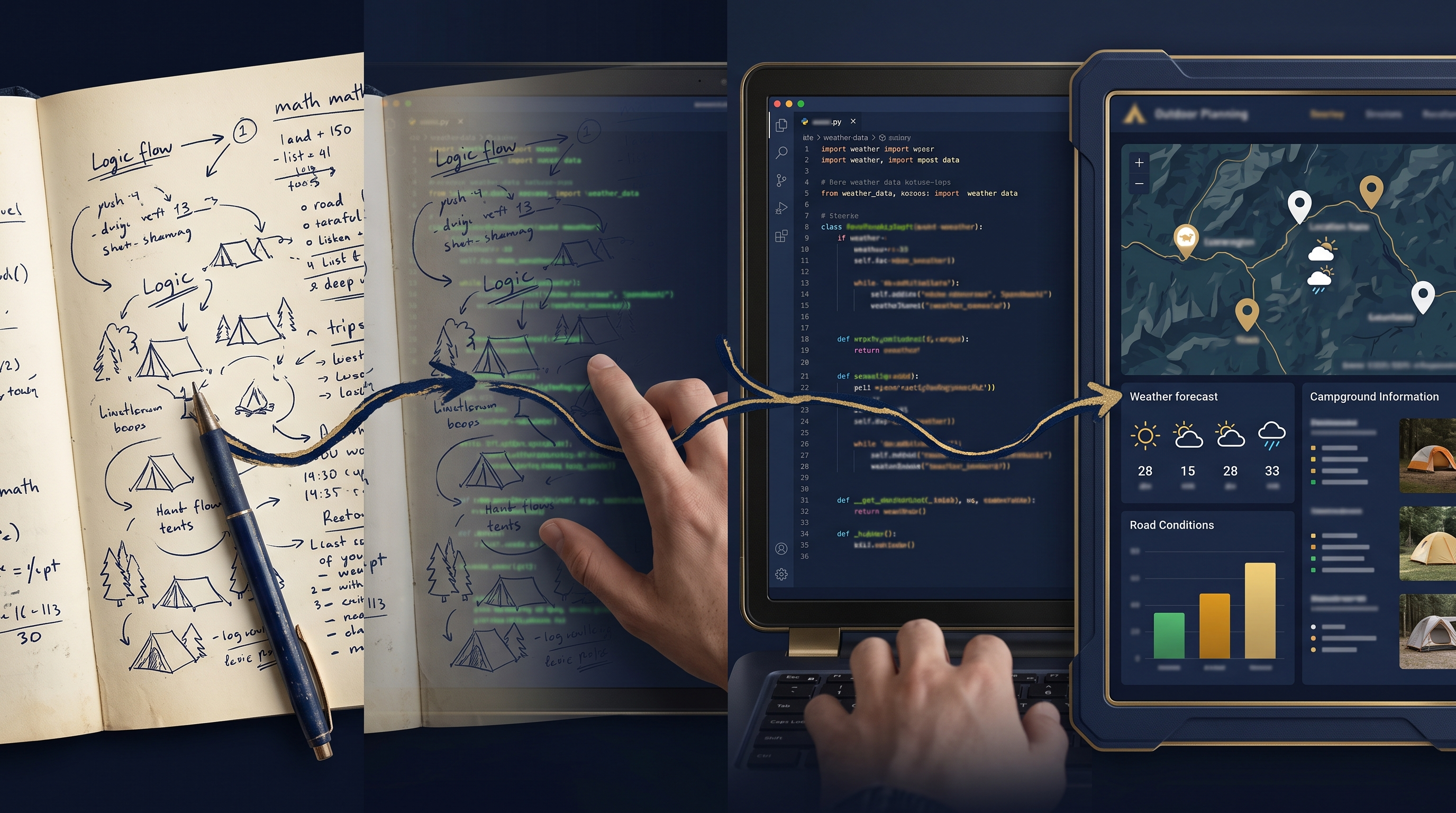
- Define one user problem. I start with the decision the person is trying to make, not the feature I want to show off.
- Describe the intended behaviour. What should the system ask, remember, verify and refuse to guess?
- Generate a small working version. The first goal is a testable loop, not a giant finished platform.
- Try to break it. I test strange questions, missing information, mobile layouts, follow-up logic and bad data.
- Inspect the failure. Sometimes the prompt is wrong. Sometimes the code is wrong. Sometimes the product assumption is wrong.
- Connect real services carefully. Every API adds value and another thing that can fail, cost money or become stale.
- Repeat without pretending it is done. MyOutdoorCompass is a working beta moving quickly toward live operation—not a finished authority.
Where AI Helps—and Where It Can Hurt
A 2026 study of 162 vibe coders found that non-coders, novices and professionals all recognized limitations, but their ability to verify and debug differed. That matches my experience. AI can make software creation more accessible without magically distributing software-engineering expertise.

Why This Connects to the New Economy
In The Economy Changed. Most Career Advice Did Not, I argued that the better question is no longer only “What career should I choose?” It is also “What skills, assets and options am I building so I can adapt?”
MyOutdoorCompass is one answer to that question. It combines domain experience, writing, affiliate marketing, websites, AI, APIs, user behaviour and a willingness to keep learning.
None of those skills alone guaranteed the product. Stacked together, they made the idea possible.

Should You Learn This Way?
Choose university when the credential, depth, network or profession requires it. Choose a diploma when you want concentrated structure and instructor accountability. Choose an applied platform when you are ready to attach learning to a real project immediately.
The smartest answer may be a combination. Formal education and independent building are not enemies. The mistake is paying for any path without knowing what result you expect it to produce.
Build Something Small Before You Build Something Huge
You do not need to start with an AI decision engine. Start with one website, one audience and one useful problem. The skills compound from there.
Try Wealthy Affiliate Free Start From Zero See MyOutdoorCompassFrequently Asked Questions
Can a non-developer really build an app with AI?
Yes, especially a prototype or focused tool. Production software still requires testing, security, data controls, maintenance and the judgment to recognize unreliable output.
Is vibe coding the same as learning to code?
No. Vibe coding can teach concepts and help a beginner work with code, but generating code is not the same as mastering computer science or software engineering.
Does Wealthy Affiliate replace a university degree?
No. It provides applied online-business training, websites, hosting, research tools and community. It does not award a computer science, business or marketing degree.
How much did Jeremy pay Wealthy Affiliate?
Jeremy paid four annual payments of $497 USD from October 2022 through the current term, totalling $1,988 USD before his October 2026 renewal.
What is MyOutdoorCompass?
It is Jeremy’s working AI-powered outdoor decision-tool beta, designed to combine personal context with useful travel and outdoor information. It is evolving quickly and is not a substitute for official emergency sources.

Leave a Reply