
Last Updated on September 19, 2026 by Jeremy
If you want to fail at affiliate marketing, the instructions are surprisingly simple: pick whatever pays the biggest commission, publish content you would never read, recommend products you do not understand, check your rankings every morning and quit before the work compounds.
That is the reverse-psychology version. The more useful answer to why affiliate marketing fails for beginners is that small, reasonable-looking habits slowly build a website nobody trusts. Here are 12 of them—and what to do instead.

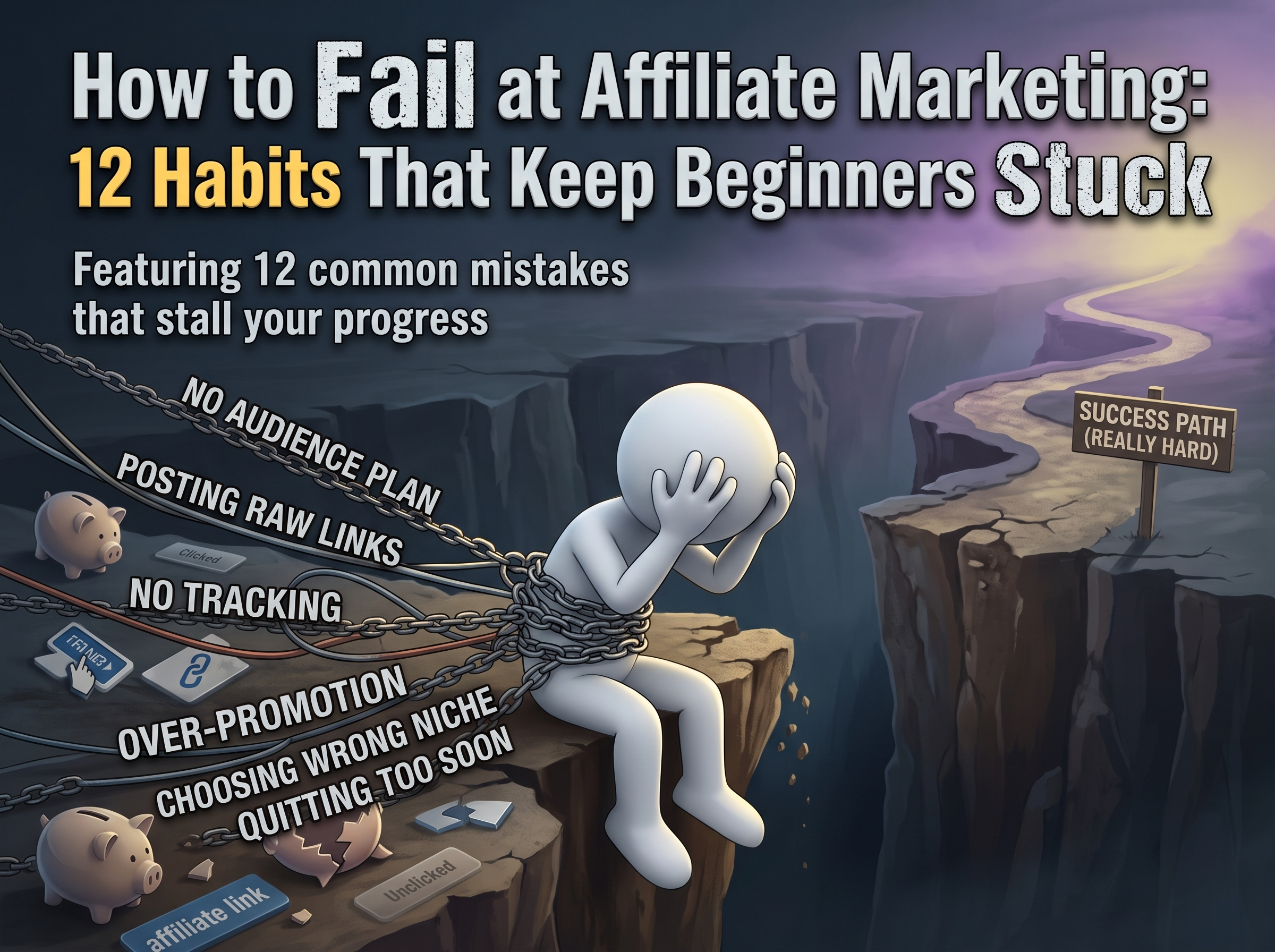
Image transparency: The four editorial business images in this article were generated with AI to represent common affiliate-marketing work situations.
The short version: Affiliate marketing is not a shortcut around building a useful business. It is a way to earn from recommendations after you attract the right audience, solve real problems, disclose your relationship and help readers make a decision. Remove the usefulness or the trust, and the link has very little to work with.
1. Choose a niche for commission, not credibility
The fastest way to hate your new business is to choose a topic only because a product pays well. You soon discover that you cannot answer follow-up questions, create original examples or sustain the work after the first burst of enthusiasm.
Do instead: Choose the overlap between problems you can keep exploring, people you understand and products that genuinely help. You do not need to know everything on day one, but you need enough curiosity to become more useful each month.
2. Build five businesses before one earns attention
Logos, domains and new ideas feel productive because they offer quick completion. Improving one old article, collecting better evidence and building an email sequence feel slower. Beginners often restart at the exact moment the less glamorous work is about to teach them something.
I am building multiple sites, so I know the temptation firsthand. The lesson is not that several sites are impossible. It is that each one needs a distinct audience, publishing rhythm and reason to exist. My seven-websites experiment is documentation—not proof that everyone should copy the workload.
Traffic problem
No clear topic cluster, no internal path and too many abandoned subjects.
Trust problem
No firsthand detail, weak disclosure and recommendations that sound interchangeable.
Business problem
No measurement beyond page views, so effort cannot improve intelligently.
3. Publish keywords instead of answers
A keyword can reveal demand. It cannot replace the experience of the reader who searched it. If an article repeats the phrase, summarizes competitors and avoids every difficult decision, it may be optimized for a query while still being useless to a human.
Google’s own guidance asks creators to make helpful, reliable, people-first content. That means answering the next question, showing limits, identifying who the advice is for and leaving the reader better equipped to act—even if they never click an affiliate link.
4. Let AI remove the reason to trust you
AI can help organize research, identify missing questions, compare structures and edit a rough draft. It can also produce confident errors, generic claims, invented experience and dozens of articles with no recognizable author behind them.
The problem is not simply that AI touched the page. Google’s published guidance focuses on quality and purpose rather than banning a production method. The failure happens when automation is used to scale content whose main purpose is ranking, while nobody verifies the facts, tests the product or adds original value.
A useful AI rule: If the tool could write the same article for a stranger with a different site name, you have not added enough of yourself yet. Verify every factual claim, remove invented certainty and explain what you personally observed, tested, compared or still do not know.

5. Recommend products you have not investigated
A review made from a sales page is an advertisement in disguise. If you cannot test the product, be explicit about that limitation and do deeper research: documentation, support policies, pricing terms, credible user feedback and real alternatives.
Original reviews should help someone decide who should buy, who should not and what could disappoint them. That is the standard behind my Rank Math Pro review and comparison: features matter, but so do fit, workflow and the reasons a reader might stay with the free version.
6. Hide the affiliate relationship
A vague disclosure in a footer does not repair a sales-heavy page. Tell readers clearly and near the recommendation when you may earn from a link. The FTC’s endorsement guidance centres on disclosing material connections clearly and conspicuously.
Disclosure does more than satisfy a rule. It gives the reader the information needed to judge your recommendation. If a business model collapses when the audience understands it, the business never had enough trust.
7. Link every product and guide no decision
Twenty buttons do not create twenty times the chance of a sale. They often signal that the page does not know what action matters. Each article needs a job: explain, compare, troubleshoot, review or help the reader choose.
Do instead: Match the offer to the reader’s stage. An early educational page may link to a deeper comparison. A review can present one primary next step and a credible alternative. A troubleshooting article should solve the problem before promoting a replacement.
8. Measure rankings and ignore the business
A top-ten ranking for the wrong intent can earn nothing. A smaller page that produces qualified clicks, email signups or enquiries may be far more valuable.
| Signal | What it may tell you | Question to ask next |
|---|---|---|
| Impressions rising | Search engines are testing the page | Does the title match the actual answer? |
| Traffic but no clicks | Offer, placement or intent may be wrong | Is there a logical next step? |
| Clicks but no sales | Audience or merchant page may not convert | Are visitors informed and qualified? |
| One article converts | A problem or format is working | What related decision can you help with? |
| Updates improve results | Maintenance has measurable value | Which older pages deserve attention? |
9. Buy tools to avoid the uncomfortable work
A plugin cannot supply a point of view. A keyword tool cannot make a weak answer trustworthy. A course cannot publish, test and update the work for you.
Tools are useful when they remove a known bottleneck. Before buying one, write down the task, current cost, expected improvement and cancellation date. My Tools I Use page separates what is actually used from what merely sounds promising.

10. Publish once and never return
Prices change. Screenshots age. Products add or remove features. Links break. Search intent shifts. An accurate article can become misleading without a single new sentence from you.
Schedule updates based on risk: pricing and regulated topics need closer attention than evergreen personal essays. Record what changed and why. A visible correction can build more trust than pretending the first version was permanent.
11. Expect proof before doing enough work to create it
Affiliate marketing is attractive because the startup cost can be low. That does not make the learning curve short. Beginners may need to develop research, writing, WordPress, analytics, negotiation and audience skills before the first meaningful pattern appears.
This is why From 0 to 100K does not promise easy income. The site documents time, costs, experiments, wrong turns and small wins. Read the progress updates as evidence of a process, not a guarantee of the same result.
12. Protect the original plan from evidence
A niche can be too broad. An offer can be weak. A content format can underperform. Persistence does not mean repeating the same action forever; it means staying with the goal long enough to test a better method.
Keep a decision log. When something fails, note the traffic, intent, offer, page quality and time invested. Change one major variable where possible. Otherwise every pivot destroys the information the experiment could have produced.

The affiliate marketing failure checklist
If you intend to fail…
- Chase commissions, not problems.
- Publish what you cannot verify.
- Hide limitations and relationships.
- Measure vanity metrics only.
- Restart whenever work gets repetitive.
- Never update old content.
If you intend to build…
- Know one audience deeply.
- Add evidence and original experience.
- Disclose clearly.
- Track the full reader journey.
- Improve what already exists.
- Change course when evidence earns it.
A 30-day recovery plan
- Week 1: Choose one audience and one measurable problem. Audit ten existing pages for intent, accuracy and usefulness.
- Week 2: Update the three pages closest to a decision. Add evidence, disclosures, alternatives and internal links.
- Week 3: Publish one genuinely missing answer—not five variations of an existing post.
- Week 4: Review impressions, clicks, affiliate events and reader behaviour. Record what you will keep, stop and test next.
The uncomfortable truth: The model can work, but the link is the least important part at the beginning. First comes attention, then usefulness, then trust, then a decision. Affiliate revenue is a possible outcome of that chain—not a substitute for it.
Frequently asked questions
Why does affiliate marketing fail for beginners?
Common causes include unfocused niches, weak or generic content, unrealistic timelines, poor product fit, unclear disclosures, no measurement and giving up before enough useful work accumulates.
Is affiliate marketing still worth starting?
It can be a viable business model for someone willing to build an audience, create trustworthy decision support and accept uncertain results. It is not guaranteed or passive at the beginning.
Does AI content cause affiliate marketing failure?
AI is a tool, not an automatic failure. Problems arise when creators publish inaccurate, generic or search-engine-first material without verification, experience or original value.
How long does affiliate marketing take?
There is no reliable universal timeline. Niche competition, content quality, distribution, existing authority, offer fit and available time all affect the result.
What should a new affiliate measure?
Track impressions and traffic, but also internal clicks, affiliate clicks, leads, sales, conversion rate, update dates, content costs and the time required to produce results.
Can I recover a failing affiliate website?
Often, yes—if there is a real audience and the site can become useful. Audit intent, accuracy, differentiation, internal paths and product fit before adding more content.




Leave a Reply