
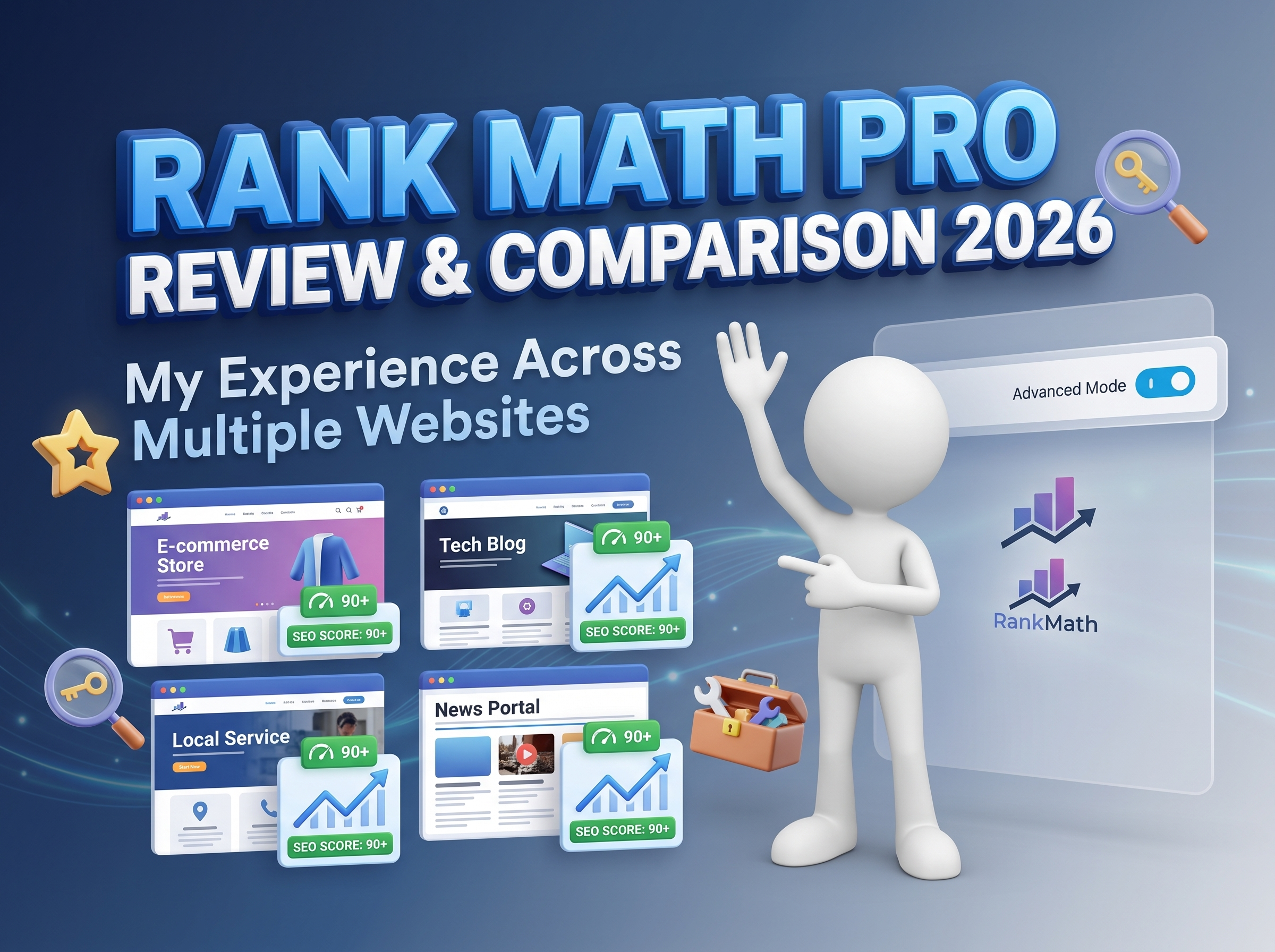
Last Updated on September 10, 2026 by Jeremy
I have used Rank Math while building, auditing and restructuring multiple WordPress websites. That is a very different test from installing a plugin on a clean demonstration site, turning every green light on and calling it a review.
This Rank Math Pro review and comparison is based on what happens when a content creator depends on the plugin for real posts, sitemaps, schema, redirects and performance data—while themes change, plugins conflict and a website grows far beyond its original plan.
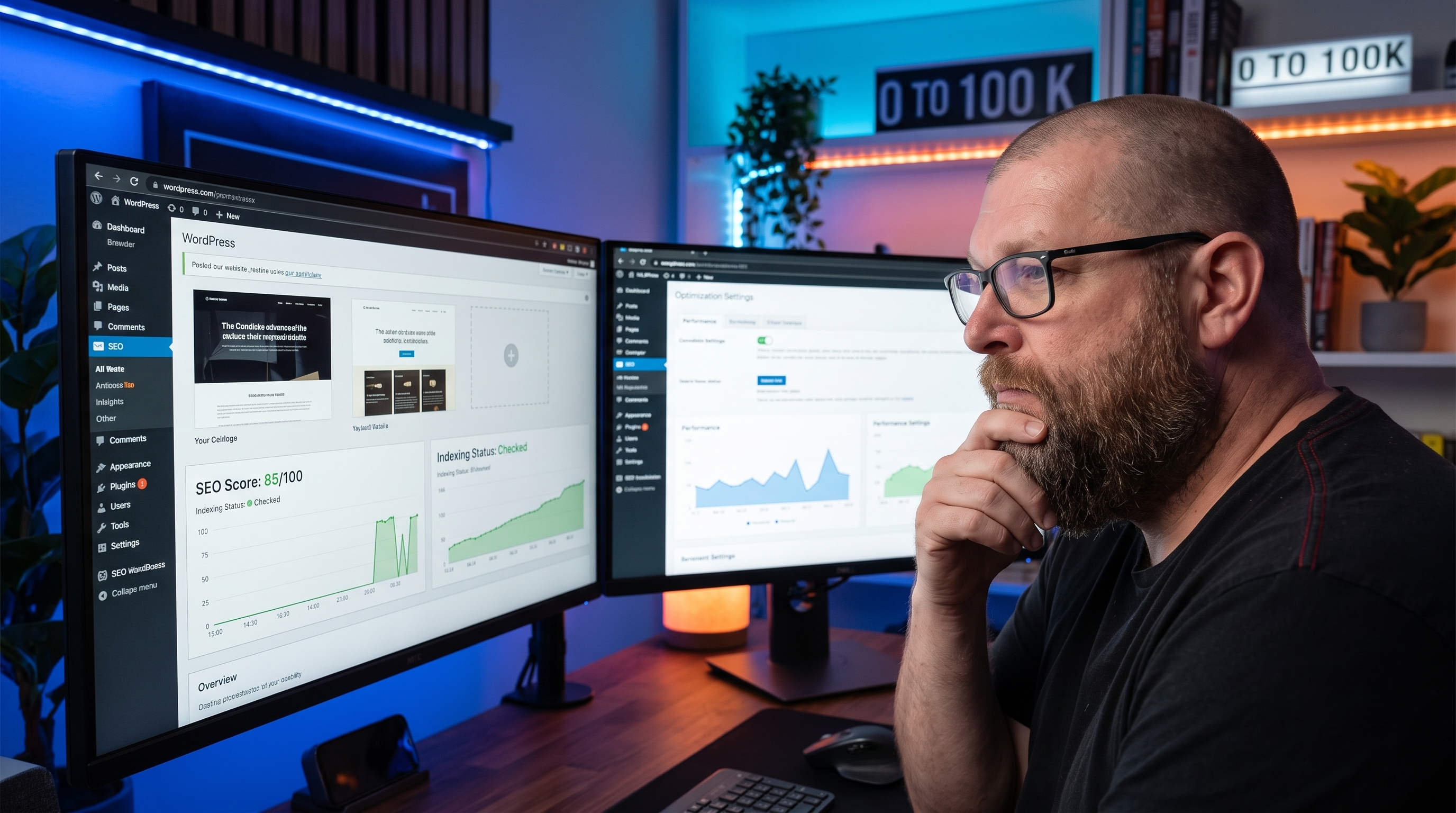
Image transparency: The four editorial illustrations in this article were generated with AI. Product features and pricing were checked against Rank Math’s current official pages.
My verdict first
Rank Math Free is enough for many new and smaller websites. Rank Math Pro becomes worthwhile when you will genuinely use its advanced schema, rank tracking, deeper analytics, reporting or workflow features.
I still consider Rank Math a capable SEO system. I do not consider a Pro subscription a substitute for useful content, technical judgment or checking the website outside the plugin. I currently keep Pro active on Everything RVs and More, while deciding site by site whether the additional layer earns its place.
What I actually tested
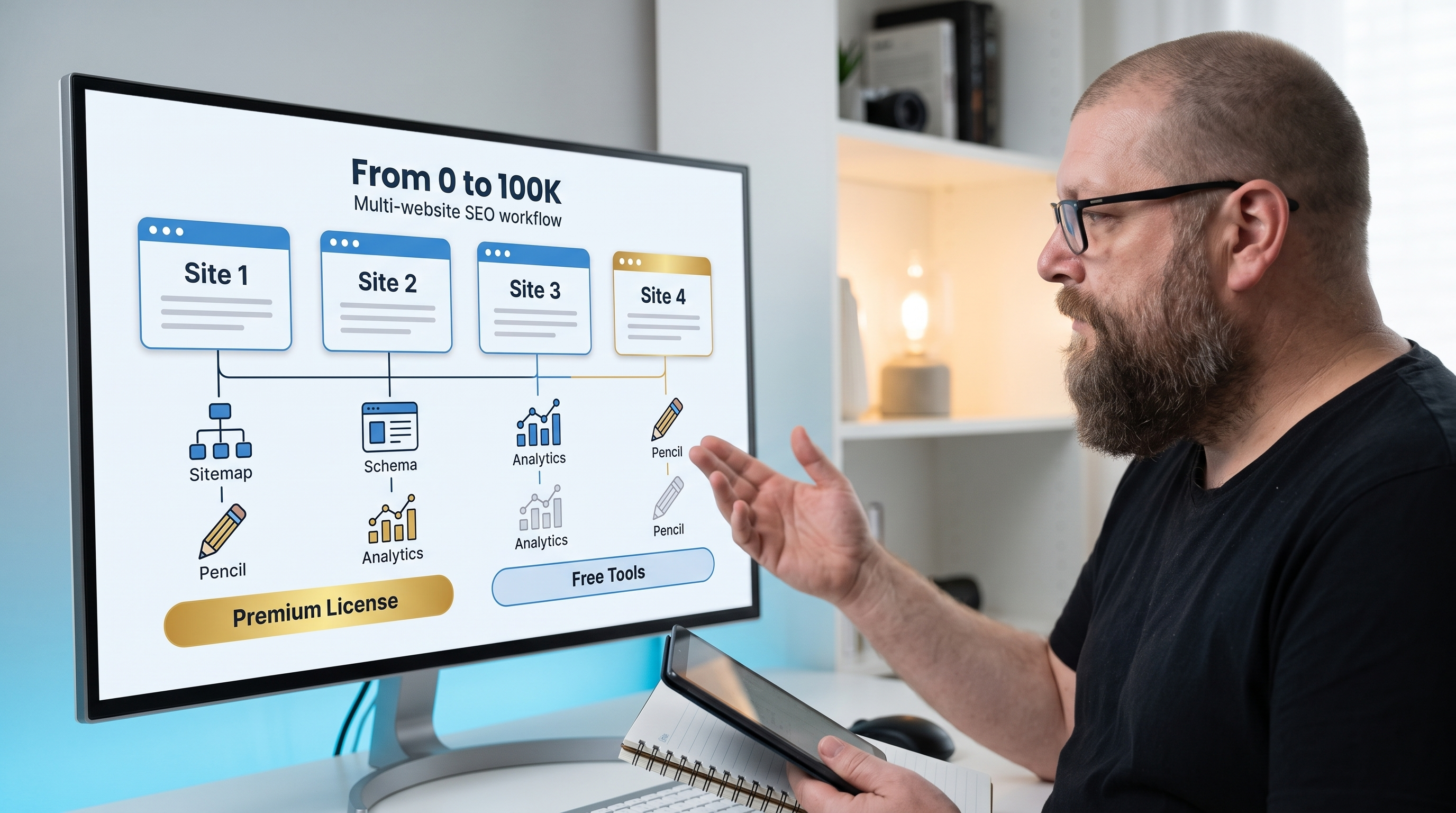
My websites do not all serve the same audience. Everything RVs and More has hundreds of posts, calculators, troubleshooting content and an affiliate brand directory. Earthbound Tours combines travel guides, booking tools and tour pathways. From 0 to 100K documents the business-building process. FlyFishCR supports a real Costa Rican lodge and outfitting operation.
Across that mix, I have used or evaluated Rank Math for:
- titles, descriptions and focus-keyword checks;
- XML sitemaps and indexation controls;
- Article, FAQ, Organization and other schema decisions;
- redirects and 404 monitoring;
- Search Console and Analytics connections;
- content audits and internal-link decisions;
- comparing Free and Pro needs across websites of different sizes.
This also means I have seen the unglamorous side: settings that must be revisited after site changes, reports that need context and an intermittent blank Rank Math admin panel that did not have an instant one-click explanation.
Best quality
It brings a wide SEO toolkit into one WordPress interface and can reduce the need for several single-purpose plugins.
Biggest risk
The feature count makes it easy to enable modules without understanding whether the website needs them.
Best user
A hands-on site owner who wants control and will verify outcomes beyond the plugin score.
Rank Math Free versus Pro in practical terms
The free version already handles the foundation most publishers need: metadata, canonical controls, sitemaps, common schema options, Search Console connection and on-page guidance. That is why “Pro has more features” is not a sufficient reason to upgrade.

| Need | Free may be enough when… | Pro becomes more useful when… |
|---|---|---|
| On-page SEO | You need titles, descriptions, canonical controls and basic content checks. | You want deeper content overviews, advanced filtering or performance information inside WordPress. |
| Schema | Your content uses common schema types with straightforward settings. | You need schema templates, multiple schemas, imports or more advanced custom control. |
| Rank tracking | You already monitor performance directly in Search Console or another tool. | You want keyword histories and winning or losing queries surfaced in the WordPress workflow. |
| Analytics | You are comfortable using Google’s own reporting interfaces. | You value integrated reports and post-level performance summaries. |
| Video, news, local or store SEO | These are not core parts of the site. | Your publishing model genuinely depends on the relevant advanced modules. |
| Support | Documentation and community answers cover your needs. | Priority product support materially reduces downtime or investigation time. |
Rank Math’s current public pricing page says its individual Pro plan can be used on unlimited personal websites owned by the customer, while client sites require a different plan. I still do not activate every module on every site. License capacity and operational necessity are separate questions.
The Rank Math Pro features I value most
Advanced schema control
Schema is one of the strongest reasons to consider Pro—provided you understand what you are marking up. The ability to build, import and reuse schema can save time on a site with several repeatable content types. It can also help create a mess faster if every post is assigned markup it does not qualify for.
My rule is simple: schema must describe the visible page honestly. A plugin cannot turn thin content into a real review, invent an author’s experience or make an FAQ useful merely because the JSON-LD validates.
Integrated performance context
Bringing search information closer to the content can shorten the distance between “traffic dropped” and “which pages or queries changed?” That is useful during a site audit. It is not the final diagnosis. I still check Search Console, Analytics and the live search result rather than trusting one dashboard.
Redirect and 404 tools
Redirects are valuable during consolidation, slug changes and removal of obsolete material. The danger is creating redirects casually without documenting them. A redirect should have a clear destination and reason—not simply hide every 404 indefinitely.
Modular design
Rank Math lets users enable and disable modules. I like that in principle because an affiliate site, local business and news publisher do not need identical SEO systems. The discipline is in leaving features off until their purpose is clear.
The problem I encountered: an intermittent blank admin panel
During recent work on Everything RVs and More, Rank Math’s admin area would intermittently appear blank even though the public website continued working. Hosting support found no PHP fatal error, and the relevant scripts were returning successfully. Their investigation pointed toward a client-side initialization or timing problem, but that did not establish one definitive culprit.

Why I am including this: A review should document friction, not only features. The issue was intermittent, the live site was not down and the evidence did not justify claiming that Rank Math alone caused it. It did justify gathering browser console and HAR evidence and reviewing the surrounding plugin environment.
If you encounter a similar screen, avoid deleting data or randomly changing several systems at once. Record the time and URL, check the browser console, test for plugin or theme conflicts in a safe environment, verify REST and script requests, and give support a repeatable description.
What Rank Math cannot do for you
- It cannot decide whether an article deserves to exist.
- It cannot supply firsthand experience you do not have.
- It cannot guarantee rankings because the score reaches 100.
- It cannot choose a trustworthy source merely because a link is external.
- It cannot prevent keyword cannibalization if your content plan keeps repeating the same intent.
- It cannot replace Search Console, real user behaviour or manual quality review.
I explained the broader shift toward search, voice and AI discovery in my guide to ranking a website under newer SEO rules. Rank Math can support that work, but it is still the operator—not the plugin—that must understand the audience and intent.
How I would optimize Rank Math Pro in 2026
- Run the setup wizard carefully. Confirm site type, organization data and index settings rather than accepting everything automatically.
- Enable only needed modules. Every feature adds decisions, interfaces and potential interaction with other plugins.
- Verify the sitemap publicly. Confirm the correct post types appear and excluded material stays excluded.
- Review schema templates. Match each template to visible content and current search-engine requirements.
- Connect first-party data. Use Search Console and Analytics as evidence, not decoration.
- Document redirects. Record the old URL, new URL, reason and date.
- Audit quarterly. Remove obsolete modules and revisit settings after major theme, plugin or content changes.
Who should pay for Rank Math Pro?
Pro may be worth it if…
- You manage several substantial personal sites.
- You will use advanced schema repeatedly.
- Integrated rank and performance tracking saves real time.
- Your content model needs advanced local, video, news or ecommerce tools.
- Product support has measurable value to your workflow.
Stay with Free if…
- Your site is new and the publishing habit is not established.
- You mainly need titles, sitemaps and basic schema.
- You already have dependable reporting tools.
- You are upgrading to chase a plugin score.
- You cannot name the paid feature you will use next week.
Pricing: check the renewal, not only the offer
At the time of this review, Rank Math advertised its individual Pro plan at an introductory monthly equivalent billed annually, with taxes excluded and a higher stated renewal rate. Prices, bundles and promotions can change. Use the official Rank Math pricing page and calculate the full annual charge and renewal before purchasing.
I would not choose the plan based on Content AI credits or a temporary bonus unless that specific tool already belongs in your workflow.
Disclosure: This is an independent experience-led review, not a promise of rankings. The Rank Math links in this article are direct informational links, not affiliate links at publication.
Final Rank Math Pro review
Rank Math Pro is strongest when it consolidates work you were already doing: structured data, reporting, rank tracking, redirects and technical controls. It is weakest when the interface becomes a scoreboard and publishers begin writing for plugin lights instead of people.
For my largest RV site, the paid toolkit remains useful enough to keep evaluating through the current admin-panel investigation. For a smaller site, I would start with Free, build the content and measurement habit, and upgrade only after a specific Pro feature has a job.
That is the larger lesson behind From 0 to 100K: the best tool is not automatically the one with the longest feature list. It is the one that removes a real bottleneck without creating a new dependency you do not understand.
Read my ChatGPT Work reviewFrequently asked questions
Is Rank Math Pro worth it in 2026?
It can be worth it for site owners who use advanced schema, rank tracking, reporting or specialized modules. Many new or smaller websites can handle their essential SEO settings with Rank Math Free.
Can I use Rank Math Pro on multiple websites?
Rank Math’s current individual Pro plan says it supports unlimited personal websites owned by the customer. Client websites require an appropriate business or agency plan. Confirm the current terms before buying.
Do I remove Rank Math Free after installing Pro?
No. Rank Math’s documentation says the Pro plugin operates on top of the free plugin, so both must remain installed and active.
Does Rank Math guarantee higher rankings?
No SEO plugin can guarantee rankings. Rank Math helps configure and monitor SEO elements, but content quality, competition, technical health, links, user needs and search-engine systems all affect results.
Is Rank Math better than Yoast?
That depends on the features, interface and workflow you need. This review focuses on my Rank Math use rather than claiming a universal winner without running both products through the same current test.
Should a beginner start with Rank Math Pro?
Usually, start with Free unless a paid feature solves an immediate, understood requirement. Learn titles, indexing, sitemaps, schema basics and Search Console before adding complexity.




Leave a Reply