

Last Updated on December 17, 2025 by Jeremy
One of the first things I notice when new people join Wealthy Affiliate is this: most genuinely do not know where to begin. Not because they are incapable, but because the online business world makes everything look like it should happen all at once. Content, SEO, social, affiliate platforms, products, audiences, tools. It is a lot, fast.
For me, starting was simple. I followed the training. The part that took time was understanding the intent behind what I was doing. I would say it was closer to year one when it truly clicked, and once it clicked, the work started to feel like a system instead of random effort. I also made the classic early mistake: I launched four websites within about a year, and suddenly I was doing four times the work from the beginning.
Now with this fifth website, From 0 to 100K, I am not just applying the learning here. I am applying it across all of my previous four websites too. It feels like I am operating in five stages of growth at once. That perspective changes how you define progress.
This is not a get rich article. I was in an MLM years ago and I was promised the world. I got out and started affiliate marketing because it was a better path fit. After doing real research, I knew this was not a get rich quick system. This article is meant to reflect that reality.

Why Most Beginners Quit Affiliate Marketing
Most beginners quit for one reason: the feedback loop is slower than they expected. They do work, and they expect a reward. When the reward does not show up quickly, the mind fills the gap with a brutal conclusion: this is not working.
But quitting is often a systems problem, not a personal failure. In the beginning you can be doing the right things and still not see anything that feels like progress, because the signals show up in a specific order. Income is usually not the first signal.
- Expecting money now, not later
- Wanting results fast, then interpreting silence as rejection
- Feeling behind because others sound further ahead
- Burnout from trying to do everything at once
My own early experience proved this to me the hard way. After month six of my first website, I did not have meaningful results. Then one day I woke up and BAM, I had payments pending on one of my affiliate platforms. I was shocked, happy, and fired up. Turns out it was fraudulent credit card activity and the purchases were revoked for safety reasons. I felt betrayed, miserable, and very close to quitting. A few days later I regrouped, refocused, and kept publishing. I eventually did get paid, just not from that episode and not from that platform.
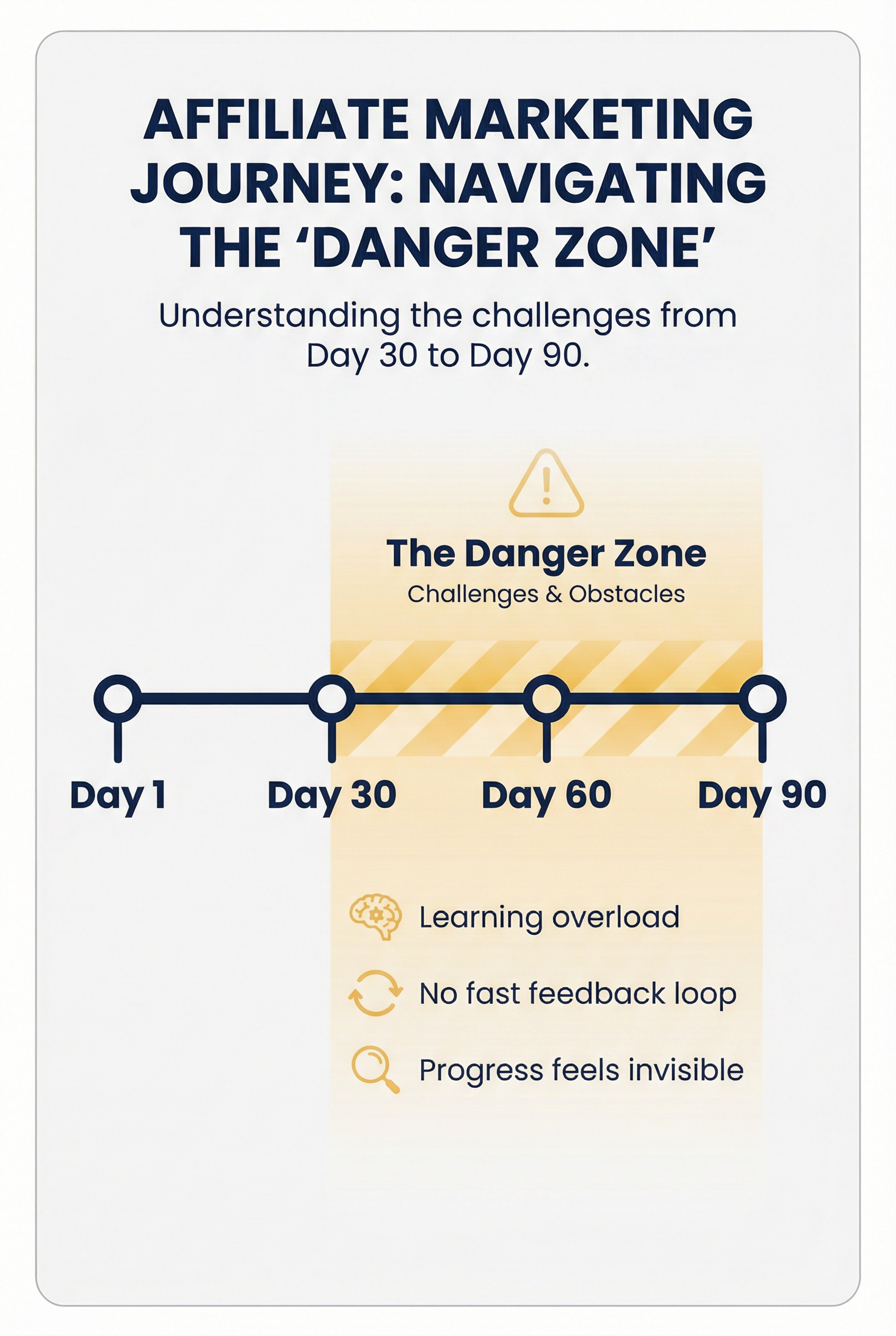
Why the 30 to 90 Day Window Is the Breaking Point for Most Beginners
This is the window where effort increases, but visible reward often has not arrived yet. Your content is live, but not ranking. Your social posts exist, but feel invisible. You are doing work, but you are not getting confirmation. That gap is where most people panic.
By day 30, many people expect a working system and constant income on repeat. That can happen if you stumble into the right niche at the right time, but most people do not. What usually happens is day 30 becomes the start of refinement, not revenue.
Your focus shifts to trying to build the perfect system: joining affiliate platforms, figuring out your audience, learning SEO, learning what to post on social, and trying to understand why some things work and others flop. The list feels endless because it is.
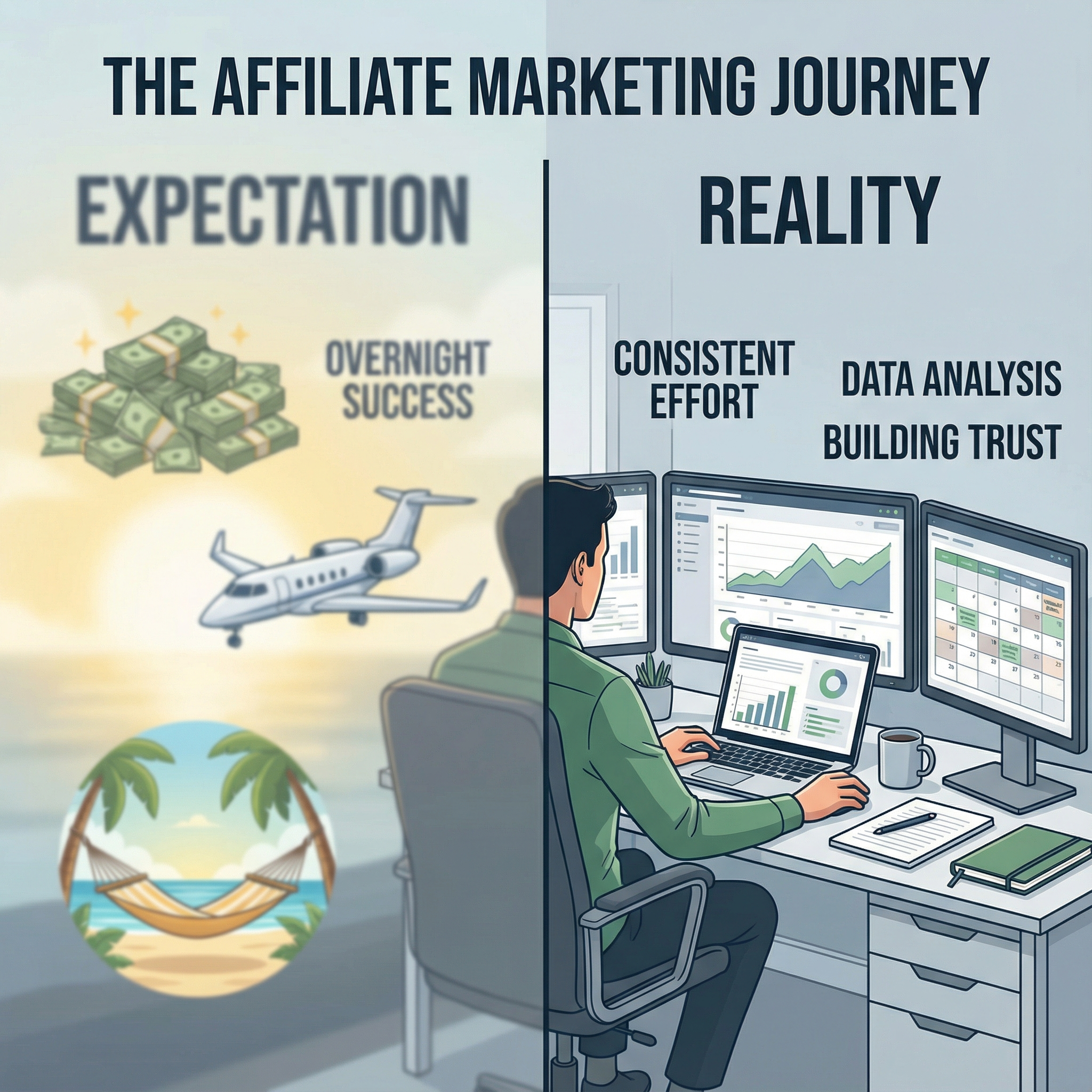
The Real Reasons Beginners Fail (It Is Not What They Think)
Beginners usually think the reason is lack of talent or lack of a secret strategy. In reality, the failure pattern is usually simpler: too much movement, not enough momentum.
- Chasing tools instead of systems: tools feel productive, systems create repeatable results.
- Switching niches too early: impatience resets your learning and your data.
- Measuring the wrong metrics: income is a later signal, not an early one.
- Consuming content without execution: learning feels safe, publishing feels risky.
A mistake I personally made was joining too many affiliate programs at once. I was worried about making money now like many beginners, so I link stuffed where I could instead of where it made sense. That is backwards. Links should support the content, not replace it.
What Progress Actually Looks Like in Affiliate Marketing (Early On)
Progress early on does not usually look like money. It looks like signals. Quiet signals. The kind you miss if you only measure success by income.
- Search impressions showing your pages are being discovered
- First clicks even if they do not convert yet
- Comments, replies, or questions from real humans
- Understanding your audience better than you did last month
The mindset shift that changed everything for me started last winter when I began rebuilding. I focused more on SEO, and in 2025 I started leaning harder into AEO. I am still testing, but I am seeing results. The difference is I am testing with intent and applying the learning across five websites, not just one. That compounding effect is real.

How to Avoid Quitting When Results Are Quiet
The simplest strategy I have used is commitment in time blocks. I committed to one year. I reassessed. Then I committed monthly for two years before committing again to another full year. My plan is to commit until successful across at least one of my sites, then reassess how to make that happen across all five.
The burnout part is the tricky one. My rule is: breathe, regroup, refocus, and protect energy like it is a resource. Because it is.
Read next (internal links that fit this exact problem):
Is Affiliate Marketing Still Worth It for Beginners?
Yes, but only if expectations are realistic and you treat it like a skill stack, not a lottery ticket. Affiliate marketing rewards consistency, usefulness, and patience. It punishes hype and impatience.
Also, the environment changes constantly. Search evolves. Platforms update. Algorithms shift. If you are building for search traffic, it helps to keep an eye on what Google publicly shares about search updates and best practices: Google Search Central Blog.
A Proof Point Worth Reading: Shawn’s One Year, Four Brands Breakdown
There is a Wealthy Affiliate article that lines up perfectly with what I am talking about here, because it shows the real pace of progress. Shawn documented a full year, building four brands, scaling traffic through Pinterest and Facebook, tracking clicks, engagement, and treating the process like a business from day one. Not flashy. Not overnight. Repeatable.
If you need a grounded example of what sticking with it can look like, read this: One Year, Four Brands, and the Strategy That Changed Everything: My Journey from Beginner to Business
The seeds you plant in silence today will become the forest everyone sees tomorrow.
Referenced from Shawn’s WA post and discussion thread.
When I read it, it hit like a freight train on a dirt road because the storyline is familiar. Different niches, same mindset: systems, curiosity, and staying in the game long enough for the compounding to kick in.
When You Should Actually Consider Quitting (And Why That Is Okay)
Quitting is not always failure. Sometimes quitting is a clean decision. If there is zero execution over time, no interest in learning, or an expectation of income without building systems, it might be time to reevaluate.
Personally, I use a long horizon. Jobs often take years to build real success, and I apply that same logic here. If after ten years not one of my websites has moved the needle and I have lost a fortune without learning or adapting, then it is time to ask why. But if you love the process, and the freedom to create matters to you, the learning itself has value even before revenue.
Final Thoughts (No Pitch)
If you had one chance to step back and reevaluate after reading this, I would hope you could find at least three reflection points. Most people quit too early. Quiet periods are normal. Systems outlast motivation.
One last piece of advice: with how fast the online world shifts, use AI as a tool, not a replacement. That approach is going to matter moving forward, especially for beginners.
If you want a structured starting point for clarity, the most direct place to begin is here: Start Here: Your Path From 0 to 100K.
FAQ
Why do most beginners quit affiliate marketing?
Most beginners quit because they expect the reward loop to be fast and it is not. The work often shows up as signals first, like impressions, clicks, and engagement, long before it shows up as income. When people only look for income, they miss the earlier progress.
How long does affiliate marketing take to work?
It depends on your niche, consistency, and how well your content matches intent, but it usually takes time. Early stages are foundation building: content, clarity, internal structure, and learning what your audience responds to.
Is affiliate marketing hard for beginners?
It can feel hard because there are many moving parts and progress is not obvious at first. Once you narrow focus to one path and measure the right signals, it becomes far more manageable and repeatable.
Can you succeed in affiliate marketing without experience?
Yes, because the skills are learnable. The bigger factor is whether you will stay consistent long enough to develop clarity, get data, and improve based on what the data tells you.
What should beginners focus on first in affiliate marketing?
Focus on building a foundation: one site, a clear audience, and content that solves real problems. Track early signals like impressions, clicks, and questions, then improve one piece at a time instead of chasing new tools.





Leave a Reply