
Last Updated on November 1, 2025 by Jeremy
Scale Smart with $1/Day: Reviewing, Optimizing & Expanding
Last week was testing. This week was deciding. I pulled every ad into one view, logged the real numbers (spend, reach, views, clicks, CPE, CPC), then let the data choose what to scale and what to pause. I added a short, human “top comment” on the winning post (with my WA tracking link and the 2,000 AI credits note), and started light, helpful DMs with real people who commented. No hype—just honest next steps.
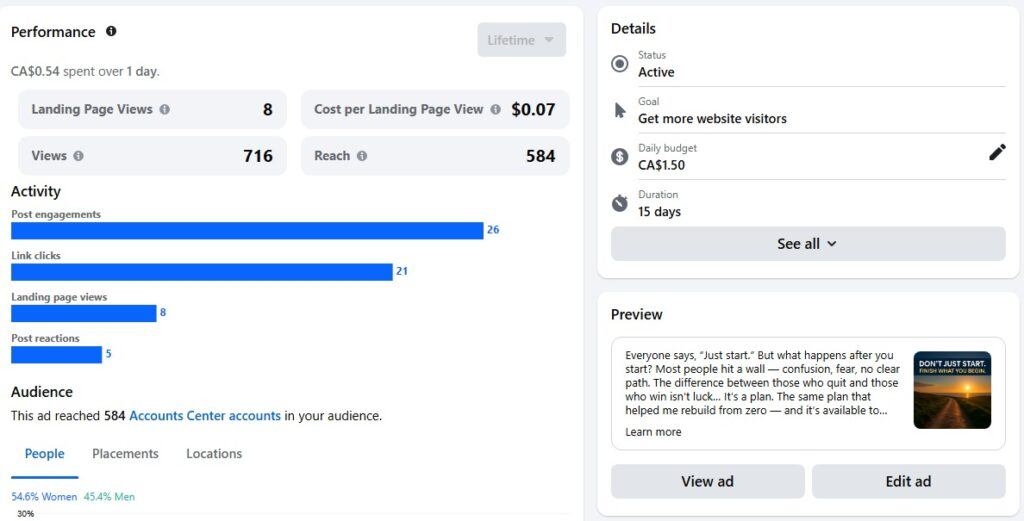
See screenshot below of the Week 6 overview metrics panel.
What I Accomplished This Week
Every week in the From 0 to 100K Bootcamp, I focus on progress — not perfection. Week 6 was where the data finally started to speak. I analyzed every running Facebook ad, measured cost per engagement (CPE) and cost per click (CPC), then made the tough call to pause one ad and double down on two that were quietly compounding.
The biggest difference this week was my approach to engagement. Instead of relying on pinned comments, I focused on building conversations organically. Below is my current top-performing Facebook post — the one generating real clicks, shares, and DM conversations that actually lead to referrals.
That post alone brought in more organic traction than any ad I’ve run in the last three weeks. It’s proof that content built on authentic insight and consistency still performs — even on a $1-a-day testing schedule.
- Audited 4 active ads and recorded their full metrics.
- Paused 1 under-performer, scaled the two that were still building steady engagement.
- Started light, human DMs with real commenters — always help first, link only when they ask.
- Published two new posts on From 0 to 100K, both connected to my best-performing ads:
- Documented everything inside my Wealthy Affiliate Week 6 Report to help others see what’s working.
Task List — Reviewing & Optimizing $1/Day Ads
Each week of the Bootcamp comes with a specific checklist, and Week 6 was the first time it felt like a real campaign dashboard. Instead of guessing, I followed the “Review → Adjust → Engage → Expand” rhythm from Kyle’s $1/day formula and adapted it to my own testing style. Here’s how that played out day by day.
- Review Ad Results (Days 1–2): I opened Meta Ad Center and logged every metric—spend, reach, views, clicks, CPE, and CPC—side by side. Seeing it all in one place instantly revealed which creatives were actually compounding.
- Make Smart Adjustments (Day 2): I paused one ad that stalled after $10 spent, even though it looked good early on, and scaled the two that showed consistent traction. The goal wasn’t perfection—it was progress through proof.
- Pinned Comments vs. Real Engagement (Day 3): I learned that one genuine conversation beats any “hack.” While previous weeks relied on pinned comments, this week’s focus was natural comment flow—and it paid off in DMs and referrals.
- Respond & Engage (Daily): Every time someone commented, I replied within 24 hours, tagged them by name, and kept the tone human. The result? Facebook rewarded the post with more organic impressions because of fast, authentic interaction.
- DM Outreach (Days 3–5): I reached out to warm commenters with genuine curiosity—no mass messages, no pressure. Just: “Hey, saw your comment—what kind of online business are you building?” It opened real conversations.
- Weekly Wrap-Up (Days 5–6): I published my full report inside Wealthy Affiliate with screenshots, insights, and the two blog posts tied to the campaign theme.
- Next Tests (Day 6–7): Launched two new ads—a text-only variation and a refreshed image post—each running at $2/day for seven days. The focus now is learning, not luck.
See screenshot below of Meta dashboard metrics and my Week 6 checklist in action.
Ad Performance Highlights
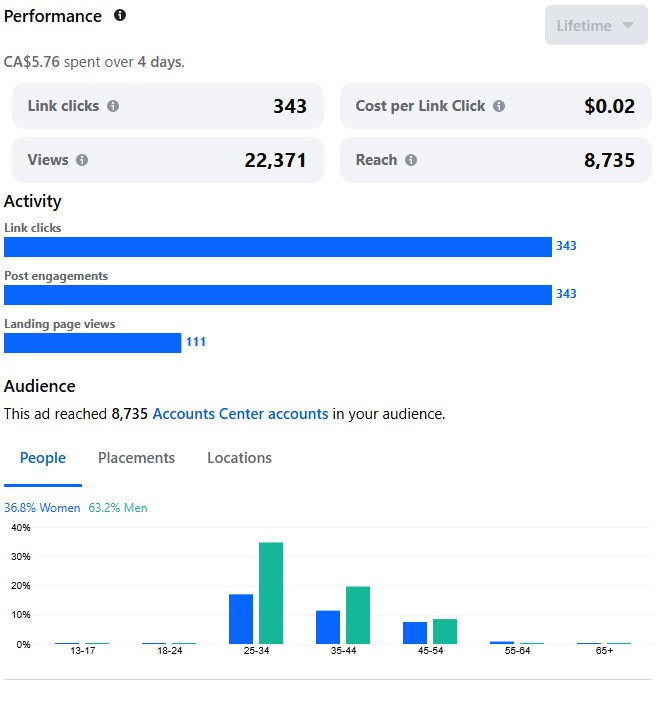
I always say data tells the story, but it’s only useful when you listen to what it’s saying. Below is a quick look at the four ads I ran this week — their goals, reach, and how they actually performed. What you’ll notice: the strongest performers weren’t the flashiest. They were the most human.
The clear standout this week was “10+ Years of Falling”, hitting the $0.02 mark consistently with meaningful click-throughs. The most engaging piece, though (pictured above), was “Fear Stops Most People,” which sparked real conversations and direct messages — proof that the emotional angle still wins.
No screenshots needed — this table reflects the live data pulled from Week 6 reports.
Micro-Lessons & Insights from Week 6
Every week leaves a few lessons behind—some from data, others from instinct. Week 6 reminded me that scaling ads isn’t about spending more; it’s about understanding patterns and letting the data reshape your assumptions.
-
1️⃣ Text-based ads with colored backgrounds outperformed image ads.
The surprise winner was the simplest format—plain text on a bold background. People paused to read, not just scroll. Lesson learned: clarity and contrast beat clever design. -
2️⃣ Unexpected regional results flipped my expectations.
Engagement from Nicaragua actually outpaced the U.S., proving that interest doesn’t always come from where ad budgets usually point. It’s a good reminder that markets outside the “big three” can hold incredible value if you speak to them authentically. -
3️⃣ Client campaigns echoed the same trend.
Testing on FlyFishCR.com’s Facebook page brought nearly identical engagement patterns—and even gained new followers. Consistency across brands means the system works beyond my own pages.
The Week-7-and-Beyond Mindset
From here forward, I’m treating this process as a living system—not a campaign. My framework for the coming weeks includes:
- Content Engine: blogging, vlogging, and a weekly cadence that compounds reach.
- Social Proof: testimonials, success stories, and Vegas-style case studies that show real wins.
- SEO & AI: building clusters, hubs, and internal links that strengthen authority.
- Numbers That Matter: affiliate math, ROI tracking, and cost-per-result clarity.
- Facebook Scaling: creative rotation and data-driven expansion.
- Community: points, content, and co-building tools with my audience.
- Messaging: objection handling and storytelling that actually converts.
- Ultimate Goal: scale the network to 100 super affiliates—together.
These lessons didn’t just teach me about ads—they redefined how I look at consistency. The real win wasn’t the $0.02 clicks; it was proving that a structured, repeatable rhythm keeps growing even when the budget stays small.
Looking Ahead: Week 7 and the Road to Scale
Week 6 gave me clarity through data. Now it’s about sharpening focus and testing how far that $1/day framework can stretch. Scaling isn’t about throwing more budget at ads—it’s about precision. The right message, in front of the right people, at the right time. That’s where results stop being random and start becoming reliable.
In Week 7, I’ll be layering retargeting elements, testing new creative angles, and syncing ad activity with on-site content to build a full feedback loop. Every new ad will have a home base on the website—so visitors don’t just click; they connect.
The deeper I go, the more I realize this isn’t just a Facebook experiment—it’s a blueprint for sustainable marketing. A method that grows with you, learns from mistakes, and rewards long-term focus.

Join the Bootcamp & Build Alongside Me
Week 7 is where clarity meets scale—one smart decision at a time.
Disclosure & Final Notes
Some links on this page are affiliate links. If you join or purchase through them, I may earn a commission—at no extra cost to you. I recommend tools I use personally and I publish my results weekly so you can see the full picture, not just the highlight reel.
Metrics in this update were pulled from my Facebook Ad Center and on-site analytics on Nov 1, 2025. Screenshots may be redacted to protect private info. Ad budgets in this series typically range from $1–$2/day per test. Your results will vary based on offer, audience, and execution.
This post is for educational purposes—follow along, adapt it to your niche, and let your own data lead. If you’d like to build beside me, you can start here: Join the Bootcamp.


Leave a Reply