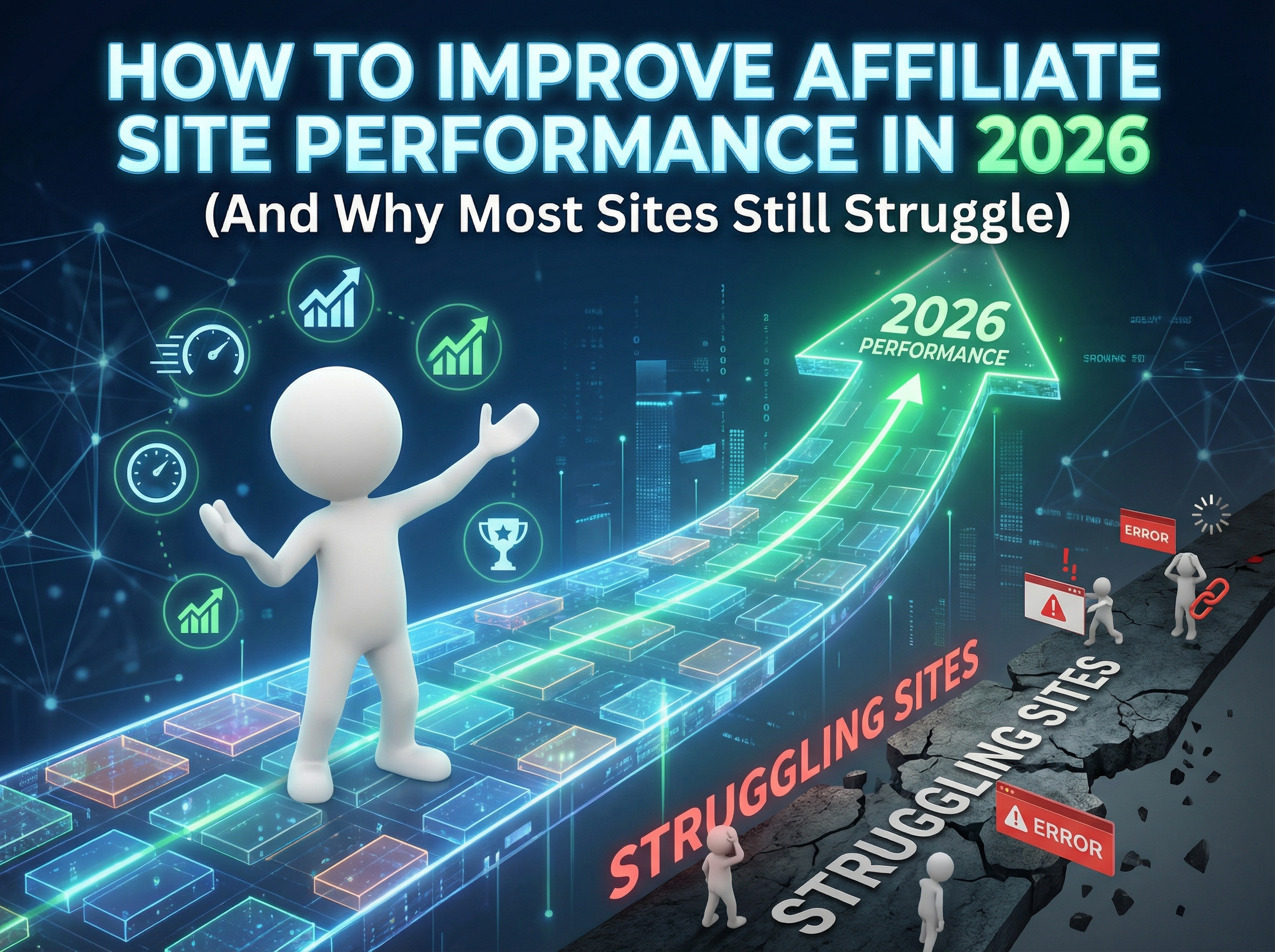
How to Improve Affiliate Site Performance in 2026 (And Why Most Sites Still Struggle)

Last Updated on February 14, 2026 by Jeremy

1st

If you’re new here, start with the roadmap: Start Here: Your Path From 0 to 100K. This post is for the moment when you’ve already started… and now you’re staring at performance numbers wondering why they aren’t moving.

Realistic analytics-focused workspace showing affiliate website performance tracking
Affiliate performance • 2026 reality check

“Improve performance” sounds like a button you click. In real life, it’s usually three things: better pages, better intent match, and better trust signals. The problem is most affiliates tweak the wrong stuff first, then wonder why the graph looks like it took a nap.

TL;DR: How to Improve Affiliate Site Performance in 2026

  • Fix intent first (your page must answer exactly what the searcher meant).
  • Then fix the offer path (make the next step obvious and friction-free).
  • Then prove trust (real-world experience beats “generic best of” pages).
  • Then scale content volume (performance compounds when you publish consistently).
  • Finally, tighten technical basics (speed, indexing, internal links, schema).

Why Affiliate Sites Struggle in 2026

Analytics graph visually representing an affiliate site performance plateau

Most “struggling” affiliate sites aren’t failing because the owner is lazy. They struggle because the site is misaligned.

The page says one thing, the searcher wanted another, and the next step feels like a sales trap. So the visitor bounces… or reads… and does nothing.

Quick gut-check: If your traffic is steady but clicks/conversions are flat, you likely have an intent problem or a trust problem (or both).

The 5 Performance Bottlenecks (What’s Actually Blocking Growth)

Visual metaphor showing a bottleneck restricting flow and growth
  1. 1) Intent mismatch

    Your post targets “how to” but reads like a review. Or it targets “best” but never compares like a buyer’s guide. In 2026, that mismatch is the fastest way to lose rankings and conversions.

  2. 2) Weak next-step path

    The reader finishes your page and has no idea what to do next. Or you give them ten CTAs and they do none. One clear path beats five “options.”

  3. 3) Thin trust signals

    No proof you’ve tested anything, no photos, no experiences, no “here’s what happened when I did it.” Generic content is everywhere now. “Real” stands out.

  4. 4) Content volume gap

    Many sites stop too early. They publish 15–30 posts, don’t see a payoff, and walk away right before the compounding phase.

  5. 5) Technical/structure friction

    Slow pages, weak internal linking, poor indexing, missing schema, or messy site architecture. Not glamorous—but it matters.

Performance = Traffic × Conversion × Authority

Most people only obsess over traffic. But traffic by itself is just… visitors. Performance is what happens after the click.

Traffic: Do you rank for the right intent, not just “a keyword”?
Conversion: Does the page guide a decision (or just “talk”)?
Authority: Does the reader believe you… enough to take the next step?
Translation: If one of these is weak, the entire equation suffers. That’s why some sites get traffic and still earn nothing.

The 30 → 100 Article Gap (Where Most People Quietly Lose)

Workspace visual suggesting content creation volume and consistent publishing effort

If you want the uncomfortable truth: a lot of affiliate sites stall because they simply don’t publish enough high-intent pages to build momentum.

Not “write 100 posts and you’re guaranteed to win.” That’s not the point. The point is that compounding needs inventory: more entry points, more internal links, more topical coverage, more chances to rank, and more chances to convert.

Builder rule: If you’re going to judge the model, run the full test. Half a test gives you half a result. Then people call it a “scam” and go back to scrolling.

The Practical 2026 Performance Audit (Do This Before You “Try Harder”)

Checklist and analytics workspace representing a performance audit process
  • Intent: Does the title match the searcher’s goal (learn vs compare vs buy)?
  • Above-the-fold: Is the first screen clear about who the page is for and what it solves?
  • Scannability: Do you have clean sections, short paragraphs, and real headings (not fluff)?
  • Trust signals: Do you include personal experience, photos/tests, clear disclaimers, and real outcomes?
  • Internal links: Are you guiding readers to the next logical step (not random “related posts”)?
  • CTR: Is the snippet/title compelling enough to win the click?
  • Conversion path: After the reader gets value, do they know the next step?
  • Schema: Are FAQ and structure helping search engines understand your page?
Small but deadly mistake: People tweak colors, logos, fonts, and “branding” while their page is still unclear. Clarity beats cosmetics.

The Compounding Model (What “Better Performance” Really Looks Like)

Conceptual visual representing steady compounding growth over time

Here’s the shift that matters in 2026: stop thinking “one post = one result.” Start thinking “one post = one asset inside a system.”

Week to week: Improve one page, publish one page, link it correctly, measure what changed.
Month to month: Build topical coverage so Google (and readers) can see what you’re actually about.

If you want the “start here” version of the bigger system (and the order to build it in), you’ll find it on the core roadmap: Start Here: Your Path From 0 to 100K.

FAQ: Affiliate Site Performance in 2026

These are written to answer real “voice search” style questions (AEO), so they’re direct on purpose.

How do I improve affiliate site performance fast?

Fix intent and clarity first. Make sure your page answers exactly what the searcher meant, then create one obvious next step (another guide, a comparison, or a tool). “Fast” improvements usually come from aligning intent + tightening conversion path.

Why do affiliate sites struggle in 2026?

Competition is higher, generic content blends in, and search engines reward helpful structure and credibility. Sites struggle when they publish thin pages, don’t build topical coverage, and don’t show real experience.

What should I fix first: traffic or conversions?

Conversions. If your pages don’t guide decisions, more traffic just means more visitors leaving. Once the path is clear, traffic improvements become more valuable.

How many articles does an affiliate site need?

Enough to cover a topic properly. Many sites stall around 15–30 posts because they haven’t built enough coverage and internal linking for compounding to kick in. Consistency matters more than a magic number.

Does schema help affiliate posts rank?

Schema helps search engines understand your content and may improve how your page appears in results. It’s not a cheat code, but paired with clear structure and useful answers, it’s a strong support signal.

What’s the biggest mistake affiliates make when trying to “optimize”?

They polish the site before the page is useful. Logos, colors, and fancy layouts don’t fix unclear intent or thin trust. Clarity, usefulness, and credibility come first.

Last updated: February 2026 • Author: Jeremy

Comments

5 responses to “How to Improve Affiliate Site Performance in 2026 (And Why Most Sites Still Struggle)”

  1. Godwin Avatar
    Godwin

    Hi there –

    This blog resonates with me for a variety of reasons. As an affiliate marketer, I consistently review my website to identify both improvements and setbacks. With regards to bottlenecks, posting content which is not valuable is one way to decrease one’s authority. This is particularly applicable when multiple blogs by an individual address have little substance. Overlooking internal linking, over selling digital/physical products can drive away visitors.

  2. Aly Avatar
    Aly

    This breakdown of traffic, conversion, and authority as a simple equation really resonates, especially the point about fixing conversions before chasing more traffic. I’ve seen sites with decent rankings stall because the page reads well, but never clearly guides the reader to a decision. When you run your performance audit, do you prioritize updating existing high-impression posts first, or do you prefer publishing new high-intent content to fill topical gaps before optimizing what’s already live?

    1. Jeremy Avatar
      Jeremy

      Aly, great question — and you’re thinking about this the right way.

      I almost always start with existing high-impression posts first. If Google is already sending signals that a page deserves visibility, improving clarity, tightening intent alignment, and fixing weak calls to action can unlock gains much faster than starting from scratch.

      That said, if there’s a clear topical gap where high-intent content is missing entirely, I’ll create that piece and then internally link it back into those high-impression articles. That combination tends to compound results.

      Optimization first. Expansion second. Scale third.

      That order has saved me a lot of wasted effort over the years.

  3. Angela M. Avatar
    Angela M.

    Hello Jeremy,

    This article really hit a nerve for me because it explains something a lot of people quietly experience when building affiliate sites. It’s easy to think the problem is just “not enough traffic,” but the way you explained strategy, structure, and trust signals made it clear that performance problems usually run deeper than that. Things like random content publishing, weak funnels, or not showing real experience with what you’re recommending can quietly hold a site back even if the traffic is decent. 
    The part that stood out to me most was your point about writing for both humans and AI discovery engines at the same time. That shift toward structured answers, clear headings, and real experience feels like a big change from the old “keyword stuffing and listicles” approach that used to dominate affiliate blogs. 
    Something I kept wondering while reading this is whether most struggling affiliate sites actually realize which part of their system is the weak link. In your experience, is it usually the content itself, the niche choice, or the lack of a real conversion path once visitors land on the site?

    Angela M 🙂

    1. Jeremy Avatar
      Jeremy

      Angela, that’s a great observation, and you’re right that many people initially assume the issue is traffic.

      In most cases, though, the weak link shows up after the visitor arrives. The site might rank, the content might even read well, but there’s no clear path for the reader to move from learning something to actually taking a next step. That’s where a lot of affiliate sites quietly stall.

      Content quality does matter, of course, but structure and intent alignment usually reveal the bigger problem. If a page answers a question well but doesn’t naturally guide the reader toward a decision, the opportunity just fades away.

      What I see most often is a combination of things: decent articles, decent traffic, but no real system connecting the two to outcomes. Once that connection is tightened, the same content can perform very differently.

      I’m glad that part stood out to you, because that shift toward experience, structure, and clear answers is really shaping how sites grow now.
      Jeremy

Leave a Reply

Your email address will not be published. Required fields are marked *

Related Post