
Last Updated on October 24, 2025 by Jeremy
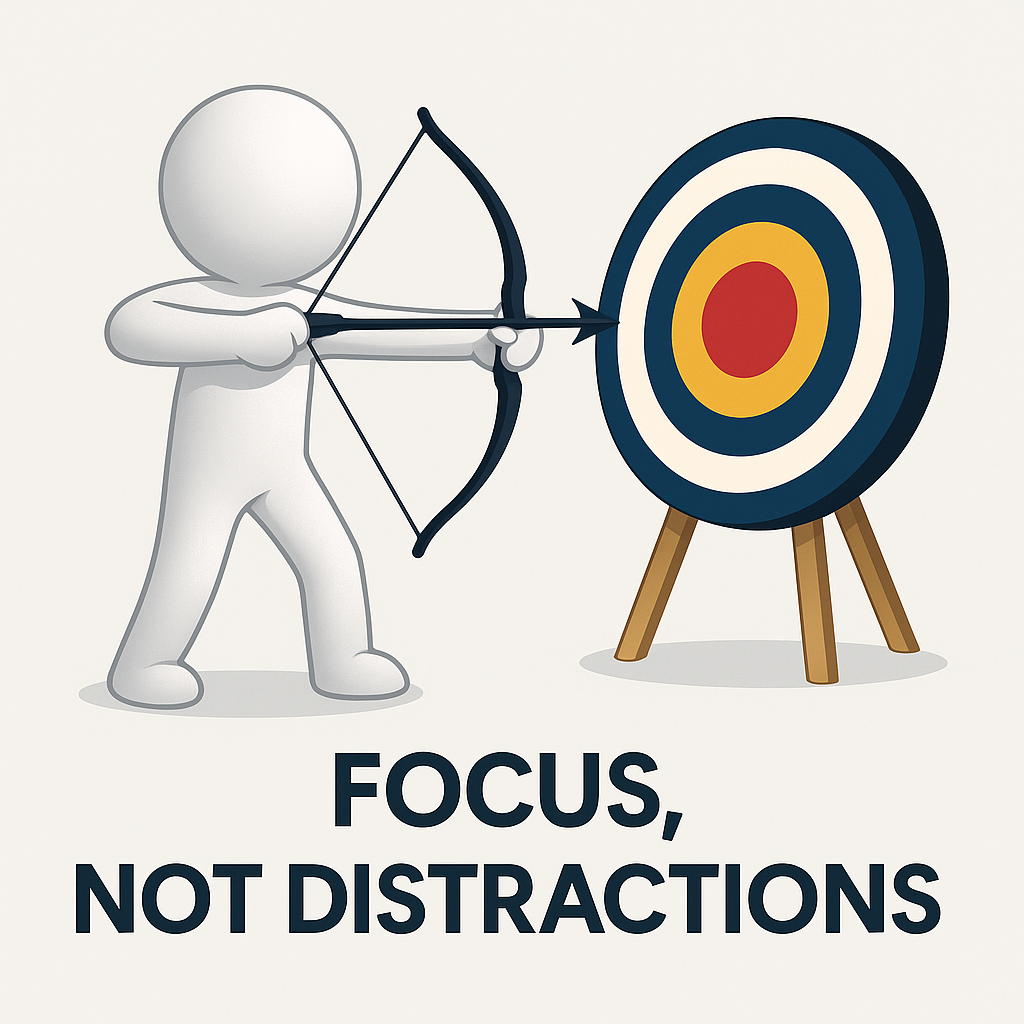
You know that zone you slip into when everything just clicks? That’s what “focus” feels like to me. It’s not some magical mindset or guru technique — it’s the quiet, gritty space where you’re getting shit done. The kind of nights where the family’s asleep, the RV’s heater hums in the background, and the only light left on is that dry-erase board with half your to-do list staring back at you. You sip your tea, crack your knuckles, and get back to work because, deep down, you know these moments count.
Over the years — from the MLM grind to building multiple sites and running campgrounds — I’ve learned that focus isn’t about staying busy. It’s about being all-in when it’s time to build. My winters are my “grind months.” That’s when I zone in, head down, and give this online business every ounce I’ve got. Come summer, my focus shifts to the park — but when I’m in that online groove, I don’t hold back. No excuses, no shortcuts, just a promise to myself that if I show up long enough, the results will too.
That’s the quiet faith nobody talks about — the belief that if you keep showing up, the process will eventually pay off.
I’ve seen it happen: small, steady trickles of traffic and commissions across a couple of my sites. Not a flood, not an overnight jackpot, but proof that what I’m building works. That’s the difference between those who make it and those who quit. The ones who see the art in the process don’t walk away when the paint’s still drying.
Because this business — this lifestyle — isn’t a get-rich-quick scheme. It’s like painting. From the outside, people see colors splashed on a canvas, but we know better. We see the pride, the patience, the brushstrokes that took hours to perfect. You’ve got to see the finished piece before anyone else does. And when it finally sells — when that first commission, that first subscriber, that first breakthrough hits — it’s not luck. It’s the result of staying in the zone long enough for the art to take shape.
What “Focus” Means to Me Now
Back in the MLM days, “focus” looked like juggling ten things at once and calling it productivity. Now? It’s the opposite. I still multitask like any RV-living parent does, but when it’s time to build, I hammer out one thing at a time. Whiteboard says what’s next; I do it. Then the next line. That’s the game.
Old Focus (Messy Hustle)
- Lots of tabs, little completion
- Endless “research,” few publishes
- Chasing shiny tools over reps
New Focus (Single-Task Groove)
- Pick one task → finish it
- Ship on a schedule, not a mood
- Whiteboard = boss, not my feelings
Consistency is just single-tasking with a finish line.
Real life matters, too. Family time is non-negotiable. Health isn’t optional. That balance makes the work better because I’m not crawling to the keyboard on fumes. I’d rather show up sharp for two focused hours than fake it for ten. If you want my step-by-step writing loop, I broke it down here: How I Write Blog Posts That Actually Rank (My 2-Hour Process).
The Weird Part That Works: Dream-Building
When I’m deep in a project, my brain keeps working while I sleep. I’ll wake up with a layout, a hook, even a logo idea, and think, “Well… guess I’m designing that now.” Keeping the creative gears turning is how this new site came to life — from branding to the logo. The results will show in due time, but the momentum is already real.
No mysticism here — just a mind that refuses to clock out while the story’s still writing itself.

Staying locked-in when the world isn’t watching: that’s where momentum starts.
Micro-Tests That Keep You Learning (Including My $1 Version)
Here’s the truth: you don’t need big budgets to learn fast. You need tiny experiments that tell you what to do next. I run micro-tests to see what actually gets traction — then I double down on the winners and skip the guesswork.
I use a $1 boosted-post as a quick signal check. It’s not “ads for sales”; it’s “ads for learning.” I shared my results here so we can keep this post evergreen: Week 5: Facebook $1 Ad Challenge Results.
My biggest takeaway so far: ads absolutely drive traffic — and the right hook gets people to stop and care. Be personable. Create ad-worthy content.
How I Pick What to Test
- Pull a punchy line from the week’s post and use it as the hook
- Test a simple image vs. a clean text-only post
- Try a short “question” opener vs. a bold statement
- Keep the CTA soft: “Read the full breakdown” beats “Buy now” at this stage
What I Watch For
- Saves & comments → the angle resonates
- Outbound clicks → promise is clear
- Time on page → post actually delivers
- If it flops: change the hook, not the entire strategy
Pro tip: I’m now applying this same micro-test mindset on another client’s Facebook page. Traffic follows the right creative — and creative follows a clear promise.
10 Fast Feedback Loops (No Big Budget Needed)
A feedback loop is just a fancy way of saying: test something small, watch what happens, and adjust fast.
- A/B your first 3 sentences (problem vs. promise lead)
- Question vs. statement hooks on social
- Image quote vs. plain text
- Carousel of key takeaways vs. single image
- Short 15-sec clip vs. static thumbnail
- Soft CTA (“read the breakdown”) vs. direct CTA
- Morning vs. evening publish times
- Two interest clusters (skill-building vs. side-income)
- Internal link placement: top, mid, or end of post
- Headline with number vs. without number

The Distraction Kill List (My Real-World Version)
True story I missed this post’s original slot by two days. Didn’t hit the whiteboard, got tunnel vision on other tasks, and boom — the schedule slipped. That’s life. The fix isn’t guilt; it’s course correction: write it down, finish the thing, then backtrack and close the loop.

What Derails Me Fast
- Facebook doom-scrolling. I open it to post, then wander into feeds and lose the plot.
- GPT rabbit holes. I’ll start drafting a post… then detour into Udio Music or some shiny idea that’s not today’s job.
- Email vortex. It’s “business,” sure — but one important email can yank me from a task I started 15 minutes ago.
- Bonus: Family interruptions happen, but we’ve built a system: if I’m mid-task, they give me space to land the plane first.
How I Guard the Work
- Whiteboard = boss. Three lines for today. Cross them off before anything else.
- Headphones + music. Signal to my brain: we’re in the groove now.
- PDF task sheets. Monthly checklists (thanks, GPT) to keep the big picture tight.
- Partner accountability. Having someone nudge me when a task slips keeps me honest.
- Finish-line ritual. Before closing a tab, write the next line on the whiteboard.

I once spent 30 minutes fighting an image prompt with GPT… then rebuilt it in Canva in five. The lesson wasn’t “AI is bad” — it was “don’t let tools stall the ship date.”
When I Slip, This Gets Me Back in Minutes
- Pause → Write it: Put the active task on the whiteboard in ink.
- Timer on: 25-minute block. No tabs. No inbox. Just the task.
- Ship a simple version: Clean structure now; fancy later.
- Log one learning: What pulled me off course? Note it for next time.
- Set the next line: One sentence defining tomorrow’s first move.
Momentum beats perfection. Every time.
Systems That Actually Stick
WA Article Templates
Wealthy Affiliate’s article templates keep me from “thinking about writing” and push me into writing. I open the right template, fill the blanks, and follow the structure. No guesswork, no spinning wheels. When in doubt, I default to the system and the post gets done.
Monthly PDFs
I run the month off a single PDF: posts to publish, reviews to update, outreach, promos, and rest days. It’s simple, it’s visible, and it removes the mental load of “what now?” A portable printer is next so my plan isn’t trapped on a screen when I’m on the road.
Partner Accountability
Nothing fancy — just someone who says, “Did you ship the thing?” That one nudge keeps me honest when the whiteboard gets crowded. Solo doesn’t have to mean alone; a quick check-in can save an entire day.
How I Track Micro-Wins (Before the Big Ones)
I’m not a dashboard junkie. A lot of folks inside WA love digging into Google Trends, and there’s a member who crushes it with Pinterest and shares his results openly. Me? I keep it simple and watch for the small signs the system is working — because those show up first.
What I Glance At Weekly
- Time on page for the newest post
- Internal link clicks from tutorials → reviews
- Saves, comments, or “follows” from micro-tests
- Search impressions trending in the right direction
Recent Micro-Wins
- $1 ads delivering new eyes from countries I targeted — proof the angle landed
- And honestly? Being back in Costa Rica for the winter — unrelated, but grateful. Energy matters
Worth a Look (Pinterest Training)
Some members build entire traffic engines on Pinterest. Vitaliy’s breakdown is a solid starting point: How to Tell if Your Target Pinterest Keywords Are Goldmines for Traffic.
Your Focus Game Plan for This Week
- Take time to reflect. What’s actually moving the needle for you right now?
- Hammer out one long-overdue task. Pick it, finish it, cross it off in ink.
- Move your body. A couple hours of yoga, tai chi, or walking — show up sharper.
- Plan a future task. Outline it on your monthly PDF; give it a date and a finish line.
- Kill the noise. Turn off notifications on your phone and laptop for the next work block.
Keep it boring, keep it repeatable, keep it shipping. That’s how the art sells — and the business pays off.
Stay in the Zone Long Enough for the Art to Sell
If you’ve made it this far, you already know the punchline: focus isn’t a hack — it’s a habit. It’s the winter grind in an RV while the family sleeps. It’s a whiteboard with three lines you cross off in ink. It’s tiny micro-tests that trade guesses for data, and a distraction kill list that keeps you honest when the internet flashes something shiny.
Don’t wait for motivation. Create momentum. Show up. Ship something simple. Learn. Then repeat the exact move that worked. That’s how a trickle becomes a stream — and how a “maybe” turns into a business that pays the bills and buys you a little more freedom every season.
Keep Going — Here’s Your Next Move
- Use my 2-hour publishing loop to get your next post out the door: How I Write Blog Posts That Actually Rank.
- Curious about the micro-test angle I mentioned? Here’s the quick summary of my $1 learning model: Week 5: Facebook $1 Ad Challenge Results.
No secrets — just systems. When you’re ready, show up for the next rep.





Leave a Reply