
Last Updated on October 30, 2025 by Jeremy
Most people fail online because they chase trends instead of a plan.
I’ve been there—overthinking every step, jumping to the next “big thing,” and quitting before anything had a chance to work. That cycle feels like progress, but it quietly resets you to day one over and over.
- Movement ≠ progress. If everything is “new,” nothing compounds.
- Consistency beats novelty. The plan only pays when you let it.
This guide is the antidote. It explains why people quit early, how to build a plan that actually compounds, and the exact steps I’m using in my rebuild. If you’re new, keep this open alongside Start Here: Your Path From 0 to 100K and How to Start Your Affiliate Website (No Experience).

Every beginner starts with excitement — a big idea, a burst of motivation, and a dozen new tabs open. But when results don’t show up right away, doubt creeps in. The mind starts whispering: “Maybe this isn’t working,” or “Maybe I picked the wrong niche.”
That’s where most people quit — not because they can’t do it, but because they never gave their effort enough time to mature into results. Online success has a delayed payoff, and in the gap between action and reward, most people get impatient and hit reset.
The restart loop is what silently kills 90% of online businesses.
Each time you abandon one idea for another, you throw away more than content — you lose data, momentum, and the trust your early audience started giving you. You go back to zero, armed with lessons you’ll probably ignore the next time because a new “shortcut” feels easier.
Consistency is the real differentiator. You don’t have to be the fastest or smartest — just the one still standing when others quit halfway through the marathon.

The missing piece isn’t motivation or even knowledge—it’s an operating system. Plans that work have inputs, outputs, and a review cadence. Once you install that, progress stops feeling random and starts feeling inevitable.
A real plan is an operating system: inputs, outputs, and a weekly review cadence.
- Cadence: 2 posts/week (1 guide, 1 review). Each post links to ≥2 related articles and 1 primary CTA.
- SOP: Research → Outline → Draft → Edit → Publish → Update internal links → Promote (email/social) → Track.
- KPIs: Impressions, CTR, time on page, clicks to CTA, email signups. Review every Friday.
- Decision Rules (after 4 weeks): Keep (meets KPI), Tweak (title/intro/links), or Merge (consolidate weak posts).
- Mon: Research + outline (guide)
- Tue: Draft (guide)
- Wed: Publish guide + internal links
- Thu: Research + draft (review)
- Fri: Publish review + promotion + KPI review
- Templates win: Use the same outline for all guides/reviews to reduce cognitive load.
- One primary CTA: Every post should point to a single, obvious next step.
- Internal links: Add at publish time and again during Friday review to compound authority.
- Refine, don’t restart: When a post underperforms, change titles/lede/links before considering a rewrite.
Need a blueprint to plug into this OS? Start here: Start Here: Your Path From 0 to 100K . And for the hands-on launch walkthrough: How to Start Your Affiliate Website (No Experience) .
- Publish 2 posts/week (1 guide, 1 review)
- Each post: ≥2 internal links + 1 primary CTA
- Friday KPI review + decision rule (Keep/Tweak/Merge)
- Never restart—iterate titles, intros, and links first

The hardest part of building an online business isn’t the strategy—it’s the silence between effort and reward. That quiet gap tests your belief more than your skill. It’s where most people drift away, not because they can’t do the work, but because they mistake slow progress for failure.
Consistency is a muscle, not a mood.
What keeps you going when traffic is low and income hasn’t caught up yet is something deeper than motivation. It’s emotional endurance—the ability to keep showing up even when the results aren’t instant. That’s what builds the kind of consistency data can’t measure but success depends on.
- Step 1 – Awareness: Notice your patterns—when you create most, when you avoid work most.
- Step 2 – Structure: Build small daily rituals that move the needle (write 200 words, post 1 comment, refine 1 headline).
- Step 3 – Resilience: When momentum dips, return to routine, not results. Progress hides inside repetition.
- Step 4 – Perspective: Track growth in skill and clarity, not just earnings. Income always lags behind consistency.
If you’ve ever felt like your effort outweighs your reward, you’re not alone. I wrote an entire post about it called Affiliate Marketing and Focus — How to Stay Consistent When the Paycheck Isn’t Here Yet . It’s a raw look at the emotional side of staying patient when the numbers don’t yet show your growth.
- Days you showed up → Output consistency
- Ideas refined instead of restarted → Resilience index
- Moments you helped someone else → Community impact
- New insights recorded → Learning velocity
Measure those for a month—you’ll see growth long before the analytics catch up.
The people who win in this space aren’t always the fastest learners—they’re the ones who can wait the longest without losing faith in the process. Every quiet season is just the soil phase before things grow.
This article started with a simple idea I shared on Facebook: most people fail online because they chase trends instead of a plan. The conversation that followed shaped the framework you’re reading now.
Community questions sharpen plans. This is the thread that turned a post into a playbook.
Readers’ questions about “plan vs. trend” inspired the OS in Section 3 and the consistency tools in Section 4.
If you’re coming from that thread, here are the next steps I recommend:
• Install a weekly publishing cadence (see Section 3)
• Train your “consistency muscle” (Section 4)
• Start with a clear blueprint:
Start Here: Your Path From 0 to 100K
When you’re ready to launch your first site (even with zero tech skills), follow this walkthrough: How to Start Your Affiliate Website (No Experience) .
In digital business, success rarely comes from guessing—it comes from guidance. Learning directly from people who’ve already made the mistakes (and turned them into systems) can save you years of trial and error.
As Neil Patel once said, “The best investment you can make is in learning faster than everyone else.”
External experts like Patel and the team at HubSpot emphasize the same truth: consistent learning and steady implementation will always outperform short-term hacks. That’s why platforms like Wealthy Affiliate are so powerful — they don’t just teach strategies, they guide you through applying them in real time.
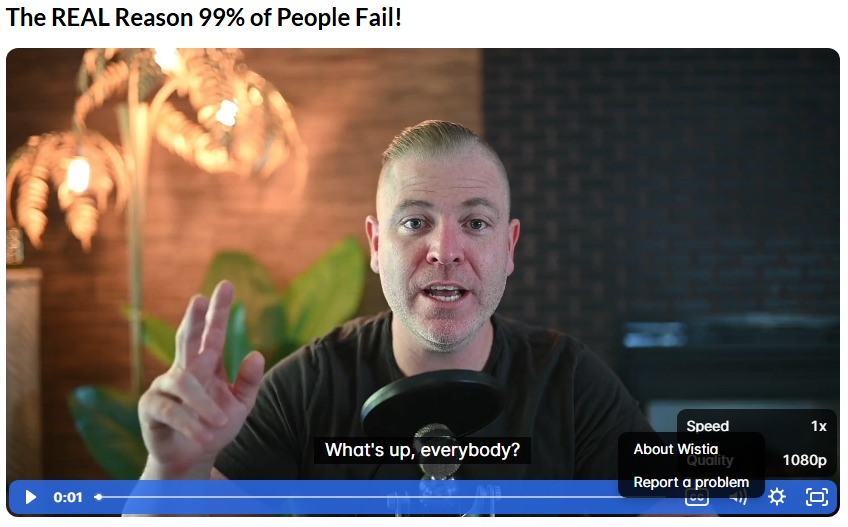
Inside WA, the co-founder Kyle is known for keeping education simple, practical, and honest. His approach cuts through the noise of “get-rich-quick” culture and focuses on building long-term online assets. One of his cornerstone lessons, “The Real Reason 99% of People Fail,” breaks down the emotional and strategic traps most beginners fall into — and how to avoid them.
Watch the video below by clicking this link: https://my.wealthyaffiliate.com/kyle/blog/the-real-reason-99-of-people-fail
Every plan, no matter how polished, still needs one thing to make it real — consistent action. You don’t have to build everything overnight. You just have to build something today that your future self can thank you for. That’s the quiet truth behind every “overnight success.”
If you’ve read this far, you’re already doing more than most people ever will. You’re studying, questioning, and preparing — and that’s what separates dreamers from builders. Your next step doesn’t need to be perfect. It just needs to exist.
Jeremy’s Words of Wisdom
I remember my first real dive into the online business world — and it didn’t start with affiliate marketing. It started with an MLM called LegalShield. I’d just lost my 9–5 job and wanted a complete career shift. I found an ad on Indeed that said “Work from home,” and something inside me said, “Why not?”
A guy named Ken called me. He became my mentor. He sent me a video about the company we’d be promoting, and I was hooked. I joined, went to the Monday meetings, followed the system — the whole thing. But eventually, I realized I wasn’t building something for *me*. I was building someone else’s dream.
That moment changed everything. I took what I learned — consistency, follow-up, duplication — and applied it to something I could own. That’s when I found Wealthy Affiliate. It clicked. This was the foundation I’d been missing. But like most people, I rushed it the first time. Four websites later, I burned out, then restarted from zero.
This “From 0 to 100K” build isn’t a comeback — it’s a rebuild. It’s proof that starting over doesn’t mean starting from scratch. It means starting again, but smarter. And that’s the whole reason this brand exists.
Wherever you are in your journey — whether you’re on step one or step one hundred — remember: you can’t fail if you don’t quit. Keep showing up. Keep learning. Keep adapting. That’s how you go from plan to proof.
From Plan to Proof: Your Turn
You’ve seen how mindset, a weekly operating system, and patient execution turn a restart into a rebuild. The difference between those who stall and those who win? One kept going.
If you’re ready to build something that lasts, join me inside Wealthy Affiliate for training, community, and 2,000 AI credits to kickstart your momentum.
Start for Free TodayHave a similar story or a question? Drop it in the comments — I read every one.
 Facebook
 X
X
 Pinterest
 LinkedIn





Leave a Reply