
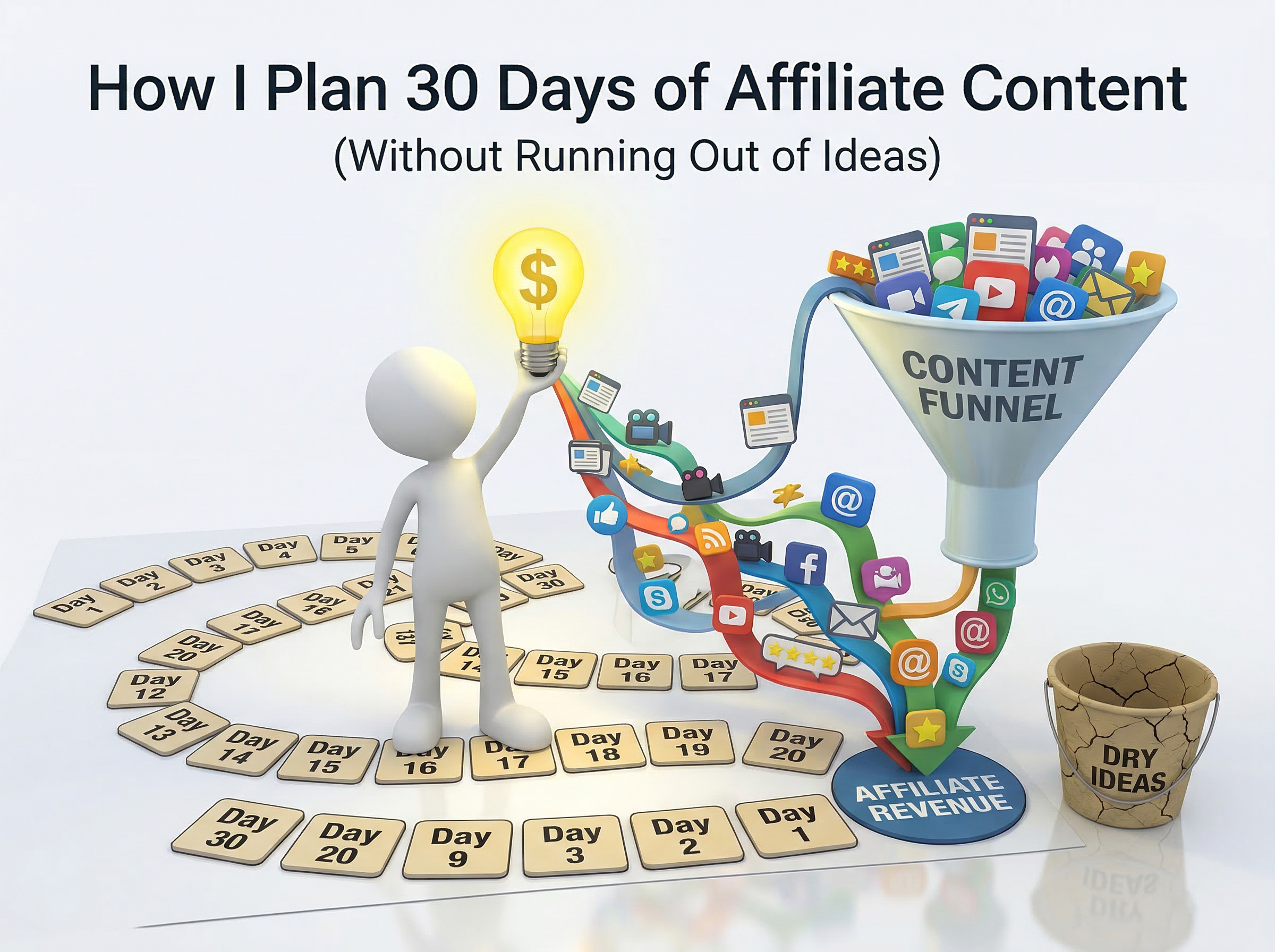
Last Updated on March 16, 2026 by Jeremy
One of the biggest struggles new affiliate marketers run into is not building a website, installing WordPress, or even learning the basics of SEO.
It is figuring out what to write next without slowly turning your site into a random pile of articles that do not help each other.
At first, the ideas usually come easy. You have a few obvious beginner topics, maybe a couple of reviews, maybe one or two “how to start” style posts. Then the wheels start wobbling. You sit down to plan your next article, open your keyword tool, stare at ten possibilities, and none of them feel like the right move.
I know that feeling because it is a very real stage in the process. It is also where a lot of affiliate websites start drifting. Not because the owner is lazy. Not because they are not trying. Mostly because they never built a content system. They built a few articles.
Once I started planning content in batches instead of one post at a time, things got much clearer. I stopped treating every article like a fresh emergency and started building them in connected groups that actually made sense.

Why Most Affiliate Websites Run Out of Content Ideas
Most beginners do not actually run out of ideas. They run out of structure.
The first few posts often feel obvious. You know you need a beginner guide. You probably want a niche article. Maybe a review or a comparison post sneaks in there too. But after that, a lot of people start fishing for isolated keywords instead of building around one central topic.
That is where the trouble starts.
Instead of building a content library, they start publishing disconnected articles. A tool review here. A broad opinion piece there. A how-to article that sort of fits, but not really. The site grows, but not in a way that builds momentum.
- They choose topics based on whatever looks decent in a keyword tool that day
- They publish content that does not connect naturally to what is already on the site
- They focus on quantity before building enough topical depth
- They try to monetize too early instead of strengthening trust first
This is exactly why learning how to create an affiliate content calendar matters so much. It gives your content a job. Every article starts helping the next one instead of fighting for relevance on its own.

What a 30-Day Content Plan for an Affiliate Website Actually Looks Like
A 30-day content plan does not mean posting every day like your laptop owes you money.
It means mapping out a month of connected article ideas ahead of time so you are building authority instead of just staying busy. The goal is not to fill a calendar for the sake of it. The goal is to create a simple roadmap that supports your niche, answers real questions, and gives your site a stronger internal structure over time.
When you do this properly, your month usually includes a healthy mix of pillar content, support articles, comparison posts, strategy pieces, and a few problem-solving topics that speak directly to the reader’s pain points.
Example 30-Day Affiliate Content Map
| Day | Article Type | Example Topic |
|---|---|---|
| 1 | Pillar Article | What Is Affiliate Marketing and How Does It Work? |
| 3 | Support Article | How to Choose a Profitable Affiliate Niche |
| 5 | Support Article | How to Start an Affiliate Website |
| 8 | Comparison | Affiliate Marketing vs Dropshipping |
| 12 | Strategy | How Affiliate Sites Actually Make Money |
| 16 | Guide | How to Build Traffic Without Ads |
| 20 | Tool Review | Keyword Research Tools for Affiliate Marketers |
| 24 | Problem-Solving | Why Most Affiliate Sites Fail in the First Year |
| 28 | Authority Article | How to Plan Content for Long-Term Affiliate Growth |
Notice what is happening here. These are not random blog posts trying to coexist under the same roof. They support one main theme. That is what helps both readers and search engines understand what your site is actually about.

How I Choose Topics for 30 Days of Affiliate Content
I do not start by chasing the biggest keyword I can find. That usually sounds smart for about five minutes, then leaves you with a messy site that has no flow. Instead, I start with one central topic and build outward from it in layers.
1. Start with one core pillar
This is the topic you want your website to become known for. In this niche, that could be affiliate marketing for beginners, content planning, traffic building, or monetization strategy.
2. Find the real questions people ask around it
Once the pillar is clear, I look for the questions a beginner would naturally ask next. That is where the strongest support articles usually come from. They are useful, specific, and easy to connect back to the main topic.
3. Turn those questions into article clusters
This is where the plan starts working harder. Instead of one topic leading nowhere, one topic now creates five or six logical follow-up articles. That is how you go from “I need another post idea” to “I have a full month mapped out.”
For example, if the pillar topic is affiliate content planning, the support questions might include:
- How do I create an affiliate content calendar?
- What should I write about on a new affiliate site?
- How many blog posts should I publish in a month?
- How do I choose topics that actually fit together?
- What content types help build trust before monetization?
Now you are not just planning content ideas for affiliate websites. You are building a cluster that can carry its own weight.
- Does this topic solve a real reader problem?
- Does it support my main niche direction?
- Can I link it naturally to existing content?
- Does it build authority instead of just filling space?
- Will this article still matter in six months?

Affiliate Website Content Planning Checklist
Before I lock in a 30-day plan, I run every topic through a simple filter. This saves a lot of wasted writing later.
If a topic looks decent in a keyword tool but does not support the site’s direction, that topic might still be valid. It just may not belong on that website.
- Does the topic support my main theme?
- Does it answer a question that a real beginner would ask?
- Does it create a natural internal linking opportunity?
- Will it help readers move one step closer to solving their problem?
- Can I write it from experience, insight, or useful research instead of fluff?
That last one matters more than people think. If the article has no real substance, readers can feel it. So can search engines eventually. Thin content still looks thin even after you polish it up and put a bow on it.
Why a Content Calendar Solves the “What Should I Write Next?” Problem
The biggest benefit of a content calendar is not just organization. It is relief.
Once the next ten articles are already mapped out, your brain stops treating every writing session like a fresh decision-making crisis. You do not need to sit there rethinking your whole strategy because Tuesday showed up again. You already know the next move.
That shift matters. It makes publishing feel lighter. It also makes consistency much easier to keep, and consistency is one of the quiet advantages that strong affiliate sites tend to have.
Readers feel the structure. Search engines pick up on the pattern. And you stop wasting time reinventing your plan every week.
Build the Foundation Before You Obsess Over Monetization
A lot of beginners want to jump straight into monetization, which is understandable. The whole point of affiliate marketing is eventually making the thing pay. But if the site is still thin, scattered, or unclear, monetization usually lands awkwardly.
The stronger play is building enough authority first. Once your site has useful, connected content and a clear sense of direction, monetization becomes much easier to introduce without it feeling forced.
That is also why the order matters. Build the content base. Build trust. Build traffic. Then let monetization sit on top of something solid instead of hoping it magically carries the whole site.
Want a Simpler Way to Build the Foundation?
If you are serious about building an affiliate website properly, content planning is one of the first systems worth tightening up. It helps you create a site that grows with purpose instead of one that just looks busy.
I built the early foundation for my own affiliate journey inside Wealthy Affiliate, and it gave me a structured place to learn, build, publish, and improve without trying to duct-tape fifteen random tools together from day one.
Start Your Free Wealthy Affiliate AccountFinal Thoughts
Running out of article ideas usually is not a creativity problem. It is a planning problem.
Once you start building content in connected groups instead of isolated posts, your site becomes easier to grow, easier to structure, and much more useful for the people landing on it. That is the part many beginners miss. Content planning is not about acting organized for the sake of it. It is about making the whole site stronger with every post you publish.
And that is when things start feeling different. You are no longer just posting articles. You are building an asset.
Frequently Asked Questions
What is a 30-day content plan for an affiliate website?
A 30-day content plan is a mapped-out month of article topics designed to support each other, strengthen topical authority, and make publishing more consistent. Instead of guessing what to write next, you work from a structured plan.
How do I create an affiliate content calendar?
Start with one main topic, break it into the questions beginners naturally ask, group those questions into useful clusters, and assign them to a realistic publishing schedule. The goal is to build connected content, not just fill dates on a calendar.
How many articles should a new affiliate site publish in a month?
That depends on your schedule and quality level, but many new affiliate websites do well with 8 to 12 strong articles per month. A smaller number of useful, connected posts will usually beat a pile of rushed filler.
Why do affiliate websites run out of content ideas?
Usually because the content was never planned in clusters. When every post is chosen in isolation, the idea well dries up faster. A proper content plan makes topic discovery easier because one article naturally leads to the next.
Affiliate Disclosure: Some links in this article may be affiliate links, which means I may earn a commission if you sign up through them at no extra cost to you. I only recommend tools and platforms that make sense within the kind of business-building approach I document here.




Leave a Reply